
Episode summary
Patrick Harker on Real-Time Payments and the Future of the Federal Reserve | Macro Musings
 Macro Musings
· · 59 min · Hosts: David Beckworth · Guests: Patrick Harker

Summary
Patrick Harker traces an unusually varied path from engineering student and football player to academic leader, White House Fellow, and Philadelphia Fed president. He says the career pivot came from mentors who pushed him toward research and leadership, and he argues that running large institutions is mostly about assembling strong teams rather than personal heroics.
A major theme is how niche institutions can survive by understanding their customers better than larger rivals. Harker uses the Bank of Bird-in-Hand, Pennsylvania, as a model community bank that adapted to Amish norms through genealogical records, mobile branches, and even a horse-and-buggy drive-through. He extends that logic to higher education, warning that demographic decline, reduced international enrollment, and college-sports spending are driving mergers and closures.
On Fed operations, Harker emphasizes that the central bank is as much a payments-and-IT organization as a monetary-policy body. He says he was not initially a fan of FedNow, preferring leapfrogging to newer payment technology, but accepted it once the system decided to build it. He also argues that real-time payments should not always be instantaneous, since small delays can reduce fraud and liquidity demand.
The episode closes on monetary policy, where Harker says the Fed should treat inflation as “job one,” be more cautious about balance-sheet interventions, and think harder about tools like capital buffers and discount-window stigma. He is also bullish on AI as a productivity tool, but says young people still need to learn to think before they lean on it.
Key takeaways
- Harker says the Bank of Bird-in-Hand shows community banks can thrive if they deeply understand a narrow customer base like the Amish.
- He argues the Fed’s payment and IT operations matter as much as headline-rate decisions, and he helped clear the way for FedNow even though he was initially skeptical.
- Harker says real-time payments should not necessarily be fully instantaneous, because a small delay can cut fraud and lower liquidity needs.
- He believes the Fed should prioritize inflation over the dual-mandate trade-off when labor-market forces are outside monetary policy’s control.
- Harker warns that higher education is facing consolidation and closures because of demographic decline and falling international enrollment.
- He says AI should augment experience and judgment, not replace the learning process for younger workers.
Notable quotes
“If it works, it's the Harker plan. If it doesn't work, it's the Remendur plan”
“if you really understand your customer, I mean, really deeply understand your customer, you can not just survive, but you can thrive”
“the Fed spends a lot of money on information technology like any large financial institution does”
“faster payments equal faster fraud”
“Inflation is job one. And if you're in spitting distance of the inflation target, then you worry about unemployment”
How the episode opens
Our guest today is Patrick Harker. Patrick is the former president of the Philadelphia Federal Reserve Bank and he joins us today to discuss his time at the Fed, the FOMC, and his amazing academic career. Pat, welcome to the program.
Thanks for having me. — This is long overdue and thank you for coming on. And we're recording here at Wharton. — Yep.
Um and you were formerly a dean here. Now you're back after the Fed. And you were also the president of the University of Delaware.
So, you've had an amazing career and incredible time also at the Fed. You were there during some important developments. And we met recently at the Atlanta Fed Financial Markets Conference.
And we had a lot of interesting conversations outside the formal presentations. And one of them we were sitting around a table and you told me this incredible story about the Amish and how a certain bank works with them. And when I heard that story, I said, "Man, I've got to get you on the podcast to tell our listeners that."
I'm glad you are. Yeah. — It is such a fascinating story and we'll get to it. Uh but before we do that, tell us more about yourself cuz again, you were not just an academic. You were a dean. You were the editor of a prominent journal. You were a college university president. Tell us about yourself.
So, I'm I'm an accidental academic, I would say. — Okay. — Uh and it really starts. This I think it's an important lesson. I also often tell young people this story. So, when I was a young student here at Penn, I was on the football team and I got hurt my junior year. And I was hanging around the department.
From the episode’s captions: roughly the first two minutes, lightly cleaned. Keep watching on YouTube →
Topics
- real-time payments
- fednow
- federal reserve policy
- crypto stablecoins
- fed balance sheet
Companies and tickers mentioned
- Federal Reserve Bank of Philadelphia
Watch the episode
Summary, takeaways and quote selection by Octagon. Quotes are short excerpts; the full conversation is in the episode.
More from Macro Musings
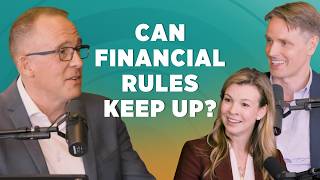
Macro Musings, this episode and its artwork belong to Mercatus Center at George Mason University. Octagon is not affiliated with the show; this page is an independent summary.
