
Episode summary
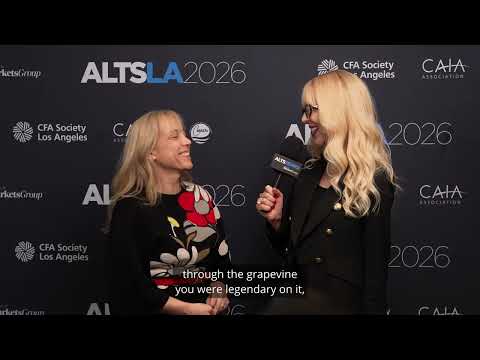
ALTSLA 2026: Andrea Auerbach of Cambridge Associates Spoke to Courtney McQuade
Summary
Andrea Auerbach argued that mega managers have earned their role in private markets by building track records over decades and then broadening access across more investor groups. Her view was not that scale is automatically good or bad, but that allocators need to know exactly what they are buying and what sits behind the platform. She said these firms can be useful in portfolios for certain types of allocators, even as they work through their own growing pains.
On private markets more broadly, Auerbach said Cambridge Associates had expected 2025 to mark a trough and had hoped 2026 would bring more distributions and transaction activity. Instead, geopolitical and market shifts have slowed the expected rebound, so she framed 2026 as a possible turnaround year rather than a sure recovery. One bright spot, in her view, is secondaries, where investors are increasingly building exposure for both return generation and portfolio shaping.
Auerbach was especially emphatic about liquidity and product structure. She said evergreen vehicles and interval funds can be misunderstood because many only promise a limited amount of liquidity, and investors may not get all the cash they want if redemption thresholds are hit. She also said the panel touched on how AI and enterprise software are affecting private markets, but that discussion was only just beginning.
Key takeaways
- Auerbach said mega managers can help broaden access to private markets, but allocators still need to do their homework on what sits behind the platform.
- She said Cambridge Associates expected private markets to trough in 2025, but 2026 may still be only the turnaround year, not a full recovery.
- Auerbach said secondaries are a bright spot and noted that secondary transaction activity is still less than 5% of overall private market transaction activity.
- She said evergreen and interval funds can disappoint on liquidity because many offer only partial cash access if redemption demand is too high.
- Auerbach said private markets are changing shape as they scale, which is altering how allocators use them in portfolios.
Notable quotes
“mega managers are mega managers for a reason, right? They've they've started a long time ago, typically in the 80s actually”
“we definitely thought private markets had trough in 2025 and coming into 2026, we were expecting to see more distributions, more market activity”
“secondary transaction activity is still less than 5% overall private market transaction activity. It's going to grow”
“as investors, you really have to understand the structure of the vehicles you're investing in”
“they are only providing a certain percentage of liquidity. And if that liquidity threshold is met, there may be you may not be able to get all of the liquidity you want”
How the episode opens
Mega managers are becoming one-stop shops. Is that good or bad for allocators? I'm here with Andrea Hourback of Cambridge Associates.
Andrea, what's your take? Yeah, mega managers are mega managers for a reason, right? They've they've started a long time ago, typically in the 80s actually.
Quite a few of them got their real start, built a strong track record in the private markets and continue to build from there. Given the industry is still only I think 40 something years old on the institutional side as these managers start to acquire other strategies and build out their platforms, they're basically being able to provide access to the private markets to different constituents, right? So they're broadening out their investor base.
Um and and as part of that, they may be going through a few of their own growing pains. Um but it's they definitely have a role in portfolios for certain types of allocators. And as always, as an investor, you have to do your homework on what exactly are you investing in and behind.
Now, Andrea, you called it. Private markets have absolutely truff. What do you think? What's your high conviction bet right now? Are they going to really grow in 2026?
Yeah, it's a wonderful question and and we definitely thought private markets had trough in 2025 and coming into 2026, we were expecting to see more distributions, more market activity. There have been a couple shifts in the in the geopolitical landscape and in the market landscape which may have put a slight pause on on transaction activity events. And so what we're thinking about in 26 is is this going to be the turnaround year for the private markets?
And in terms of a high conviction bet or where investors are putting capital, one bright spot in the investment landscape is more investors are turning to secondaries as an investment area to build out that type of exposure within their private markets portfolio.
From the episode’s captions: roughly the first two minutes, lightly cleaned. Keep watching on YouTube →
Topics
- private market secondary transactions
- private investment growth
- mega managers impact
- private markets 2026 outlook
- evergreen and interval funds
Companies and tickers mentioned
- Cambridge Associates
Watch the episode
Watch “ALTSLA 2026: Andrea Auerbach of Cambridge Associates Spoke to Courtney McQuade” on YouTube
Summary, takeaways and quote selection by Octagon. Quotes are short excerpts; the full conversation is in the episode.
More from Markets Group
-
 The €3bn German Allocator Who Said No to Alternatives
-
 RE West 2026: Valerie Red Horse Mohl of the California Endowment Spoke to Courtney McQuade
-
 RE West 2026: Steve Biggs of The Mather Group Spoke to Courtney McQuade
-
 RE West 2026: Martha Delgado of Saint Francis Foundation Spoke to Courtney McQuade
-
 Two Stints as Interim CIO: Howard Hodel on Risk, Rebalancing and Reassuring the Board
-
 Stefan Beiner on Repo, Resilience, and Why Governance Beats Prediction in Pension Investing
Markets Group, this episode and its artwork belong to their owners. Octagon is not affiliated with the show; this page is an independent summary.
