
Episode summary
Part 2: Special Session with Ash Williams: returning to Florida SBA, with questions from CIOs
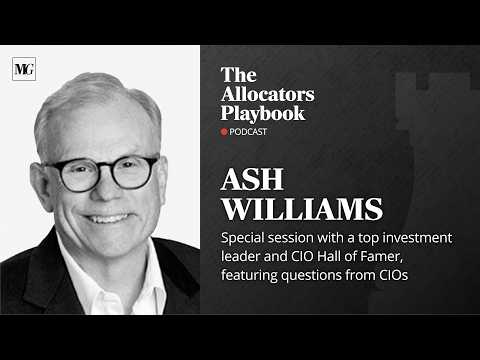
Summary
Ash Williams argued that the Florida SBA’s post-crisis success came from treating the agency like a serious asset manager rather than a cost-cutting bureaucracy. After returning in late 2008, he pushed for deeper staffing, stronger controls, more training, and enough resources to compete, saying the fund’s scale demanded investment talent, accounting, HR, compliance, and risk management depth. He said that mindset change helped the organization move from caution and underinvestment to a culture of investment merit.
He described the decisive late-2008 rebalance as the key portfolio move, explaining that when markets became extremely cheap and the economy was in distress, the fund should restore equity exposure and buy distressed private assets where it could. He also pointed to opportunistic purchases of secondaries and direct stakes in private equity-related businesses as examples of acting when others needed liquidity.
On current markets, Ash said U.S. equities look fully priced and worry is more about concentration, especially in a small group of AI-related tech names. He argued for revisiting active management, diversification, and selective use of alternatives, while warning that private markets only make sense when fees, liquidity, and manager quality justify them net of costs.
Key takeaways
- Ash Williams said Florida SBA’s edge came from spending to build a professional team and control systems, not shrinking the organization.
- He said the decisive 2008 rebalance restored full equity exposure and let the fund buy distressed private assets at attractive prices.
- Ash Williams warned that U.S. equity concentration in fewer than 10 AI-related stocks makes diversification and active management more important.
- He said private equity and continuation vehicles should be judged by manager quality and by whether they deliver real distributions, not just paper gains.
- He argued public-sector compensation can be justified when it is tied to measurable outperformance against a benchmark and strict compliance rules.
Notable quotes
“we were not under the Florida legislature. So, we were not a line item in the budget like most other executive agencies”
“the vast majority of your return will come from asset allocation. And the key to that statement being true is that when your allocation gets out of whack, you need to rebalance”
“the concentration of equity capitalization and equity earnings in the small group of tech shares that are around the subject matter of AI”
How the episode opens
Hi, I'm Christine Jordano and this is part two of a podcast with Ash Williams. In part one, we covered his life and his career up until he returned to the Florida SBA for the second time. During our final part two, we will go into how he brought that fund from 80 billion to $253 billion with all of his newly acquired skills from working for private industry.
Since he was chief investment officer of the Florida SBA, Ash has since become vice chair of JP Morgan Asset Management, but this is a special recording due to his nomination and his induction into the CIO Hall of Fame. At the end of this podcast, we will have some fun and he will answer questions from CIOS across the industry. We hope you enjoy this special session.
When you looked around at the investment office after having, you know, been gone for more than a decade, what were some of the things that you instituted almost immediately that you knew that a government investment office needed and could actually pull off with state funding? Well, the main thing was first of all, we were when you say state funding, we were not under the Florida legislature. So, we were not a line item in the budget like most other executive agencies.
We operated like an asset management firm.
We got a certain uh number of basis points on assets under management and that number was set by our trustees. So, fortunately, we did not have to deal with that problem legislative appropriations. But it is very important that a priority be placed on resources being committed to the development of a professional team and on the development of control systems both digital and human and resources being deployed and having real depth and breadth and redundancy in all the critical areas of management accum human for running a financial enterprise.
From the episode’s captions: roughly the first two minutes, lightly cleaned. Keep watching on YouTube →
Topics
- great financial crisis
- ground research in investing
- public service evolution
- compensation structures in public sector
- public fund politics
Watch the episode
Summary, takeaways and quote selection by Octagon. Quotes are short excerpts; the full conversation is in the episode.
More from Markets Group
-
 The €3bn German Allocator Who Said No to Alternatives
-
 RE West 2026: Valerie Red Horse Mohl of the California Endowment Spoke to Courtney McQuade
-
 RE West 2026: Steve Biggs of The Mather Group Spoke to Courtney McQuade
-
 RE West 2026: Martha Delgado of Saint Francis Foundation Spoke to Courtney McQuade
-
 Two Stints as Interim CIO: Howard Hodel on Risk, Rebalancing and Reassuring the Board
-
 Stefan Beiner on Repo, Resilience, and Why Governance Beats Prediction in Pension Investing
Markets Group, this episode and its artwork belong to their owners. Octagon is not affiliated with the show; this page is an independent summary.
