
Episode summary
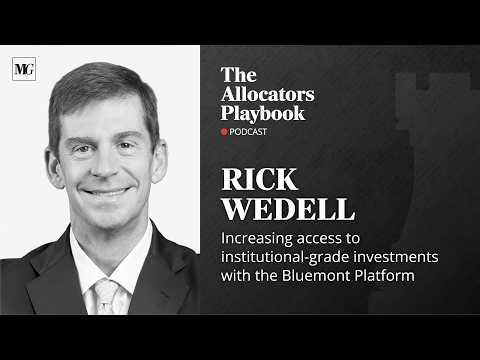
RFG Advisory CIO Rick Wedell on Increasing Access to Institutional-Grade Investments
Summary
Rick Wedell says RFG Advisory’s Bluemont platform is built to give independent advisors institutional-style tools without forcing them into a rigid house model. He says RFG now oversees about 7.5 billion to 7.7 billion in assets, manages about 3.5 billion directly, and has expanded Bluemont from traditional strategist allocations into a suite that includes its own ETFs, outside manager models, and customized SMA/UMA-style portfolios.
Wedell frames the firm’s role as collaborative: advisors can ask for specific exposures, from digital assets to faith-based portfolios, and RFG will vet providers or build the solution. He says manager selection depends on due diligence around team quality, liquidity, performance, benchmark fit, and whether products actually deliver their stated goals. He also says the platform can accommodate smaller emerging managers, though execution risk matters more when a large ticket meets a small fund.
On markets, Wedell says RFG has modestly extended fixed-income duration and sees private credit as a useful tool if investors understand liquidity, covenant risk, and leverage. He is constructive on AI as a long-term productivity force but warns that the market may be pricing in too much too fast. He argues the dollar’s reserve status remains solid, views fear around currency replacement as overblown, and says gold and bitcoin should be treated as speculative, not as substitutes for true portfolio safety.
Key takeaways
- Wedell says RFG’s Bluemont platform now spans about eight or nine ETFs and roughly $2.5 billion tied to that suite, alongside outside managers like Fidelity, First Trust, PIMCO and Bitwise.
- He says RFG’s job is to give independent advisors a “house toolkit,” not force a single house model, and to customize portfolios around each firm’s client needs.
- Wedell argues private credit can be attractive for sophisticated investors, but retail clients need liquidity, diversification and close diligence on covenants, leverage and interest collections.
- He says AI is already useful inside RFG, but while valuations are high, the right response is diversification rather than abandoning the theme.
- He says fears of dollar collapse are exaggerated because the U.S. still dominates global reserves and trade, and he treats gold and bitcoin as speculative rather than safe assets.
Notable quotes
“what we're doing with AI here at RFG is pretty revolutionary both in clientf facing uh but then also on the corporate side”
“we have about 7.5 billion a little north of that 7.7 billion in assets under adisement and we obviously advise on all of that here at RFG”
“we've kind of built like a big box of Legos, if you will”
“Private credit is is a very interesting space. It is a space that is near and dear to my heart”
“I do think that there is a lot that is being attributed to bespoke through AI that I don't necessarily know”
How the episode opens
The other big topic these days is AI.
I think AI is incredibly interesting on multiple cases. One, like I don't know, we've all at this point interacted in some small way or at some in a very large way with technology. And I will tell you that what we're doing with AI here at RFG is pretty revolutionary both in clientf facing uh but then also on the corporate side in terms of the way that in which we're provisioning services to our adviserss and then the tools that we're actually giving to our adviserss to be able to interact with their clients.
Um it's really remarkable what's happening out there and I would say that I do I do fall back on Amara's law uh which people tend to overestimate the impact of technology in the short run and underestimate its impact in the long run.
I have heard a number of people sort of pin the primacy of the dollar on the regulatory regime we have here in the US though and that is becoming significantly laxer. I don't think either the Euro zone or the United States is interesting and interested in adopting like the ruble or the Juan as you know their reserve currency. So you know worst case scenario you wind up back in the period of like the Warsaw pact where you had trading in one block that was done in rubles and trading in another block that was done in dollars.
And if you'll recall from your economic history like that actually wasn't that bad of a time for the United States. I'm Allison Hibbs with Markets Group and we are here today with Rick Widedell from RFG Advisory.
Thank you so much for having me. It's a real pleasure and uh you know I'm really looking forward to today's conversation.
From the episode’s captions: roughly the first two minutes, lightly cleaned. Keep watching on YouTube →
Topics
- ai in investing
- private credit
- currency and dollar dynamics
- gold and safe assets
- diversification and market cycles
Companies and tickers mentioned
- RFG Advisory
- Bain Capital
- BlueMont
Watch the episode
Summary, takeaways and quote selection by Octagon. Quotes are short excerpts; the full conversation is in the episode.
More from Markets Group
-
 The €3bn German Allocator Who Said No to Alternatives
-
 RE West 2026: Valerie Red Horse Mohl of the California Endowment Spoke to Courtney McQuade
-
 RE West 2026: Steve Biggs of The Mather Group Spoke to Courtney McQuade
-
 RE West 2026: Martha Delgado of Saint Francis Foundation Spoke to Courtney McQuade
-
 Two Stints as Interim CIO: Howard Hodel on Risk, Rebalancing and Reassuring the Board
-
 Stefan Beiner on Repo, Resilience, and Why Governance Beats Prediction in Pension Investing
Markets Group, this episode and its artwork belong to their owners. Octagon is not affiliated with the show; this page is an independent summary.
