
Episode summary
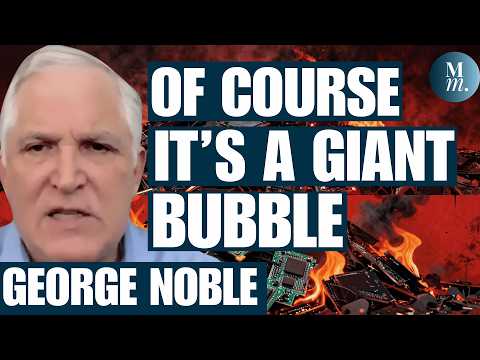
George Noble: AI Hyperscaler Earnings Go NEGATIVE by 2030
 Monetary Matters
· · Hosts: George Noble, Jack Farley
Summary
The guest argues that the AI trade is a bubble built on temporary demand, rising leverage, and accounting that front-loads optimism while pushing real costs into the future. He says the key problem is not whether AI is useful, but whether anyone can earn an adequate return on the massive capital being deployed into data centers, chips, and related infrastructure. In his view, falling pricing for compute, weaker revenue growth at AI leaders, and rising cost of capital are starting to expose the economics behind the story.
He goes further and says hyperscaler depreciation could exceed $500 billion a year by 2030, which would swamp profits and turn the sector’s earnings negative. He is especially bearish on CoreWeave and other neoclouds, which he likens to a WeWork-style leverage structure built on depreciating assets. He also says SpaceX is really a cash-flow-negative AI play with a rocket company attached, and that Tesla and SpaceX are vastly overvalued relative to their true earnings power.
Beyond AI, the guest is constructive on gold and energy because he sees a broader breakdown in fiat money, fiscal discipline, and bond-market confidence. He argues that higher real rates and term premium reflect concerns about future fiscal sustainability, not just inflation, and says that is part of the same regime shift that is undermining the most speculative assets.
Key takeaways
- The guest says AI is a bubble because demand is real but the unit economics and returns on capital do not work at current spending levels.
- He argues hyperscaler depreciation could top $500 billion annually by 2030, which would overwhelm industry profits and push earnings negative.
- He says CoreWeave is highly vulnerable because its model resembles a leveraged warehouse of depreciating GPUs and he believes the equity could be near zero in a bailout scenario.
- He calls SpaceX a cash-flow-negative AI trade with a rocket business attached, and says Tesla is far above any reasonable sum-of-the-parts value.
- He favors gold and energy because he thinks rising real rates, fiscal strain, and monetary debasement are eroding fiat money and supporting tangible assets.
Notable quotes
“Now the rubber is hitting the road. Cost of capital is going up, and that's a problem”
“I think we're in a situation where, you know, before it was, you know, pigs fly, cost of money's free. Now it's kind of like the tide's going out”
“if you actually do the numbers, do you realize hyperscaler earnings will turn negative in 2030”
“The demand is temporary, but the debt and the depreciation is permanent”
“SpaceX is not a rocket company. SpaceX is a hugely cash flow negative AI play with a rocket company attached to it”
How the episode opens
Hi, Mr. Kramer. This is Jack from New York.
I own Nebus, Iron, Oracle, and Nvidia. Am I diversified? Yeah, you're diversified in one flaming pile of Long and short of it is all right.
It's been a bubble. It's been great. Now the rubber is hitting the road.
Cost of capital is going up, and that's a problem. SpaceX is not a rocket company. SpaceX is a hugely cash flow negative AI play with a rocket company attached to it.
And Starlike, I'm highly confident that Cororeweave short of a bailout is a zero as our main neoclouds. And I put my money where my mouth is. The demand is temporary, but the debt and the depreciation is permanent.
So, compound it, bro. Momentum, bro. Meme, bro.
I'm coming for you.
This episode is brought to you by Seraya Partners, who manages the return to tangibles ETF, Lens, ticker Lens, the Seraya Thematics ETF, built for a return to tangibles. Learn more at surmiaf.com and see the show notes for disclosures. Let's get into it. I am joined today by George Noble, investor and author of the Noble Update on Substack. George, great to see you. Hey Jack, long time. Great to see you. Always good to be with you.
It has been too long, George. I'm really excited for this. How are you thinking about AI and the capital expenditure, the vast sums that are being spent on AI in data centers and chips? — Thought you'd never ask, Jack. If we're not talking about the straits of Hormuz, we got to be talking about AI. What else is there? Every day it's another adventure. I'm sure you're the same way. I wake up. I don't know what Mr. Market is going to be thinking. Look, I have strong opinions.
From the episode’s captions: roughly the first two minutes, lightly cleaned. Keep watching on YouTube →
Topics
- ai bubble
- hyperscaler capex
- coreweave short thesis
- tesla and spacex cash flow risk
- cost of capital gold and energy
Companies and tickers mentioned
- TSLA
- MU
- NVDA
- CoreWeave
- Tesla
- SpaceX
- Micron
- Nvidia
- OpenAI
- Anthropic
- Fidelity
Watch the episode
Watch “George Noble: AI Hyperscaler Earnings Go NEGATIVE by 2030” on YouTube
Summary, takeaways and quote selection by Octagon. Quotes are short excerpts; the full conversation is in the episode.
More from Monetary Matters
-
 AI is Heading for a Massive Oversupply: Top Hedge Fund Manager’s Prediction | David Orr
-
 Why Market Fragility is Building into a Crisis in 2027 | Cem Karsan & Noel Smith
-
 Inside a Short Seller’s Private Credit Investigation | Laks Ganipathi
-
 The End of Cheap Capital & What it Means for Markets | Russell Clark
-
 Breaking Down the Markets Massive Post-Midterm Moves with Andy Constan
-
 Michael Howell: Pain Now, Money Printing Later
Monetary Matters, this episode and its artwork belong to Jack Farley. Octagon is not affiliated with the show; this page is an independent summary.
