
Episode summary
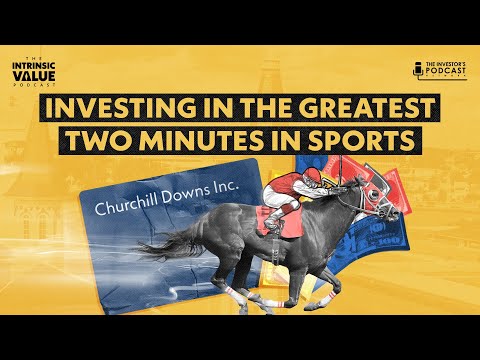
Churchill Downs Stock: Betting on the Kentucky Derby
 The Intrinsic Value Podcast
· · 1 hr 12 min · Hosts: Shawn O'Malley, Daniel Mahncke
Summary
Churchill Downs is presented as much more than a gambling company: the host and a guest argue that CHDN is a hybrid of horse racing, luxury hospitality, media, and regulated gaming. The Kentucky Derby is the brand anchor, but the investment case depends on the year-round cash flow from historical racing machines (HRM), which look like slot machines while operating under horse-racing rules in states like Kentucky and Virginia. The host says this structure has helped ChurchiII Downs compound shares and generate high-margin revenue while protecting local market positions.
A major part of the discussion is how the company uses regulation to its advantage. The guest highlights the Louisville racetrack lease that saves property taxes, lobbying power around HRM, and the de facto local monopolies created by state rules. The company also shifted away from competing head-on in mobile sports betting and toward a B2B model, supplying racing content and technology to sportsbooks like FanDuel. That move is framed as pragmatic because it avoids huge marketing costs and preserves high margins.
The episode also emphasizes risk: horse racing volume is declining, animal welfare controversies can hurt the sport, and Churchill Downs carries meaningful leverage. The host says the business still looks attractive at about 21 times earnings, but the discussion ends with the idea that CHDN’s value rests on a concentrated set of assets, rules, and markets that may be durable but are far from risk-free.
Key takeaways
- The host argues that CHDN’s real engine is HRM gaming, not the Kentucky Derby alone, because the machines provide steady high-margin cash flow.
- The guest says the Louisville racetrack structure effectively saves millions in property taxes while preserving Churchill Downs’ control of the crown jewel.
- The host says the company’s 2022 shift toward B2B horse-race wagering let it avoid the cost of competing in sportsbook marketing wars.
- The guest notes that the company’s regulatory moat is real but narrow, with HRM largely concentrated in Kentucky, Virginia, and New Hampshire.
- The host says horse racing is in modest decline, with 31,000 thoroughbred races run in the US in 2024, down 3% from 2023.
- The guest says Churchill Downs’ leverage is elevated, with S&P cutting the credit rating to double B minus in October 2025.
Notable quotes
“Behind the famous Kentucky Derby race in all its pageantry, which attracts something five times the number of attendees as a Super Bowl over the course of a week, is a gambling empire owned by Churchill Downs Incorporated”
“the company is well a trophy asset holder and profitable compounder. Today we are off to the races”
“they gave up on being a diversified sports book, you might say, to remain focused on their their horse racing niche”
“We will get a piece, a marginal piece of every single track that goes through the platform, regardless of whether we own that track or not”
“the coalition of tracks and breeders and the broader horse industry has just been extremely effective in framing historical horse racing as actually being part of agricultural and rural economic development”
How the episode opens
(00:00) We've come across a handful of really cool trophy assets on the show, but most of the time the Associated Business is barely even profitable. We saw that with Manchester United and Medicine Square Garden Sports. And yet, you're telling me that there is an event that occurs once a year that is an exception to this rule.
(00:19) That's exactly what I'm saying. Behind the famous Kentucky Derby race in all its pageantry, which attracts something five times the number of attendees as a Super Bowl over the course of a week, is a gambling empire owned by Churchill Downs Incorporated. (00:37) And the company is well a trophy asset holder and profitable compounder.
Today we are off to the races. And no, it's not because we're covering Ferrari once again. It's because Sean is pitching Church Downs, ticker CHDN.
And this is at its core a gambling company, you might say, which may immediately rupt some listeners the wrong way. (01:03) But at the same time, you could argue it is equally as much hospitality and even an events business. The company's crown jewel is the beloved Kentucky Derby horse race bonanza that as a German, I had somehow never heard of before until Shawn made me aware of just how wildly popular the two-minute race and associated festivities are in the US.
(01:27) And as far as I understand it, not unlike Formula 1 races or the Super Bowl, the Kentucky Derby is more of a cultural event and a party for the wealthy than it is simply a sporting event. But before I let you take it from me, Jean, I should mention that nothing on this show, as always, is meant to be taken as financial advice and it's only meant for educational and entertainment purposes.
From the episode’s captions: roughly the first two minutes, lightly cleaned. Keep watching on YouTube →
Topics
- kentucky derby luxury hospitality
- historical racing machines
- mobile app casino gaming
- lobbying and taxes
- intrinsic value modeling
Companies and tickers mentioned
- CHDN
- Churchill Downs, Inc.
Watch the episode
Watch “Churchill Downs Stock: Betting on the Kentucky Derby” on YouTube
Summary, takeaways and quote selection by Octagon. Quotes are short excerpts; the full conversation is in the episode.
More from The Intrinsic Value Podcast
-
 Canadian Pacific Kansas City Limited (CP.TO): Irreplaceable Moat, Unproven Compounding
-
 Reddit (RDDT): Record Cash Flow, Collapsing Share Price
-
 McDonald's ($MCD): Generational Compounder in Historical Drawdown
-
 Mercado Libre ($MELI): We Doubled Down on Meli!
-
 Airbnb (ABNB) The Business Outgrew Its Peak, the Stock Hasn't
-
 GE Aerospace: The Ultimate Compounder?
The Intrinsic Value Podcast, this episode and its artwork belong to The Investor's Podcast Network. Octagon is not affiliated with the show; this page is an independent summary.
