
Episode summary
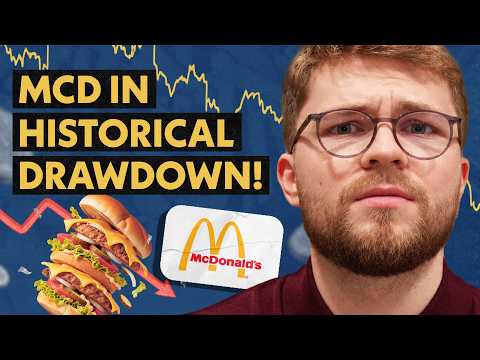
McDonald's ($MCD): Generational Compounder in Historical Drawdown
 The Intrinsic Value Podcast
· · Hosts: Daniel Mahncke, Shawn O'Malley
Summary
McDonald's is framed less as a restaurant operator than as a franchised real estate platform: it runs only about 5% of its restaurants itself, owns the land under roughly 60% of them, and earns most of its profits from rent and royalties rather than burger sales. The hosts trace that model back to Ray Kroc and Harry Sonneborn, who turned McDonald's into a landlord with long-term leases, minimum rent, and sales-based upside. They argue that this structure is why margins are far superior to conventional restaurant operators and why the company’s operating margin could move toward the low to mid-50s by 2030 if it keeps refranchising stores.
Key takeaways
- The hosts argue McDonald's gets more than 90% of profits from franchising, with rent and royalties carrying about 84% margins versus roughly 15% on company-operated stores.
- They say the real estate portfolio may be worth about $120 billion, far above the $28 billion carrying value on the balance sheet, which is central to the bull case.
- The hosts think GLP-1 drugs are a real long-term risk, but they estimate the current hit to McDonald's sales is only around 1% and not yet the main driver of weakness.
- They note McDonald's stock has fallen roughly 32% while the 10-year Treasury yield has risen 32%, suggesting the drawdown has been driven more by rates and real-estate sensitivity than by GLP-1 fears.
- Management’s plan to keep selling restaurants and franchising them out is presented as the main path to higher margins, even if reported revenue declines.
Notable quotes
“McDonald's operates only about 5% of all its restaurants itself and the other 95% are run by franchises”
“more than 90% of profits come from franchising”
“the real estate alone could be worth about $120 billion today”
“management is expecting that that trend will continue for the rest of the year”
“the stock going down must be due to GLP once and even then I was surprised by how severe or basically not severe the draw down has been”
How the episode opens
McDonald's might be the best known brand in the world and it's the world's largest fast food franchise and trading at multi-year lows. — Almost never get the opportunity to buy McDonald's shares at a discount and and Buffett once owned 4% of McDonald's and and called selling it one of his biggest mistakes.
Well, today we will find out whether the market is finally giving us a chance to make up for that mistake and make it part of our portfolio. I looked back at all the episodes we did covering stocks and I did notice that we've never covered a restaurant before. We we've done airlines, e-commerce, banks, luxury software, data centers, apps, and a whole bunch of other types of businesses, but not a single restaurant.
Well, to be fair, most of them are not great businesses. Although you can probably say the same for I don't know airlines or car manufacturers and we still looked at them. Actually I remember how we debated the tipping culture when I was in the US and we kept being shocked by the idea of you know paying your employees $1.
50 per hour and then charging 20% service fees plus an additional tip for the waiters or at least I should say I was shocked. I'm not used to that here in Germany. I kind of asked myself if that's how it works, shouldn't US restaurants be vastly more profitable than restaurants everywhere else in the world where they actually have to pay the stuff that is working for them?
But of course, that's not really true. For one, you have the back of house stuff like, you know, cooks or dishwashers and so forth and they are still paid full wages. And then secondly, in many states, you also receive a full minimum wage before tips.
From the episode’s captions: roughly the first two minutes, lightly cleaned. Keep watching on YouTube →
Topics
- restaurant franchise model
- valuation model
- real estate landlord business
- franchising economics
- glp-1 drugs impact
Companies and tickers mentioned
- MCD
- McDonald's
Watch the episode
Watch “McDonald's ($MCD): Generational Compounder in Historical Drawdown” on YouTube
Summary, takeaways and quote selection by Octagon. Quotes are short excerpts; the full conversation is in the episode.
More from The Intrinsic Value Podcast
-
 Canadian Pacific Kansas City Limited (CP.TO): Irreplaceable Moat, Unproven Compounding
-
 Airbnb (ABNB) The Business Outgrew Its Peak, the Stock Hasn't
-
 GE Aerospace: The Ultimate Compounder?
-
 Shopify: The Big Winner of Agentic Commerce?
-
 Aritzia (ATZ.TO): The Women's Apparel Brand Conquering the US, plus Nike, Lulu, and More
-
 Hermès and LVMH Stock: Time to Buy Luxury?
The Intrinsic Value Podcast, this episode and its artwork belong to The Investor's Podcast Network. Octagon is not affiliated with the show; this page is an independent summary.
