
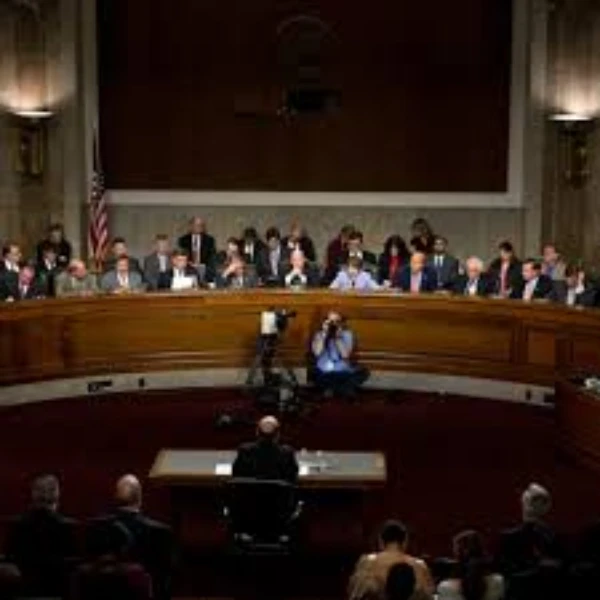
Who will testify in front of Congress in 2026?
Short Answer
1. Market Behavior & Drivers
- James Comer is likely House Oversight Committee Chair, influencing future hearings.
- Representatives Lieu and Obernolte introduced consolidated AI safety legislation in 2026.
- Meta Platforms faces an active FTC monopolization case and appeal in 2026.
- Jon Stewart's advocacy secured a formal Senate hearing for veterans' health.
- House Foreign Affairs Democrats formally requested Marco Rubio's testimony on Iran.
Who Wins and Why
| Outcome | Market | Model | Why |
|---|---|---|---|
| Ghislaine Maxwell | 19.0% | 6.5% | James Comer's stated priorities for the House Oversight Committee in the 119th Congress do not encompass issues relevant to Ghislaine Maxwell's past, strongly suggesting she is unlikely to be called, despite the market expecting testimony from other high-profile individuals. |
| Mark Zuckerberg | 40.0% | 27.0% | The provided background research offers no specific information or citations about Mark Zuckerberg testifying in 2026, yet his history of testifying on ongoing tech-related issues provides a general rationale for the market's existing expectation that he could be called again. |
| Jerome Powell | 56.0% | 46.1% | James Comer, as incoming chair of the House Oversight Committee, prioritizes "finance-related concerns" and "accountability," which provides a plausible reason for Federal Reserve Chair Jerome Powell to testify, supporting the market's position. |
| Shou Zi Chew | 53.0% | 40.7% | The provided background research details James Comer's priorities for the House Oversight Committee but offers no specific information or citations regarding Shou Zi Chew, making the evidence neutral despite the market's current assessment. |
| Sam Altman | 62.0% | 57.1% | The House Oversight Committee, likely chaired by James Comer for the 119th Congress, has a stated priority to "modernize government operations" and address "technology," making it highly probable for a prominent technology leader like Sam Altman to be called to testify, which aligns with the market's current slight lean towards him testifying. |
2. Price Chart
Historical Price (Probability)
3. Significant Price Movements
Notable price changes detected in the chart, along with research into what caused each movement.
📉 April 15, 2026: 19.0pp drop
Price decreased from 75.0% to 56.0%
Outcome: Jerome Powell
4. Market Data
Contract Snapshot
This market resolves to "Yes" if Shou Zi Chew provides live testimony in an official U.S. House or Senate committee proceeding, including depositions, either in-person or remotely, under committee authority, between the market's issuance and January 1, 2027. Invoking the Fifth Amendment, submitting written testimony without a live appearance, or making statements outside of official committee hearings do not qualify as testifying. The market closes early if the event occurs, otherwise by January 1, 2027, with resolution based on sources like C-SPAN, the New York Times, and the Associated Press.
Available Contracts
Market options and current pricing
| Outcome bucket | Yes (price) | No (price) | Last trade probability |
|---|---|---|---|
| Pete Hegseth | $0.95 | $0.08 | 95% |
| Sam Altman | $0.62 | $0.43 | 62% |
| Jerome Powell | $0.58 | $0.43 | 56% |
| Shou Zi Chew | $0.53 | $0.52 | 53% |
| Mark Zuckerberg | $0.46 | $0.60 | 40% |
| Anthony Fauci | $0.28 | $0.77 | 22% |
| Ghislaine Maxwell | $0.20 | $0.83 | 19% |
| James Donaldson | $0.21 | $0.83 | 17% |
| Jon Stewart | $0.17 | $0.87 | 16% |
| Joe Biden | $0.13 | $0.94 | 14% |
| Kamala Harris | $0.13 | $0.94 | 13% |
| Barack Obama | $0.08 | $0.98 | 9% |
| Jelly Roll | $0.14 | $0.92 | 6% |
| Taylor Swift | $0.14 | $0.94 | 6% |
Market Discussion
Traders in this market are actively discussing various individuals potentially testifying before Congress, including Bill Clinton, Hillary Clinton, and Ghislaine Maxwell, even though Jerome Powell, Shou Zi Chew, and Mark Zuckerberg show the highest current probabilities. A key point of discussion centers on the market rule that invoking the Fifth Amendment does not count as testimony, with one trader adjusting their bet on Ghislaine Maxwell after realizing this rule's implication. Beyond this, individual predictions are made without explicit arguments for or against testimony.
5. Trust Index
Order book is critically thin.
Primary risk· Trade quality
Market integrity is low (62), but Integrity averages all three scores, so the other two pull it up. Only a critically low score would cap the total.
Includes the cost to trade: a $10,000 order can't be filled here because the order book is too thin.
Weighted blend with hard caps — a critically weak safety pillar, or a severe trading anomaly, caps the total regardless of the rest. Full methodology · About the Trust Index
6. What Are James Comer's Priorities for House Oversight Committee?
| House Oversight Committee Chair | James Comer (119th Congress) [1] |
|---|---|
| Top Priority 1 | Biden Administration accountability [2] |
| Top Priority 2 | Combating waste, fraud, and abuse [2] |
Sources (4)
- 1Comer to Return as Chairman of Oversight Committee in the 119th Congress - United States House Committee on Oversight and Government Reformoversight.house.gov
- 2Chairman Comer Releases Oversight Committee’s Accomplishments for the 118th Congress - United States House Committee on Oversight and Government Reformoversight.house.gov
- 3Chairman Comer Announces Full Committee Markup of Legislation to Improve and Modernize Government Operations - United States House Committee on Oversight and Government Reformoversight.house.gov
- 4United States House Committee on the Judiciary - Wikipediaen.wikipedia.org
7. What Federal Legislation Targeted AI Safety and TikTok in 2026?
| Consolidated AI Bill | Introduced by Reps. Lieu and Obernolte in April 2026 [1] |
|---|---|
| Federal AI Standards | Bipartisan Senate bill revived in 2026 [2] |
| TikTok Joint Venture | Congressional scrutiny called for in January 2026 [3] |
Sources (8)
- 1Lieu and Obernolte introduce consolidated AI bill package - Nextgov/FCWnextgov.com
- 2Bipartisan Senators Revive Bill to Codify Federal AI Standards Center – MeriTalkmeritalk.com
- 3US lawmakers say TikTok joint venture deal needs scrutiny from Congress | Reutersuk.mobile.reuters.com
- 4H.R. 8065, the Restoring Executive Branch Authorities to Oversee Offices of the United States Attorneys Act of 2026; H.R. 8037, the Protect American AI Act of 2026; H.R. 1468, the Protect America’s Innovation and Economic Security from CCP Act of 2025; H.R. 7730, the Bankruptcy Threshold Adjustment Act of 2026; H.R. 6194, the Protecting Americans from Russian Litigation Act of 2025; H.R. 3420, the Words Matter Act of 2025; and H.R. 6453, the ADA 30 Days to Comply Act | Committee Repository | U.S. House of Representativesdocs.house.gov
- 5Kiggans Leads Bill to Strengthen U.S. Leadership in AI - Jen Kigganskiggans.house.gov
- 6Assessing America's AI Action Plan | Committee Repository | U.S. House of Representativesdocs.house.gov
- 7Less Hype, More Help: AI That Improves Safety, Productivity, and Care - U.S. Senate Committee on Commerce, Science, & Transportationcommerce.senate.gov
- 8Senator asks White House if TikTok investors will pay $10 billion to US Treasury | Reutersreuters.com
8. Are Meta, OpenAI, and Clinton Foundation Facing Resolution in 2026?
| Meta Investigation Status | Active FTC monopolization case, appeal ruling projected January 2026 [1] |
|---|---|
| OpenAI Investigation Status | Active FTC investigation regarding ChatGPT, no public resolution timeline indicated for 2025/2026 [2] |
| Clinton Foundation Investigation | Not under active investigation by specified agencies with projected resolution in late 2025/first half 2026 [3] |
Sources (6)
- 1FTC Appeals Ruling in Meta Monopolization Case | Federal Trade Commissionftc.gov
- 2FTC Investigates OpenAI ChatGPT Productnatlawreview.com
- 3New Records Reveal DOJ’s Yearslong Efforts to Shut Down Investigation into Clinton Foundationgrassley.senate.gov
- 4FTC v. Metaen.wikipedia.org
- 5New memos show IRS opened criminal probe into Clinton Foundation in 2019, abruptly stoppedwgxa.tv
- 6New FBI Clinton Doc Reinforces Deep State’s Asymetric Justicethefederalist.com
9. Which Celebrity Advocacy Campaigns Have 2026 Congressional Hearings?
| Jon Stewart Advocacy Hearing | January 2026, Senate Veterans' Affairs Committee [1] |
|---|---|
| Taylor Swift Ticketing Reform Hearing | No formal commitments identified [2] |
| Jelly Roll Fentanyl Campaign Hearing | No formal commitments identified [3] |
Sources (3)
- 1Building a 21st Century VA Health Care System: Assessing Efforts to Restructure...veterans.senate.gov
- 2'Taylor Swift Act' and other efforts target sky-high concert ticket pricesreuters.com
- 3Jelly Roll delivers impassioned testimony before Congress as lawmakers push for new anti-fentanyl legislationabcnews.go.com
10. Who Did House Foreign Affairs Democrats Request For Iran War Testimony?
| Requested Witnesses | Marco Rubio, Pete Hegseth, Steven Witkoff, Jared Kushner [1] |
|---|---|
| Request Date and Topic | March 2026, concerning the Iran War [1] |
| Historical Follow-Through Rate (Chairmanship) | Not available from provided sources [2] |
Sources (4)
- 1House Committee on Foreign Affairs Democrats Demand Testimony from Rubio, Hegseth, Witkoff and Kushner on Iran War - Press Releases - House Foreign Affairs Committeedemocrats-foreignaffairs.house.gov
- 2House Committee Hearings: The “Minority Witness Rule” - EveryCRSReport.comeverycrsreport.com
- 3Watson Coleman Leads Letter to January 6th Select Committee Urging Them to Move Swiftly Despite Resistance from Witnesseswatsoncoleman.house.gov
- 4Fed Nominee Warsh Testifies in Senate Banking Committee Hearing | MFDFmfdf.org
12. Historical Resolutions
Historical Resolutions: 2 markets in this series
Outcomes: 2 resolved YES, 0 resolved NO
Recent resolutions:
- KXCONGRESSTESTIFY-27JAN-HCLI: YES (Feb 26, 2026)
- KXCONGRESSTESTIFY-27JAN-BCLI: YES (Feb 27, 2026)
