
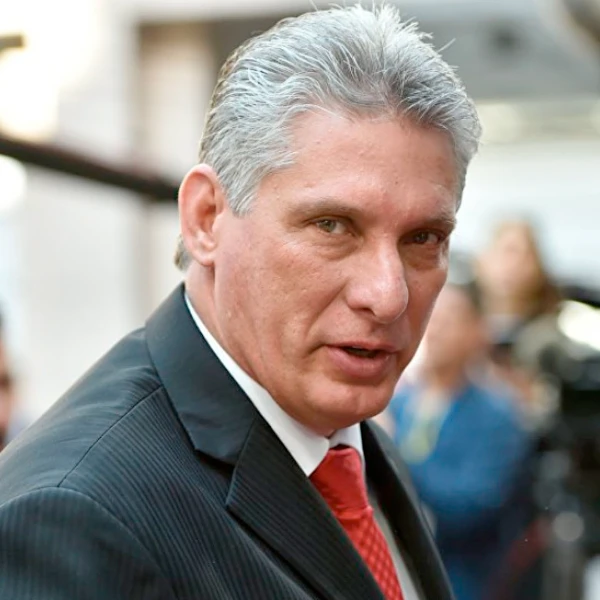
Miguel Díaz-Canel departure announced?
Short Answer
1. Market Behavior & Drivers
- Since last update (~90d): The "Before June 1, 2026" outcome resolved "no", with market probability falling 12.0pp.
- The "Before September 1, 2026" outcome experienced market-led edge compression, as the market fell 45.2pp.
- Headline model probability decreased by 5.4pp, market by 9.2pp, compressing the edge by 3.8pp.
- Two new outcomes were added, while two older outcomes were removed since the last report.
- No departure announced before September 1, 2026; Díaz-Canel publicly rejected stepping down.
- Díaz-Canel's position appears secure, supported by constitutional and party structures.
- Severe economic crisis and U.S. pressure may compel a leadership change before 2027.
Current Context
Sources (14)
- 1Cuba's president tells NBC News that he will not step down | AP Newsapnews.com
- 2Miguel Díaz-Canel: ‘Stepping down is not part of our vocabulary’ | International | EL PAÍS Englishenglish.elpais.com
- 3Latin America and the Caribbean: Fact Sheet on Leaders...congress.gov
- 4Latin America and the Caribbean:congress.gov
- 5Trump Administration Said to Tell Cuba That Its President...nytimes.com
- 6Trump is pushing for leadership change in Cuba and the next president could be a Castro | AP Newsapnews.com
- 7Are Cuba’s Díaz-Canel’s days in power numbered? | Miami Heraldmiamiherald.com
- 8Cuba crisis explained: Who holds power, and could Diaz-...aljazeera.com
- 9C.I.A. Sets Up Secret Cuba Task Force as Trump Pressures...nytimes.com
- 10Cubans face sixth blackout as energy grid collapses under US pressure | AP Newsapnews.com
- 11Trump has increased the number of spies in Cuba as US mulls a military invasion: report | The Independentindependent.co.uk
- 12Grid failure plunges Cuba into nationwide blackout | News | Al Jazeeraaljazeera.com
- 13Will Miguel Díaz-Canel cease to hold... - RAND Forecasting Initiativerandforecastinginitiative.org
- 14articles/cuba-regime-2026-post-castro-era-prediction-markets-and-the-risk-of-sudden-chang.md at main · spfunctions/prediction-markets-readinggithub.com
2. Price Chart
Historical Price (Probability)
3. Market Data
Contract Snapshot
This market resolves YES if Miguel Díaz-Canel's departure is announced before September 1, 2026; otherwise, it resolves NO. In the event of his death, the market will typically resolve to the last traded price prior to death, unless the Exchange determines a different fair settlement value at its sole discretion.
Market Discussion
As of August 6, 2026, there has been no announcement of Miguel Díaz-Canel's departure; he remains active as President of Cuba, with his term expected to last until 2028 [1]. Díaz-Canel explicitly rejected calls for his resignation in April 2026, stating that stepping down is not part of the Cuban government's vocabulary [2], following Cuba's "categorically" rejecting prospects of his removal in March 2026 [3]. While prediction markets and social media have engaged in speculative discussion regarding his potential departure throughout 2026, no confirmed event has materialized [4].
Sources (4)
- 1The PCC takes Díaz-Canel for a stroll around Havana during the worst vacation period in recent yearsen.cibercuba.com
- 2Cuba's president tells NBC News that he will not step down | AP Newsapnews.com
- 3Cuba 'categorically' rejects prospect of removing Diaz...aljazeera.com
- 4Miguel Díaz-Canel out as President of Cuba by...?polymarket.com
4. Trader Dashboard
5. What specific policy actions or diplomatic pressures from the U.S. government could realistically compel the Cuban government to announce Díaz-Canel's departure before 2027?
| US diplomatic pressure | Explicit calls for President Miguel Díaz-Canel’s resignation [1][2][3] |
|---|---|
| US economic action | De facto energy blockade on Cuba [4] |
| Cuban government stance | Rejection of negotiating political system or president's position [1][2][5] |
Sources (6)
- 1Trump is pushing for leadership change in Cuba and the next president could be a Castro | AP Newsapnews.com
- 2Cuba crisis explained: Who holds power, and could Diaz-...aljazeera.com
- 3Hialeah to lead ‘Free Cuba Rally’ in support of Trump's demand for regime change in Cuba | WLRNwlrn.org
- 4Bloomberg Businessweek Weekend: July 31st 2026 | Bloomberg Businessweekyoutube.com
- 5As U.S. pressure on Cuba grows, a Castro could be the next president | The Seattle Timesseattletimes.com
- 6How Geopolitical Risk Is Reshaping Markets & Private Investing | EP 40youtube.com
6. What evidence supports the assessment that Miguel Díaz-Canel's position is secure until his term ends in 2028, despite internal and external pressures?
| Presidential term ends | 2028 [1] |
|---|---|
| Formal power retained until | April 2031 [1] |
| Regime's priority | Elite cohesion over economic growth [2][3] |
Sources (7)
- 1Cuban President Miguel Díaz-Canel Will Retain His Formal...translatingcuba.com
- 2BTI 2026 Country Report - Cubabti-project.org
- 3BTI 2026 Cuba Country Reportbti-project.org
- 4Cuba crisis explained: Who holds power, and could Diaz-Canel be replaced? | Al Jazeera Mirroraljazeeranews-3fuh52rgrl.edgeone.app
- 5Trump is pushing for leadership change in Cuba and the next president could be a Castro | AP Newsapnews.com
- 6Will there be regime change in Cuba in 2026?boz.substack.com
- 7Cuba crisis explained: Who holds power, and could Diaz-...aljazeera.com
7. How does Miguel Díaz-Canel's base of power within the Communist Party and military compare to that held by Fidel and Raúl Castro?
| Díaz-Canel's personal power | Limited compared to Fidel and Raúl Castro [1] |
|---|---|
| Díaz-Canel's power base | Lacks a strong independent power base [1][2][3][4] |
| Real authority in Cuba | Attributed to the military (GAESA) and Raúl Castro [1][2][4][5] |
Sources (5)
- 1Cuba Without the Castrosdissentmagazine.org
- 2Trump is pushing for leadership change in Cuba and the next president could be a Castro | AP Newsapnews.com
- 3Miguel Díaz-Canel to replace Raul Castro as party chief | Miami Heraldmiamiherald.com
- 4Who is actually in charge of Cuba?monocle.com
- 5Castro family is still central to Cuba's leadership. Here are...cbsnews.com
8. What sources provide the most reliable data on public sentiment or elite approval for Miguel Díaz-Canel's leadership within Cuba?
| Data availability on sentiment | Severely limited [1][2] |
|---|---|
| Probability of departure before 2027 | Up to 67% in 2026 (prediction markets) [3][4] |
| Primary method for gauging sentiment | Qualitative analysis from expert observers, journalists, social media [5][6][7][8] |
Sources (8)
- 1MEASURING CUBAN PUBLIC OPINION: METHODOLOGYascecubadatabase.org
- 22016 Cuban Public Opinionnorc.org
- 3Market platform bets on Díaz-Canel's exit: Expectations for...en.cibercuba.com
- 4Díaz-Canel among the leaders most likely to leave power...en.cibercuba.com
- 5Trump is pushing for leadership change in Cuba and the next president could be a Castro | AP Newsapnews.com
- 6Which Way for Cuba? - Dissent Magazinedissentmagazine.org
- 7Cuba nominates Castro replacement Miguel Díaz-Canel - BBC Newsbbc.co.uk
- 8Miguel Díaz-Canel to replace Raul Castro as party chief | Miami Heraldmiamiherald.com
9. What internal economic or political crises could force the Cuban Communist Party to replace Díaz-Canel before his term officially ends?
| Economic Reform Measures Approved | 176 (approved in June 2026) [1][2][3] |
|---|---|
| Leader's Popularity Status | Unpopular figure [4][5] |
| Official Acknowledgment | Internal bureaucratic errors contributing to failures [4][1][3] |
Sources (6)
- 1Under Pressure from Trump, Cuban Leader Calls for '...nytimes.com
- 2Díaz-Canel Voices Concerns Over Private Capital Expansion in Cubacubaheadlines.com
- 3Marrero Acknowledges Mistakes but Blames U.S. Sanctions for Crisiscubaheadlines.com
- 4Cuba crisis explained: Who holds power, and could Diaz-...aljazeera.com
- 5Trump is pushing for leadership change in Cuba and the next president could be a Castro | AP Newsapnews.com
- 6Market platform bets on Díaz-Canel's exit: Expectations for...en.cibercuba.com
10. What Could Change the Odds
Key Catalysts
Key Dates & Catalysts
- Expiration: June 01, 2026
- Closes: September 01, 2026
Sources (10)
- 1Trump Administration Said to Tell Cuba That Its President...nytimes.com
- 2Trump is pushing for leadership change in Cuba and the next president could be a Castro | AP Newsapnews.com
- 3Are Cuba’s Díaz-Canel’s days in power numbered? | Miami Heraldmiamiherald.com
- 4Who are the players deciding Cuba's future amid talks with US? | Reutersreuters.com
- 5Cuba's president tells NBC News that he will not step down | AP Newsapnews.com
- 6Miguel Díaz-Canel: ‘Stepping down is not part of our vocabulary’ | International | EL PAÍS Englishenglish.elpais.com
- 7Latin America and the Caribbean: Fact Sheet on Leaders and Electionscongress.gov
- 8RAND Forecasting Initiative | Will Miguel Díaz-Canel cease to hold the position of First Secretary of the Communist Party of Cuba before 1 January 2027?randforecastinginitiative.org
- 9The dilemmas over Cuba’s future: Regime change or negotiated transition | International | EL PAÍS Englishenglish.elpais.com
- 10Cuba crisis explained: Who holds power, and could Diaz-Canel be replaced? | Donald Trump News | Al Jazeeraaljazeera.com
12. Historical Resolutions
Historical Resolutions: 3 markets in this series
Outcomes: 0 resolved YES, 3 resolved NO
Recent resolutions:
- KXDIAZOUT-MDC-26AUG01: NO (Aug 01, 2026)
- KXDIAZOUT-MDC-26JUL01: NO (Jul 01, 2026)
- KXDIAZOUT-MDC-26JUN01: NO (Jun 01, 2026)
