Short Answer

The model assigns meaningfully lower odds than the market for Trump making a new free trade agreement with China Before 2029, with the model at 31.8% versus the market's 43.0%.

1. Market Behavior & Drivers

This market displays a gradual upward trend, with the probability of a new free trade agreement rising from a starting point of 36.0% to a current price of 43.0%. The price has traded within a defined range of 32.0% to 47.0%, experiencing significant volatility around news from the May 2026 Trump-Xi summit. A notable 8.0 percentage point spike occurred on May 19, pushing the price to 44.0%. This appears to have been driven by initial optimism following a White House "Fact Sheet" that announced "historic deals." However, this was immediately followed by a 10.0 percentage point drop on May 20, as the market reacted to information that a comprehensive free trade agreement had not been established, and that the administration's approach was more transactional.
The price action suggests a support level in the low-to-mid 30s, where the price reversed its sharp decline, and a resistance level in the mid-to-high 40s, which capped the summit-related spike. Total volume of over 2,500 contracts indicates trader engagement, with activity likely concentrated around these key news events, reflecting moments of strong market conviction. The current price of 43.0% suggests that while the market sees a comprehensive agreement as a real possibility, it remains a less than even-money chance. Market sentiment is highly sensitive to the specific nature of any U.S.-China deal, distinguishing sharply between smaller, transactional arrangements and the comprehensive free trade agreement required for the market to resolve as YES.
  • Trump has not signed a comprehensive free trade agreement by May 2026.
  • May 2026 bilateral agreements legally differ from a comprehensive free trade agreement.
  • Significant economic or political catalysts may be needed for an FTA shift.
  • China indicates strong willingness for trade cooperation, including a formal FTA.
  • Trade Promotion Authority absence remains a primary US legislative hurdle by 2029.
  • President Trump announced two new bilateral trade institutions in May 2026.

Who Wins and Why

Outcome Market Model Why
Before 2029 43.0% 31.8% Trump's 'America First' policy previously prioritized tariffs over new free trade agreements with China.

Current Context

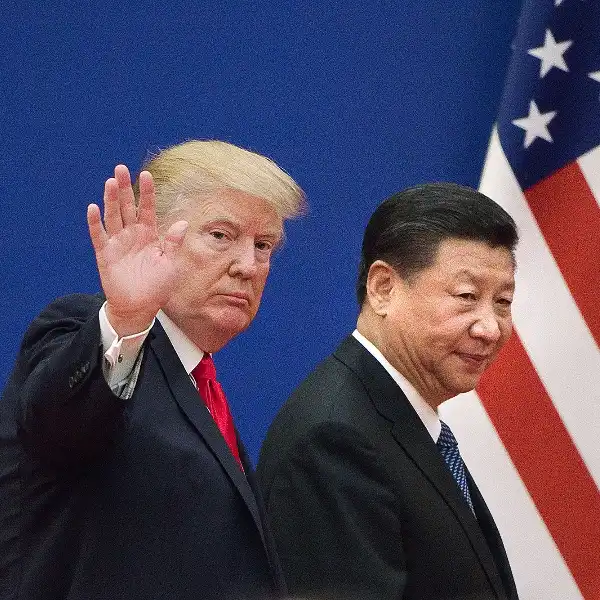
President Trump has pursued a transactional, not comprehensive, trade strategy with China. As of May 2026, President Donald J. Trump has not signed a comprehensive free trade agreement with China. Instead, his administration has pivoted toward a transactional, incremental approach, most notably establishing the 'U.S.-China Board of Trade' and the 'U.S.-China Board of Investment' during a May 2026 summit [1][2][3]. This strategic shift came after a period of intense 'trade war' escalation in 2025, which featured high reciprocal tariffs, and aimed to foster a more pragmatic, truce-based relationship with Beijing to stabilize the economy and address domestic political risks [4][5][6].
Specific agreements and a Supreme Court ruling shaped this policy shift. Recent agreements resulting from this approach include China's commitments to purchase $17 billion annually in U.S. agricultural products from 2026 to 2028, resume imports of certain U.S. poultry and beef, and acquire 200 Boeing aircraft [1][2]. This policy adjustment was partly necessitated by a February 2026 U.S. Supreme Court ruling, which determined that certain tariffs imposed under the International Emergency Economic Powers Act (IEEPA) were unconstitutional without explicit Congressional authorization, compelling the administration to modify its legal and economic strategy [7][8][9]. Experts observe that while this current approach offers needed predictability for businesses, it falls short of broad-based trade liberalization, maintaining a framework defined by state-managed, sector-specific, and transactional outcomes rather than a traditional free trade deal [6][10][3].
Sources (10)
  1. 1Fact Sheet: President Donald J. Trump Secures Historic Deals with China, Delivering for American Workers, Farmers, and Industry – The White Housewhitehouse.gov
  2. 2The World Economy After the Trump-Xi Summit - Shang-Jin Wei - CHINA US Focuschinausfocus.com
  3. 3China Is the Clear Winner After Trump Summitforeignpolicy.com
  4. 4Trump’s approach on China has changed, now appears focused on getting along – DNYUZdnyuz.com
  5. 5The Xi-Trump Summit & What It Says About The US-China Imperialist Conflict | Socialist Alternativesocialistalternative.org
  6. 6Trump Has a Path Out of the Trade War. Will He Take It? | Yale Insightsinsights.som.yale.edu
  7. 7Tariffs in the second Trump administrationen.wikipedia.org
  8. 8The Protectionist Turn | Council on Foreign Relationscfr.org
  9. 9The Impact of Trump's Tariffs: A Comprehensive Analysis: CLAclaconnect.com
  10. 10Trump-Xi Meeting: Trump's China Pragmatism Is Welcomeforeignpolicy.com

2. Price Chart

Historical Price (Probability)

Outcome probability
Date

3. Significant Price Movements

Notable price changes detected in the chart, along with research into what caused each movement.

📉 May 20, 2026: 10.0pp drop

Price decreased from 44.0% to 34.0%

Outcome: Before 2029

What happened: The primary driver of the price drop was the emerging information from President Trump's May 2026 visit to Beijing, indicating he did not establish a new comprehensive free trade agreement with China [1][2]. Instead, his administration pursued bilateral trade through new institutions and secured specific commercial commitments, such as aircraft purchases [2][3][4]. News reports circulating around May 20, 2026, reflecting the lack of a broad FTA from the summit, caused the market to drop. While social media noted the visit, such as the "President Zi" typo [4], it appeared to be mostly noise regarding the trade agreement's specific outcome.

📈 May 19, 2026: 8.0pp spike

Price increased from 36.0% to 44.0%

Outcome: Before 2029

What happened: The primary driver of the market spike was the release of the White House's "Fact Sheet" following the May 2026 Trump-Xi summit [2]. This official communication, likely amplified across social media and traditional news, highlighted "historic deals" and the establishment of a "U.S.-China Board of Trade" and "U.S.-China Board of Investment" [2]. Despite the summit not yielding a new free trade agreement [5][6], the highly positive framing of these limited commitments likely led to an overoptimistic interpretation that steps were being taken towards a future comprehensive FTA, coinciding with the market movement. Social media was a primary driver, accelerating the spread of this interpretation.
Sources (6)
  1. 1The Xi-Trump Summit & What It Says About The US-China Imperialist Conflict | Socialist Alternativesocialistalternative.org
  2. 2Fact Sheet: President Donald J. Trump Secures Historic Deals with China, Delivering for American Workers, Farmers, and Industry – The White Housewhitehouse.gov
  3. 3THE PRESIDENT’S 2026 TRADE POLICY AGENDAustr.gov
  4. 4Trump Campaign Mocked After ‘President Zi’ Typo Goes Viral During China Visit - BreezyScrollbreezyscroll.com
  5. 5Trump-Xi summit: US and China conclude 'very successful' talks but few deals confirmedbbc.com
  6. 6The Xi-Trump Beijing Summit: What Was Agreed—and What Was Notchina-briefing.com

4. Market Data

Contract Snapshot

A "Yes" resolution occurs if a new free trade agreement with China becomes law before January 20, 2029, with the outcome verified by the Library of Congress. The market resolves to "No" if such an agreement does not become law by this date. The market opened on January 10, 2025, and will close early if the agreement becomes law, otherwise by January 20, 2029, at 10:00 am EST.

Available Contracts

Market options and current pricing

Outcome bucket Yes (price) No (price) Last trade probability
Before 2029 $0.42 $0.66 43%

Market Discussion

Following a mid-May 2026 summit in Beijing, the U.S. and China did not announce a comprehensive free trade agreement, but rather reached preliminary outcomes focused on managing economic relations [1][2][3][4]. Key results included agreements in principle to establish a China-US Trade Council and a China-US Board of Investment, along with a framework for reciprocal tariff reductions [5][2][4]. Prediction markets and political commentary indicate skepticism regarding a major trade breakthrough, focusing instead on the stability of an existing tariff truce set to expire in November 2026 [6][7][8][2][9].

Sources (9)
  1. 1President Trump’s State Visit to China Delivers Historic Deals and Greater Market Access for American Farmers, Ranchers, Workers, and Businesses | United States Trade Representativeustr.gov
  2. 2The Xi-Trump Beijing Summit: What Was Agreed—and What Was Notchina-briefing.com
  3. 3Trump-Xi summit: US and China conclude 'very successful' talks but few deals confirmedbbc.com
  4. 4US advances implementation of preliminary outcomes of China-US trade talks - Global Timesglobaltimes.cn
  5. 5The Xi-Trump Summit & What It Says About The US-China Imperialist Conflict | Socialist Alternativesocialistalternative.org
  6. 6US x China tariff agreement by May 31? Predictions & Odds... 2026 | Polymarketpolymarket.com
  7. 7What Will the US Tariff Rate on China be on July 1?actionnetwork.com
  8. 8Traders predict Trump will make major announcements during China tripcnbc.com
  9. 9The aftermath of Trump-Xi summit: comparing U.S. and China announcements | NPR Illinoisnprillinois.org

5. Trust Index

Octagon Trust Index Kalshi 63 Caution

Order book is critically thin.

Primary risk· Trade quality

How it adds up
Integrity80% of score78Good

Market integrity is low (68), but Integrity averages all three scores, so the other two pull it up. Only a critically low score would cap the total.

Trade quality20% of score4Avoid

Includes the cost to trade: a $10,000 order can't be filled here because the order book is too thin.

Trust score63Caution

Weighted blend with hard caps — a critically weak safety pillar, or a severe trading anomaly, caps the total regardless of the rest. Full methodology · About the Trust Index

Trust profile
Integrity4 screens run · 6 don't apply

6. What key economic or political catalysts between 2026 and 2029 could shift the Trump administration's strategy from transactional deals to pursuing a formal free trade agreement with China?

Potential FTA timeframe2026-2029 [1][2][3]
Trump Admin Trade PreferenceTransactional trade deals [1][2][3]
China's Economic Plan FocusIndustrial upgrading and "high-level opening up" (15th Five-Year Plan 2026-2030) [4][5]
A significant shift to an FTA requires major economic or political catalysts. A potential Trump administration's transition from transactional trade deals to a formal Free Trade Agreement (FTA) with China between 2026 and 2029 would necessitate substantial economic or political catalysts [1][2][3]. Historically, the administration has favored bilateral, outcome-driven agreements, exemplified by the "Phase One" trade deal, which focused on specific purchases and limited structural changes such as intellectual property protections [6][7][8][9][10][11][12][13][14]. Experts have voiced skepticism about China's adherence to commitments within these transactional arrangements, suggesting that a persistent failure to address core issues could itself serve as a catalyst for a strategic change [9].
Economic pressures on both nations could drive a strategic reevaluation. A notable US economic downturn during the 2026-2028 period, despite current projections for modest growth, could prompt a reevaluation of the prevailing trade strategy [15][16][17][18][19]. Simultaneously, deepening economic challenges within China, characterized by subdued domestic consumption, a struggling property market, and industrial overcapacity, might compel China to offer greater concessions in trade negotiations [4][20][21][22][23].
Broader policy shifts and trade strategy failures may push for an FTA. China's 15th Five-Year Plan (2026-2030), which emphasizes industrial upgrading and a "high-level opening up" to encourage investment, could align with the objectives of an FTA [4][5]. Furthermore, the demonstrated ineffectiveness of "de-risking" strategies, implemented by both the US and China to diversify supply chains and reduce dependencies, might accelerate a move towards a formal free trade agreement [7].
Sources (23)
  1. 1clingendael.orgdocs.clingendael.org
  2. 2carnegieendowment.org
  3. 3axios.com
  4. 4allianzgi.com
  5. 5weforum.org
  6. 6china-briefing.com
  7. 7weforum.org
  8. 8medium.com
  9. 9csis.orgchinapower.csis.org
  10. 10eurasiareview.com
  11. 11ustr.gov
  12. 12whitehouse.gov
  13. 13cfr.org
  14. 14wgcu.org
  15. 15morganstanley.comadvisor.morganstanley.com
  16. 16stanford.edusiepr.stanford.edu
  17. 17deloitte.com
  18. 18purdue.eduag.purdue.edu
  19. 19umich.edulsa.umich.edu
  20. 20stanford.edufsi.stanford.edu
  21. 21china-briefing.com
  22. 22citigroup.com
  23. 23goldmansachs.com

7. How do the May 2026 U.S.-China Board of Trade and Investment agreements legally and economically differ from a comprehensive Free Trade Agreement?

Agreement TypeInstitutional, government-to-government forums (not comprehensive FTAs) [1][2]
Legal CommitmentsManagement-focused, overseeing specific non-sensitive goods (not legally binding, comprehensive tariff reduction) [1][3][4]
Economic BasisManaged, reciprocal outcomes like specific purchases (not broad, rules-based liberalization) [5][6][7]
Legally, the May 2026 U.S.-China Board of Trade and Board of Investment agreements differ significantly from a comprehensive Free Trade Agreement (FTA). These boards operate as institutional, government-to-government forums, which contrasts with the comprehensive, legally binding commitments characteristic of an FTA [1][2]. While an FTA aims for broad tariff reductions and the establishment of standard trade rules, these boards function as management-focused vehicles designed to oversee trade in specific non-sensitive goods and facilitate discussions on tariffs and investment on a case-by-case basis [1][3][4]. The arrangements are politically managed and subject to ongoing negotiation, rather than being enshrined within a fixed, treaty-level legal framework [5][6][7].
Economically, the agreements prioritize managed, reciprocal outcomes over broad liberalization. These agreements are founded on achieving specific, reciprocal outcomes, exemplified by actions such as China's procurement of Boeing aircraft and agricultural products, rather than through broad, rules-based liberalization [5][6][7]. This approach aligns with the U.S. administration's 2026 trade agenda, which explicitly prioritizes "managing" trade with China to achieve reciprocity and balance [8]. This policy represents a deliberate shift away from "unfettered free trade" models towards state-led interventions and managed commercial relationships [8].
Sources (8)
  1. 1The Xi-Trump Beijing Summit: What Was Agreed—and What Was Notchina-briefing.com
  2. 2US and China Charter a Board of Trade: What It Means for Sellers Sourcing from Chinazqdropshipping.com
  3. 3The Missing Deliverable: The US-China Board of Trade in Sharper Relief - Global Trade Alertglobaltradealert.org
  4. 4China and the U.S. Agreed to ‘Strategic Stability’ in Beijing. They Don’t Define It the Same Way. | Council on Foreign Relationscfr.org
  5. 5President Trump’s State Visit to China Delivers Historic Deals and Greater Market Access for American Farmers, Ranchers, Workers, and Businesses | United States Trade Representativeustr.gov
  6. 6The aftermath of Trump-Xi summit: comparing U.S. and China announcements | NPR Illinoisnprillinois.org
  7. 7Trump talks up trade deals with China, but experts see no big wins for U.S. - CBS Newscbsnews.com
  8. 8THE PRESIDENT’S 2026 TRADE POLICY AGENDAustr.gov

8. How does the Trump administration's 2026 transactional China policy compare to the 'Phase One' trade deal negotiated during his first term?

2026 China Policy FocusTransactional approach and reciprocity [1]
2026 Policy ManagementU.S.-China Boards of Trade and Investment [1]
Phase One Deal OutcomeChina did not meet purchase commitments [2]
The Trump administration's 2026 China policy emphasizes transactional, sector-based deals for reciprocity. This approach focuses on establishing "U.S.-China Boards of Trade and Investment" to manage commerce, with negotiations targeting specific sectors such as Boeing aircraft, agriculture, and rare earths [1][3][4][5][6]. Rather than seeking comprehensive structural transformation, this strategy appears to shift the U.S.-China dynamic from a "new cold war" to a "cold peace," with deals typically announced after a Trump-Xi summit [1][3][4][6].
In contrast, the 2020 "Phase One" trade deal was a legally binding agreement with unmet purchase commitments. Negotiated during the China–United States trade war, this first-term agreement was a bilateral deal centered on structural reforms, specifically addressing intellectual property and technology transfer [7][8][9]. The "Phase One" deal also included large-scale, fixed-volume purchase commitments, which China ultimately did not fulfill [7][8][2].
Sources (9)
  1. 1Trump’s approach on China has changed, now appears focused on getting along – DNYUZdnyuz.com
  2. 2China bought none of the extra $200 billion of US exports in Trump's trade deal | PIIEpiie.com
  3. 3How Trump and Xi Traded a New Cold War for a Cold Peacetime.com
  4. 4Fact Sheet: President Donald J. Trump Secures Historic Deals with China, Delivering for American Workers, Farmers, and Industry – The White Housewhitehouse.gov
  5. 5US-China Relations in the Trump 2.0 Era: A Timeline - China Briefingchina-briefing.com
  6. 6U.S., China announce deals after Trump-Xi summitcnbc.com
  7. 7ECONOMIC AND TRADE AGREEMENT BETWEEN THE UNITED STATES OF AMERICA AND THE PEOPLE’S REPUBLIC OF CHINA FACT SHEETustr.gov
  8. 8U.S. Signs Phase One Trade Deal with China - EveryCRSReport.comeverycrsreport.com
  9. 9China–United States trade waren.wikipedia.org

9. What evidence from Beijing's recent economic policies and diplomatic statements indicates its willingness to enter a formal FTA with the U.S.?

Value of tariff reductionAt least $30 billion worth of goods from each side [1][2][3][4][5][6][7][8][9][10]
Annual U.S. agricultural purchasesAt least $17 billion annually from 2026 through 2028 [4][11][12]
Future U.S. tariff cap timeframeNot to exceed levels agreed upon in October 2025 negotiations [4][13][6]
China demonstrates strong willingness for trade cooperation, including tariff reductions and existing deals. Beijing has indicated a strong willingness to engage in extensive economic cooperation and tariff adjustments with the U.S., committing to implementing existing trade deals and extending the current trade truce. Chinese diplomatic statements affirm a desire for stable economic ties and cooperation through dialogue. This includes a tentative agreement to lower tariffs, with reductions potentially covering at least $30 billion worth of goods from each side. China's Ministry of Commerce has also emphasized that future U.S. tariffs on Chinese goods should not exceed levels agreed upon in previous negotiations in Kuala Lumpur in October 2025 [1][2][3][5][8][9][10][4][6][7][13].
Beijing commits to addressing non-tariff barriers and increasing U.S. product purchases. Furthermore, China has committed to resolving non-tariff barriers and market access issues, particularly for agricultural products. This directly addresses U.S. concerns regarding beef facility registration and poultry exports. China has also pledged to significantly increase its purchases of U.S. agricultural products, committing to at least $17 billion annually from 2026 through 2028, in addition to existing soybean commitments. Specific arrangements have also been made for China to purchase Boeing aircraft, with the U.S. guaranteeing the supply of aircraft engines and related parts [1][3][5][9][10][4][6][7][11][12].
Sources (13)
  1. 1youtube.com
  2. 2globaltimes.cn
  3. 3thestar.com.my
  4. 4businesstimes.com.sg
  5. 5benzinga.com
  6. 6scmp.com
  7. 7youtube.com
  8. 8scmp.com
  9. 9people.cnen.people.cn
  10. 10chinadailyhk.com
  11. 11profarmer.com
  12. 12pbs.org
  13. 13indiatimes.comtimesofindia.indiatimes.com

10. What are the primary legislative hurdles in the U.S. Congress to granting Trade Promotion Authority (TPA) for a China-specific trade deal before 2029?

TPA-2015 ExpirationJuly 1, 2021 [1]
Advance Notice Requirement90 days before negotiations [2][3]
TPA Renewal FeasibilityPolitically contentious, especially for a China-specific deal [4][5]
New Trade Promotion Authority is crucial for future trade deals. The absence of current Trade Promotion Authority (TPA) legislation is the primary hurdle for any new U.S. trade deal, including one specific to China. The previous TPA-2015 expired on July 1, 2021, necessitating new legislation before negotiations can proceed [1]. Renewing TPA presents a significant political challenge, as such authority has historically been contentious in Congress. Securing this authority would be particularly difficult for a trade deal specifically targeting China [4][5].
Strict procedural requirements govern fast-track consideration of trade agreements. Beyond the need for new TPA legislation, specific procedural requirements must be met to ensure an implementing bill receives fast-track treatment. These include providing at least 90 days advance written notice to Congress before negotiations commence [2][3]. Additionally, consultation with key congressional committees, such as the Senate Finance and House Ways and Means committees, along with a congressional oversight group, is required [2][3]. Failure to comply with these notice or consultation procedures can trigger a 'procedural disapproval resolution' in either chamber, effectively blocking fast-track consideration of the implementing bill [2][3].
Sources (5)
  1. 1Presidential Authority to Address Tariff Barriers in Trade Agreements under Trade Promotion Authority (TPA) | Congress.gov | Library of Congresscongress.gov
  2. 219 USC Ch. 24: BIPARTISAN TRADE PROMOTION AUTHORITYuscode.house.gov
  3. 319 USC 3805: Implementation of trade agreementsuscode.house.gov
  4. 4Congressional Votes on Free Trade Agreements and Trade Promotion Authorityeverycrsreport.com
  5. 5Trump has the power to raise tariffs because Congress has given up its control over trade policy | LSE United States Politics and Policyblogs.lse.ac.uk

11. What Could Change the Odds

Key Catalysts

As of May 2026, President Trump has not signed a comprehensive free trade agreement with China, but did announce the establishment of two new bilateral institutions: the U.S.-China Board of Trade and the U.S.-China Board of Investment [1][2]. Current US-China trade policy is focused on 'managed economic coexistence' and stabilizing the relationship through these new boards, rather than pursuing a traditional free trade deal [3][4]. The administration has secured specific commitments from China, such as annual agricultural product purchases of $17 billion starting in 2026, to address trade deficits [3][4][2].
Prediction markets and analysts indicate that the current 'tariff truce' is a major area of focus; the truce reached in October 2025 remains in effect, with traders closely monitoring its stability ahead of expiration dates in late 2026 [5]. Future trade policy is expected to be reactive and technical rather than transformative [5][6][7]. President Xi Jinping is scheduled for a return visit to Washington in the fall of 2026, which is viewed by markets and policymakers as the next key date for potentially announcing further trade breakthroughs or adjustments to tariff arrangements [1][2][8].

Key Dates & Catalysts

  • Expiration: January 20, 2029
  • Closes: January 20, 2029
Sources (8)
  1. 1Trump-Xi summit: US and China conclude 'very successful' talks but few deals confirmedbbc.com
  2. 2Fact Sheet: President Donald J. Trump Secures Historic Deals with China, Delivering for American Workers, Farmers, and Industry – The White Housewhitehouse.gov
  3. 3The Xi-Trump Summit & What It Says About The US-China Imperialist Conflict | Socialist Alternativesocialistalternative.org
  4. 4US-China Relations in the Trump 2.0 Era: A Timeline - China Briefingchina-briefing.com
  5. 5What Will the US Tariff Rate on China be on July 1?actionnetwork.com
  6. 6Traders predict Trump will make major announcements during China tripcnbc.com
  7. 7What’s next for US–China relations? | World Economic Forumweforum.org
  8. 8Can US-China economic ties regain stability despite rivalry? | ThinkChinathinkchina.sg