
Episode summary
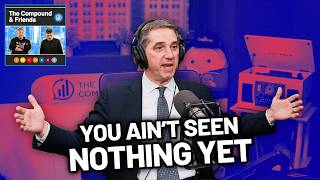
Preparing for the Next Capital Loss Cycle | TCAF
 Ask The Compound
· · 1 hr 9 min · Hosts: Michael Batnick, Josh Brown · Guests: Dan Ivascyn

Summary
Dan Ivascyn argues that the investing backdrop has shifted from a low-rate, low-volatility world to one defined by geopolitical rupture, higher fiscal spending, AI infrastructure buildout, and more frequent market frictions. He says PIMCO’s secular forum is meant to step back from daily noise and identify the themes that will matter for economies and portfolios over years, not quarters.
A central point is that the firm’s 2026 outlook, “Rupture and Resilience,” reflects both sides of that shift: the global order is getting more unstable, but the U.S. economy and consumer remain strong enough that he does not want fixed income portfolios to be “wildly defensive.” He expects AI-related capital spending, energy/grid investment, defense outlays, and reshoring to keep supporting growth, while also creating uncertainty around inflation, collateral values, and the pricing of credit risk.
He also says investors are underestimating how the next credit cycle may look. Rather than a sudden wave of defaults, he expects a steadier rise in realized losses as AI disrupts older business models and floating-rate borrowers face more pressure. In his view, that creates opportunity for active fixed income managers, especially where they can set terms, structure downside protection, and earn attractive coupons on higher-quality risk.
Key takeaways
- Dan Ivascyn says PIMCO’s secular forum is designed to identify long-horizon themes and filter out short-term market noise.
- He argues that “rupture” reflects geopolitical and policy shifts, while “resilience” reflects a still-strong U.S. consumer and economy.
- Ivascyn expects AI infrastructure, energy, defense, and reshoring to drive huge capital spending and create both growth and credit opportunities.
- He does not think this is the time to be “wildly defensive” in fixed income because starting yields are much more attractive than in the last decade.
- Dan Ivascyn expects the next credit-loss cycle to be a steady stream of losses, not necessarily a sudden wave, as AI disruption hits old-economy borrowers.
Notable quotes
“the whole idea uh and again um I think this is even more important uh today was to get away from the noise”
“our our point with the piece is that, you know, you're starting with uh financial market valuations that are high”
“Now is not the time for wildly defensive”
“we think many of these themes and trends will be hard to reverse anytime soon”
“you have this very very unique situation where the more productive AI is at the economic economy level, the more disruptive it's going to be”
How the episode opens
One of the things that I haven't really discussed because I think it's obvious to me but maybe not everybody is we've been so bad for so long like it's been so long and so many horrendous errors from I mean I was say Phil Jackson but way before that uh Isaiah and Danton and Herb Williams and Mike Woodson and just so much garbage and are you a big basketball fan or not really?
I am. No, I'm I'm uh — Do you remember this guy Anthony Randolph? Uh — He was like a skinny 611 kid from that like never came to fruition. He was we got him when he was like 25 from Golden State and he was gonna be the next guy. Like there's just so much so many years of just misery. Barnyani uh just all these washed up guys.
Michael's really big Knicks fan. — No, I know. And I'm a big Celtic fan. So I've had I've had season tickets uh to the Celtics since — I want say 2013. Okay. — We were pretty bad back then if you remember. But uh same deal. Stock stocks and draft picks. was the the squad when you when you got in there?
Oh, god. We were uh I don't remember. — 2013 Celtics. — It was almost It was almost — I was say after Walker Well, Pierce was still there. — Yeah, it was almost nobody. We had Pierce when what did they — End in 08? So, he was already he would have he would have had like two years left. We had cleaned house pretty much. It was just a lot of
Young Brown. I don't remember who was there. Um the Utah kid that we got we had we had the Kyrie rolled through.
From the episode’s captions: roughly the first two minutes, lightly cleaned. Keep watching on YouTube →
Topics
- capital loss cycle
- fixed income
- ai infrastructure spending
- geopolitical uncertainty tariffs deglobalization
- rising debt and valuations
Companies and tickers mentioned
- PIMCO
Watch the episode
Watch “Preparing for the Next Capital Loss Cycle | TCAF” on YouTube
Summary, takeaways and quote selection by Octagon. Quotes are short excerpts; the full conversation is in the episode.
More from Ask The Compound


Ask The Compound, this episode and its artwork belong to The Compound. Octagon is not affiliated with the show; this page is an independent summary.
