
Episode summary
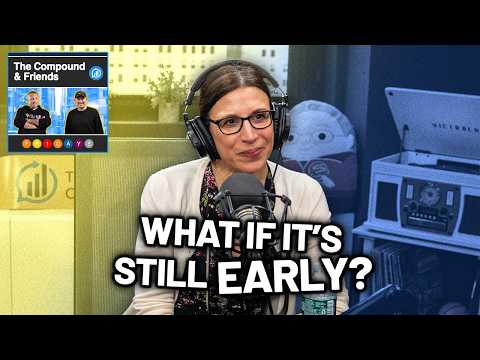
What if It's Still Early? | TCAF 244
 Ask The Compound
· · Hosts: Michael Batnick, Josh Brown · Guests: Denise Chisholm
Summary
Denise Chisholm argues that the AI spending boom looks more like a broad corporate capex cycle than a bubble. She says the key difference from 2000 is that spending is still below the level seen at the dot-com peak, free cash flow remains ahead of capex in the aggregate, and the recovery is spreading beyond a handful of hyperscalers into more sectors. She also pushes back on the idea that rising investment automatically means weaker returns, saying many capex cycles create growth rather than destroy it.
A major theme is that the market remains skeptical even as prices rise. Chisholm says valuation compression can actually be bullish when earnings growth is strong, and she argues that fear is still present in the equity market even near highs. That mix, she says, helps explain why stocks can keep climbing despite headlines, political anxiety, and repeated warnings about bubbles.
The discussion also covers semiconductors, margins, and inflation. Chisholm says semiconductor earnings growth has matched or exceeded price gains, that the business may be becoming a longer-cycle story, and that the S&P 493 is finally showing signs of recovery outside the Mag 7. On inflation, she argues that oil shocks are more likely to act like a tax on consumers than a trigger for Fed tightening, and that moderate inflation can still coexist with healthy equity returns.
Key takeaways
- Chisholm says AI capex is still not bubble territory because aggregate spending remains below dot-com extremes and free cash flow still covers the cycle.
- She argues that valuation compression can be bullish when earnings growth is strong and the market is still operating under persistent fear.
- Chisholm says semiconductor gains are being supported by earnings, not just multiple expansion, and the cycle may be longer than investors assume.
- She expects earnings breadth to improve as the S&P 493 and smaller companies move out of a multi-year profit slump.
- She says oil shocks usually reduce the odds of Fed tightening because they act more like a consumer tax than a broad inflation accelerant.
Notable quotes
“at the bubble time when you measure it especially relative to free cash flow at the peak of the bubble in 2000 corporate America in aggregate was spending three and a half to four times their free cash flow”
“the market is being pretty sober”
“the lower unit labor costs have been direct relationship the higher corporate profit margins usually are”
“oil driven shocks have historically made the Fed less likely to tighten, not more, functioning more like a tax on the consumer”
How the episode opens
Good. — We were just talking about your octopus. — What's up, man? — Yeah. — Um, I saw a real from Neil Degrass Tyson on these being the closest thing we have to aliens. They have like nine hearts, a couple of brains.
I did not — Cut off their arm, it grows back. — Well, that part I knew. I remember that. Yeah. — Each one of their tentacles can see, feel, touch, smell, taste. — I don't eat I don't eat octopus. — Okay. You don't?
But I eat calamari. I eat squid. — Okay. I don't know why I draw that distinction. Um, but the oct I saw a documentary about how intelligent — Octopi are. — Yep. — And I — Gives you a plural there. — So, the problem is we go to like we go to KMA, we go to like all these like Mediterranean restaurants and everybody gets the grilled octopus and you know, I used to like it a lot,
But now you feel better. — That's why I'm wasting away. Um, Denise, here's where I'm at. — Tell me. — I don't know if this is my age or my personality. I'm now at a stage where I eat out of the restaurant
And I have no patience for the bringing of the check routine — Like you have to flag somebody down. They come over. I'd like the check. They We'll be right back. They go and get it. Then they come. They leave it there. Then you have to sit with it for 5 minutes. Then you put
Please come back. Please come back. — Then you put your credit card in and you're looking around for somebody. I'll give it to a bus boy.
From the episode’s captions: roughly the first two minutes, lightly cleaned. Keep watching on YouTube →
Topics
- ai capex
- valuation and bull case
- mag 7 earnings broadening
- semiconductors
- fed policy and inflation
Companies and tickers mentioned
- Fidelity
- SpaceX
- OpenAI
- Anthropic
Watch the episode
Watch “What if It's Still Early? | TCAF 244” on YouTube
Summary, takeaways and quote selection by Octagon. Quotes are short excerpts; the full conversation is in the episode.
More from Ask The Compound



Ask The Compound, this episode and its artwork belong to The Compound. Octagon is not affiliated with the show; this page is an independent summary.
