
Episode summary
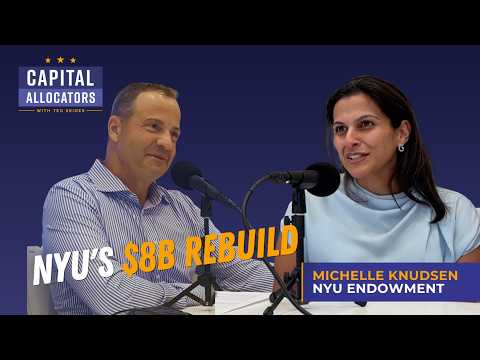
Michelle Knudsen: Rebuilding the NYU Endowment from a Clean Sheet of Paper
 Capital Allocators with Ted Seides
· · 1 hr 18 min · Hosts: Ted Seides · Guests: Michelle Knudsen
Summary
Michelle Knudsen frames her career as a progression from crisis-tested investor to portfolio builder, starting at Goldman Sachs in 2008 and carrying forward the lesson that “you always have to be prepared for the bad case scenario.” She says those years taught her to communicate clearly about what could go right, what could go wrong, and how to plan for both. At Partners Capital, she learned to think across client types, from private equity GPs to foundations and endowments, with attention to liquidity, volatility, and the difference between net-of-fees and net-of-tax returns.
At NYU, she inherited a smaller, conservative endowment and a mandate to rebuild it “from a blank sheet of paper.” She describes quickly changing governance, pushing manager selection down to the team unless a position exceeds 3% of the portfolio, and reorienting the asset mix around public equity as the benchmark for every allocation. The portfolio now includes a larger venture book, more buyout exposure, and a growing absolute return sleeve built around hedge fund and opportunistic strategies.
Knudsen emphasizes process, data, and stress testing, but says the team also has to judge whether a manager’s opportunity set and structure actually match the strategy. She wants NYU to be a preferred LP by being responsive, useful, and thoughtful, while using AI to better organize research and financial data. The main risks she sees are private-market FOMO and underestimating how AI and public-market concentration may reshape returns.
Key takeaways
- Michelle Knudsen says Goldman Sachs in 2008 taught her to build for bad-case scenarios and communicate those risks clearly to stakeholders.
- At NYU, she set 3% as the threshold for investment committee approval on a manager position, keeping smaller decisions with the investment team.
- She says NYU is moving toward about 65% in public and private equity, about 25% in absolute return and opportunistic strategies, and the rest in cash, fixed income, and real estate.
- Knudsen thinks the strongest long-term return source is equity exposure, so every allocation must compete with public equities as the opportunity-cost benchmark.
- She says NYU is leaning into venture, lower-midmarket buyouts, and trading-oriented hedge fund strategies because they fit the endowment’s growth and liquidity needs.
Notable quotes
“you always have to be prepared for the bad case scenario”
“the most reliable source of return over the long term is equity market exposure”
“I love process and a manager who can describe for me how they think about the world and how that translates into a portfolio is I'll listen to it all day”
“There are good decisions and bad decisions, and there are good outcomes and bad outcomes”
How the episode opens
Michelle, thanks so much for joining me. — Thank you for having me. I've been looking forward to this. — Why don't you take me back to the start of your career and walk me through the core steps that lead you to where you are today?
Yeah, happy to. I did not set out to become an investor. Um, I thought I was going to go into public policy.
My parents moved to Washington DC when I was in high school and I was fascinated by policy and government and my whole college career was internships on Capitol Hill, a political science major and then the fall of my senior year, I got a call from Goldman Sachs saying they had an open slot in their San Francisco office for the following fall and did I want to come interview and I remember sitting there on the phone thinking I've never taken a class in finance but why not? I had a I think a good appreciation for the role that markets play in the global economy and as somebody interested in policy that was uh that that was really important. So I crammed for the interview.
I talked to all of my friends who had done banking internships or sales and trading internships the summer before. Long story short, I got the job. And so I graduated in 2008 into the financial crisis with a job at Goldman Sachs.
And I don't think anything has shaped how I think about portfolio management or how I manage stakeholders or how I manage my career quite like starting out in the middle of a financial crisis and I learned a lot in the two years I spent at Goldman.
What did you take away from those two years that have carried through?
From the episode’s captions: roughly the first two minutes, lightly cleaned. Keep watching on YouTube →
Topics
- endowment portfolio construction
- risk management and stress testing
- ocio vs single-client cios
- venture and private equity investing
- ai in investment analysis
Companies and tickers mentioned
- NYU endowment
- Goldman Sachs
- Partners Capital
- The Mellon Foundation
Watch the episode
Watch “Michelle Knudsen: Rebuilding the NYU Endowment from a Clean Sheet of Paper” on YouTube
Summary, takeaways and quote selection by Octagon. Quotes are short excerpts; the full conversation is in the episode.
More from Capital Allocators with Ted Seides
-
 Aydin Senkut: Chasing Demand, Not Hype, at Felicis
-
 Scott Ramsower: Continuation Vehicles from the LP Seat
-
 Vik Uppal: Real Estate Special Situations With a Flexible Mandate
-
 Zack McGuire: Dynamic Allocation and Concentrated Conviction at Children's Healthcare of Atlanta
-
 Ben Harrison: AI Tools for the Investment Firm
-
 Tracy Britt Cool: The Berkshire Model for $5–50M Businesses
Capital Allocators with Ted Seides, this episode and its artwork belong to Ted Seides – Allocator and Asset Management Expert. Octagon is not affiliated with the show; this page is an independent summary.
