
Episode summary
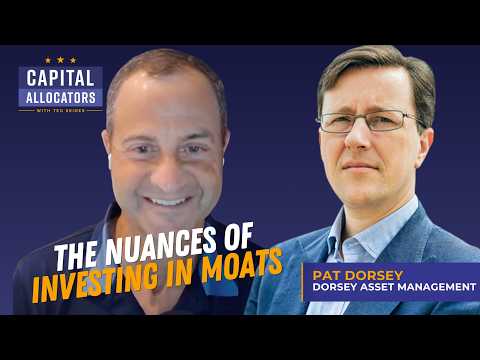
Pat Dorsey: The Nuances of Investing in Moats (Capital Allocators, EP.509)
 Capital Allocators with Ted Seides
· · 1 hr 18 min · Hosts: Ted Seides · Guests: Pat Dorsey
Summary
Pat Dorsey argues that moat investing is best understood as a qualitative discipline grounded in pattern recognition, not a search for a single magic metric. His earliest framework at Morningstar came from studying companies with more than 15% returns on capital for more than 15 years, which led him to buckets like brands, switching costs, network effects, scale advantages, and intangible assets. He says return on capital has become less useful over time as value creation has shifted toward expensed assets like software and brand-building, making judgment about pricing power, customer behavior, and reinvestment more important.
He also emphasizes that moats are only part of the story. Dorsey says he has become more focused on management quality, humility, and alignment, because even great businesses can be damaged by poor capital allocation or ego. He is skeptical of founder worship, argues that capital allocation is a learned skill that most CEOs do not naturally possess, and prefers teams that listen, self-correct, and treat investing as truth-seeking rather than being right.
At Dorsey Asset Management, that philosophy translates into a concentrated, long-only portfolio with a narrow investable universe, a strong preference for businesses with reinvestment runways, and an unusually pragmatic approach to valuation. He says the firm uses multiples first and DCF second, sizes positions by both expected return and portfolio role, and avoids industries or geographies where the team lacks an edge.
Key takeaways
- Dorsey says moat analysis works best as a qualitative framework built from customer behavior, competitive dynamics, and reinvestment runway, not just ROIC.
- He believes management matters more than he used to think, and he now weights humility, alignment, and capital allocation heavily in underwriting.
- Dorsey is skeptical of founder-led-business bias, arguing founders are not automatically better managers than hired CEOs.
- He prefers businesses that can reinvest at high returns internally, because that reduces the risk of bad acquisitions or mistimed buybacks.
- He sizes positions based on expected return, moat quality, and diversification benefits, with a hard maximum of 15 holdings.
Notable quotes
“I think that the bulk of it is qualitative, right? I mean, the bulk of it is understanding what kind of price the company can take if it has pricing power”
“the more companies you look at, the more likely you are to say, "Okay, I think there's something here." And then you try to think through, you know, why”
“I think management is is is hugely important, and I actually think that phrase from Buffett has probably done more harm than good over time”
“The skill set of a founder is very different than the skill set of a manager”
“I think it's really easy to do with your portfolio as well. That okay, you know, you know, we're familiar with this company, we've owned it for a while”
How the episode opens
Pat, thanks so much for joining me. — Thanks for having me. — I'd love you to take me back to the early influences in your life that led you down this path to investing. — I'm not sure there were any.
Um I mean, my my my father was a a bureaucrat with the Food and Drug Administration, and my mom taught nursery school. My grandfather did a lot of investing and kind of would show me that mutual fund honor roll, uh you know, in the journal or Forbes or something. But, that's about it.
I mean, I wasn't one of these people who, you know, was uh reading Buffett's letters when they were in elementary school. That those kinds of people always kind of freak me out a bit.
Where did that academic path take you through school?
So, my undergrad was in political science, subdiscipline called comparative politics, where you're basically studying how different political systems evolve and trying to draw conclusions from that. So, look at a dozen countries that have transitioned from dictatorship to democracy and say, "Hey, can we observe any patterns, right? Which actually turned out to be, unknowingly, somewhat good training for what we do as investors, right?
Because you're looking at different businesses, understanding them in a deep manner, and developing pattern recognition. Um I didn't know that at the time. After undergrad, I had a couple crappy jobs in finance, just to pay the bills.
One was with a newsletter, one in a brokerage firm, both parts of our industry that are more focused on making money off of clients than making money for clients. And so, it didn't really sit well with me. So, I went back to graduate school to get a PhD in poli sci.
From the episode’s captions: roughly the first two minutes, lightly cleaned. Keep watching on YouTube →
Topics
- moat investing
- quantitative moat analysis
- switching costs
- capital allocation
- reinvestment runway
Companies and tickers mentioned
- MORN
- COST
- Dorsey Asset Management
- Morningstar
- Costco
- Medline
Watch the episode
Watch “Pat Dorsey: The Nuances of Investing in Moats (Capital Allocators, EP.509)” on YouTube
Summary, takeaways and quote selection by Octagon. Quotes are short excerpts; the full conversation is in the episode.
More from Capital Allocators with Ted Seides
-
 Aydin Senkut: Chasing Demand, Not Hype, at Felicis
-
 Scott Ramsower: Continuation Vehicles from the LP Seat
-
 Vik Uppal: Real Estate Special Situations With a Flexible Mandate
-
 Zack McGuire: Dynamic Allocation and Concentrated Conviction at Children's Healthcare of Atlanta
-
 Ben Harrison: AI Tools for the Investment Firm
-
 Tracy Britt Cool: The Berkshire Model for $5–50M Businesses
Capital Allocators with Ted Seides, this episode and its artwork belong to Ted Seides – Allocator and Asset Management Expert. Octagon is not affiliated with the show; this page is an independent summary.
