
Episode summary
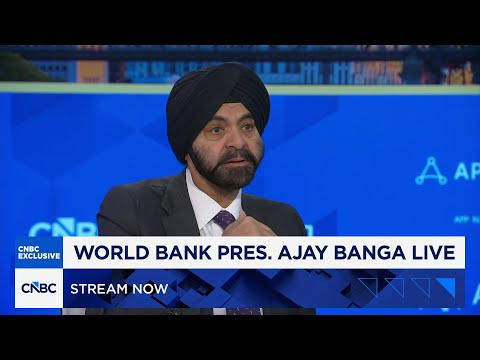
World Bank President Ajay Banga: 'Small AI' can boost developing economies
Summary
Ajay Banga said the World Bank is thinking about AI differently in the developing world, favoring what he called “small AI” over the large language models that dominate richer economies. He argued that applications for agriculture, healthcare, education and skilling can deliver real productivity gains without requiring the computing power, electricity, data and capital that many emerging markets lack. He pointed to examples in India, El Salvador and elsewhere, and said the key payoff is jobs that would not be created without these tools.
Banga said the countries moving fastest on AI are often upper-middle-income markets such as India and Indonesia, while Africa is lagging and needs more help with deployable applications and local compute. He argued that countries should not have to reinvent every app, and that smaller data centers and edge infrastructure will matter for adoption.
On capital, he said the broader rise in rates affects debt servicing, but the main issue is not a shortage of money for development projects. The World Bank, he said, mobilized $112 billion last year versus “30 something” three years ago. He added that emerging market spreads have actually narrowed, helped by countries managing balance sheets better, even though higher global rates still raise borrowing costs.
Key takeaways
- Banga said “small AI” is the right model for developing economies because it can boost agriculture, healthcare, education and skilling without big-tech infrastructure needs.
- He argued AI can create jobs in emerging markets that would not exist otherwise, making it a productivity tool rather than just a technology trend.
- India, El Salvador and Indonesia are among the quicker adopters of AI applications, while Africa needs more support to keep pace.
- The World Bank president said the institution mobilized $112 billion last year, up from “30 something” three years earlier.
- Banga said emerging market spreads have narrowed even as overall rates rose, but higher rates still increase debt-servicing pressure.
Notable quotes
“I THINK WHAT I CALL IT SMALL AI AS COMPARED TO BIG AI, BECAUSE WHAT'S BEING TALKED ABOUT IN THE DEVELOPED WORLD IS ALL ABOUT LARGE LANGUAGE MODELS”
“SMALL AI APPLICATIONS FOR AGRICULTURE, APPLICATIONS FOR HEALTHCARE, APPLICATIONS FOR EDUCATION AND SKILLING THAT WE ARE BUILDING AND LAUNCHING IN EL SALVADOR AND INDIA AND OTHER PLACES”
“THAT. ANDREW. THAT'S A REAL PRODUCTIVITY ENHANCER”
“I THINK OF IT AS A HUGE ENHANCER, AS A HUGE BOOST TO WHAT YOU COULD DO TO LEAPFROG WITH THE RIGHT KIND OF APPLICATIONS”
“LAST YEAR WE MOBILIZED THREE TIMES THE AMOUNT WE MOBILIZED THREE YEARS AGO, 112 BILLION VERSUS 30 SOMETHING”
How the episode opens
Million stories and story.
Welcome back to squawk box artificial intelligence and its impact on the global economy. Key theme at the imf World Bank annual meeting earlier this month in bangkok. Joining us right now for an exclusive interview is World Bank president Ajay Banga.
Good morning to you. Good morning. It's great to see you.
You've we've had you on the broadcast over the years in different different roles. This is a very different role. We keep talking about ai constantly and we talk about that in the context of the developed world.
I'm curious how you're thinking about that in the less developed world.
So first of all, I mean, thanks for having me. And it's great to be back. Although in a different avatar, the the developing world.
I think what I call it small ai as compared to big ai, because what's being talked about in the developed world is all about large language models. And the reality is that needs computing power, electricity, data, people and capital, which don't exactly compute in the in the developing world. But small ai applications for agriculture, applications for healthcare, applications for education and skilling that we are building and launching in el salvador and india and other places that.
Andrew. That's a real productivity enhancer. And in fact, my conversation at bangkok was that this is not about anything else than the jobs you would not have built if you don't use small ai in the emerging markets.
The exact opposite discussion to what seems to take.
Up all you think about it as a superpower, then I mean, in the developing world, is this a. — Completely I think of it as a huge enhancer, as a huge boost to what you could do to leapfrog with the right kind of applications.
From the episode’s captions: roughly the first two minutes, lightly cleaned. Keep watching on YouTube →
Topics
- ai impact on global economy
- ai in developing economies
- race for capital
- small ai
- world bank and development
Companies and tickers mentioned
- World Bank
Watch the episode
Watch “World Bank President Ajay Banga: 'Small AI' can boost developing economies” on YouTube
Summary, takeaways and quote selection by Octagon. Quotes are short excerpts; the full conversation is in the episode.
More from CNBC Squawk Box
-
 Rep. John Moolenaar on investigating Nvidia's Jensen Huang: CCP influence raises multiple concerns
-
 Jensen Huang's affair has gone from a personal scandal to a corporate governance issue: Paul Argenti
-
 Experts react to the October CPI report
-
 Fairlead's Katie Stockton on market selloff: Don't sell weakness, sell the strength
-
 Ron Baron on his Musk investments: Can make 'hundreds of billions of dollars' over the next 10 years
-
 Tech selloff looks like a normal correction, says JPMorgan's Jack Caffrey
CNBC Squawk Box, this episode and its artwork belong to their owners. Octagon is not affiliated with the show; this page is an independent summary.
