
Episode summary
Steven Tananbaum: The Evolution of Credit Investing and AI Opportunities
 Exchanges (Goldman Sachs)
· · Guests: John Waldron, Steven Tananbaum

Summary
Steven Tananbaum describes how GoldenTree built a credit platform by staying process-driven, moving quickly when markets dislocated, and focusing on a margin of safety. He says his early career taught him to be deliberate, to watch how other portfolio managers behaved, and to look at the capital structure rather than only one slice of an investment. The guest argues that distressed investing works best when entry price, management alignment, and a realistic exit matter more than the headline story.
He also frames GoldenTree’s evolution from a credit specialist into a broader multi-asset platform. The guest says the firm looks for the best risk-adjusted way to express a theme, whether through public debt, structured products, private credit, or equity. He points to successful bets in European banks and oil service during Covid as examples of how the team kept building on theses as they developed.
On AI, the guest says the biggest credit-market issue is not just financing volume but what happens if AI-driven growth slows. He thinks AI-related financing is already pressuring some markets and could create more dispersion, with investment-grade opportunities looking relatively attractive. He also says tight spreads and mid-cycle conditions have made credit less favorable than equities so far in 2026.
Key takeaways
- The guest says GoldenTree’s edge comes from a disciplined process, not from calling itself only a credit shop.
- He argues distressed investing depends heavily on entry price and management behavior, not just on how cheap a security looks.
- The guest says AI matters most as an economic growth driver; if it deaccelerates, credit assumptions may need to reset.
- He sees AI financing as creating dispersion, with some investment-grade names potentially offering the better risk-adjusted opportunity.
- The guest says the best distressed opportunity today is “distressed 3.0”: using a platform to buy companies undergoing transformation.
Notable quotes
“I always thought of myself as an investor. I traded stocks and options, got my Series Seven in 1963 in college”
“we start with providing a margin of safety. Guardrails. So, if we're investing in senior debt, it's two times asset coverage”
“how do we get here" and "where are we going”
“I would be shocked if we didn't see more dispersion”
“I always want to have a margin of safety. And always want to be an eternal student”
How the episode opens
So, when I think of AI and the credit markets, I think of it two ways. First is economically, because it s such a driver of our economy. It's hard to see how it's going to actually accelerate from here.
So, the issue if it deaccelerates, what's going to be the impact? That's probably, to me, the biggest issue. And if it deaccelerates, will people be taking down their economic growth assumptions?
And then there is the trying to line up where the best opportunities are between the different markets. And it could be the investment-grade market could be the better risk-adjusted opportunity. Welcome to Goldman Sachs Exchanges: Great Investors.
I'm John Waldron. I'm about to sit down with Steve Tananbaum. Steve is the founder and CIO of GoldenTree Asset Management, a credit manager with over $70 billion in assets under management.
He also happens to be one of the sharpest and most successful debt investors in the world. Today, I'll find out what's behind his success and where he sees opportunities ahead. Steve, welcome to Great Investors at Goldman Sachs.
John, it's great to be here. So, your first job was at Kidder Peabody, I believe? Yes.
And then MacKay Shields. Yes. Which is where you and I met.
Yes. How would you describe your early career and lessons learned in those first couple jobs? So, when I think of Kidder Peabody two-year investment banking training program focusing on M&A and high yield, and I went from an environment being a student where I had 25 to 30 hours of work each week to having 100 hours of work.
So, very overwhelming. I'm sure that you could relate from your experience at Bear. I could.
And I was overwhelmed. So, I had to have this strategy of, okay, what all do I want to accomplish?
From the episode’s captions: roughly the first two minutes, lightly cleaned. Keep watching on YouTube →
Topics
- credit investing evolution
- ai financing
- credit markets
- investment analysis framework
- asset management growth
Companies and tickers mentioned
- GS
- Goldman Sachs
- GoldenTree Asset Management
Watch the episode
Watch “Steven Tananbaum: The Evolution of Credit Investing and AI Opportunities” on YouTube
Summary, takeaways and quote selection by Octagon. Quotes are short excerpts; the full conversation is in the episode.
More from Exchanges (Goldman Sachs)
-
 Playing for Scale: The Future of Sports Investing
-
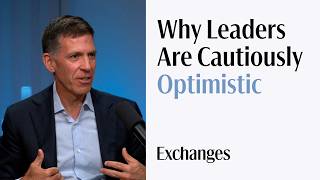 John Waldron on GDP Growth, AI, and the M&A Outlook
-
 Brookfield’s Connor Teskey on the Real Bottleneck in the AI Buildout
-
 Goldman Sachs Chairman and CEO David Solomon on AI: Implementation, Accountability, and Jobs
-
 Why Oil Prices Are Surging Despite Recovering Supply
-
 Where Chinese Exports Are Gaining the Most Market Share
Exchanges (Goldman Sachs), this episode and its artwork belong to Goldman Sachs. Octagon is not affiliated with the show; this page is an independent summary.
