
Episode summary
US Midyear Outlook: Geopolitical Shocks, the New Fed Era, and Growth
 Exchanges (Goldman Sachs)
· · 19 min · Guests: David Mericle
Summary
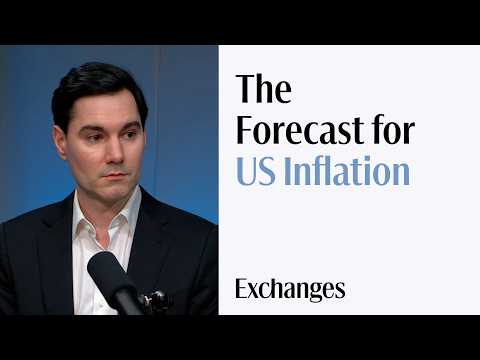
David Mericle says the US economy has been more resilient than expected, especially in the labor market, where job growth picked up sharply even after a year of weak hiring. He argues that this strength has taken one downside labor-market concern off the table for now, while inflation has stayed stickier than hoped because of the war, AI-driven demand effects, and tariff-related distortions. His base case is that inflation moves more sideways than down in the near term, staying closer to 3% than 2%.
On the June CPI report, Mericle treats the softer print as a likely outlier rather than a regime change, though he expects a run of somewhat better monthly inflation readings in the second half of the year. He says the Fed should stay on hold at the July meeting and, in Goldman Sachs Research’s forecast, remain on hold through 2026 before cutting in 2027. He sees market pricing for near-term hikes as somewhat overstated, but not wildly off.
Mericle also expects US GDP growth to run around 2% this year, helped by business investment and a still-solid labor market, but restrained by weaker consumption, housing, and government spending. He says the biggest risk remains the war, both for inflation and for the possibility that higher prices spill into monetary policy and financial markets.
Key takeaways
- Mericle expects the Fed to keep rates unchanged this year and begin cutting in 2027, not respond with near-term hikes.
- He says the labor market has surprised to the upside, with job growth now running above the roughly 50,000 to 60,000 monthly break-even pace.
- Mericle thinks June CPI was probably an outlier, although he still expects softer monthly inflation data in the second half of 2026.
- He expects US GDP growth around 2% this year, with business investment offsetting weaker consumption, housing, and government spending.
- He sees the war as the biggest macro risk because it could keep inflation elevated and complicate Fed policy.
Notable quotes
“The labor market now looks fairly different than it did to us at the beginning of the year”
“it looks like inflation will go more sideways, stay closer to three percent than to two percent”
“I think that probably was a bit of an outlier print, and I wouldn't say it greatly changed our view on the inflation path”
“Our own view is that the probability of hikes is less than 50%, more like 25%”
“we think all of that adds up to a picture for GDP growth around two percent, not bad by any means”
How the episode opens
With a newly installed Fed chairman, a surprisingly soft inflation print, and persistent geopolitical tensions, what are the implications for US inflation, growth, and Fed policy ahead? I'm Allison Nathan, and this is Goldman Sachs Exchanges. Here to break it all down is my colleague from Goldman Sachs Research, David Mericle, our chief US economist.
David, welcome back to Exchanges. Thanks, Allison. It's been a little while since I've had you on the show, David, so thanks for joining.
And I just do, for that reason, really want to start wide. So here we are in July, if we think about the many twists and turns that we've had so far this year, maybe just start us out with what about the performance of the US economy has gone just as you expected, and maybe more interestingly, what has surprised you the most? Sure, I don't know that anything's gone just as we expected, but on the surprises, let me give you a good one and a not so good one.
On the good side, I would say maybe a big surprise was after we barely created any jobs for the better part of a year, all of a sudden, in the aftermath, somewhat puzzlingly, of a war breaking out and oil prices spiking, job growth has picked up a lot over the course of the last four months. The labor market now looks fairly different than it did to us at the beginning of the year. That was something we had been a little bit worried about and now that concern, at least for now, is taken off the table.
On the negative side, I would say the biggest surprise has been that whereas we started the year thinking inflation will get better for the very simple reason that the tariffs are behind us, they will drop out of the year-on-year inflation calculation.
From the episode’s captions: roughly the first two minutes, lightly cleaned. Keep watching on YouTube →
Topics
- fed outlook
- interest rates
- us inflation
- labor market resilience
- us gdp growth
Companies and tickers mentioned
- GS
- Goldman Sachs
Watch the episode
Watch “US Midyear Outlook: Geopolitical Shocks, the New Fed Era, and Growth” on YouTube
Summary, takeaways and quote selection by Octagon. Quotes are short excerpts; the full conversation is in the episode.
More from Exchanges (Goldman Sachs)
-
 Playing for Scale: The Future of Sports Investing
-
 John Waldron on GDP Growth, AI, and the M&A Outlook
-
 Brookfield’s Connor Teskey on the Real Bottleneck in the AI Buildout
-
 Goldman Sachs Chairman and CEO David Solomon on AI: Implementation, Accountability, and Jobs
-
 Why Oil Prices Are Surging Despite Recovering Supply
-
 Where Chinese Exports Are Gaining the Most Market Share
Exchanges (Goldman Sachs), this episode and its artwork belong to Goldman Sachs. Octagon is not affiliated with the show; this page is an independent summary.
