
Episode summary
Why Nothing Looks Cool Anymore | John Mauriello
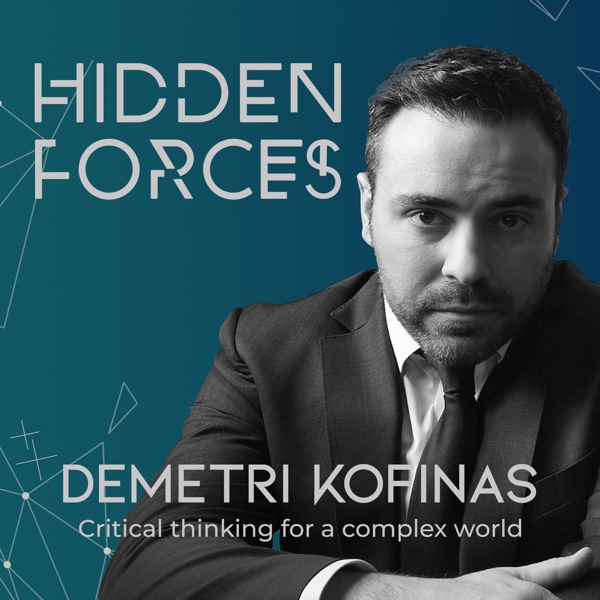 Hidden Forces
· · Hosts: Demetri Kofinas · Guests: John Mauriello

Summary
John Mauriello argues that contemporary design has lost the humanist philosophy that once gave it meaning and has been reduced to efficiency, standardization, and profit. He traces his own path from severe childhood ADHD, rebelliousness in school, and a family environment shaped by a designer mother and a surgeon father to industrial design and later YouTube, where he built Design Theory around the idea that objects shape culture and behavior.
A major thread is his critique of minimalism. Mauriello says the Bauhaus and related mid-century movements originally aimed to democratize design, but modern companies such as Apple have kept the aesthetic while stripping away the philosophy. He also says standardization, regulation, and algorithmic convergence have pushed products, especially cars and interfaces, toward a bland middle ground that is easier to produce and sell.
The conversation then turns to scams. Mauriello argues that Theranos and many Silicon Valley pitches worked because cheap capital rewarded storytelling over truth. He distinguishes legitimate ambition from fraud by stressing whether a founder stays within measurable reality: Steve Jobs listened to experts and worked around constraints, while Elizabeth Holmes ignored them. For Mauriello, the larger problem is a broader collapse of trust and incentives that rewards spectacle, extraction, and “just barely good enough” products.
Key takeaways
- Mauriello says modern design has kept the look of minimalism while abandoning its original humanist purpose of democratizing good design.
- He argues that standardization, regulation, and profit-seeking have pushed cars and consumer products toward a bland, convergent aesthetic.
- Mauriello says scams thrive when cheap capital rewards storytelling more than execution, as in Theranos and parts of Silicon Valley.
- He distinguishes ambition from fraud by whether a founder respects measurable reality and expert constraints.
- He says design should align incentives with actually serving people, not just extracting money or attention.
Notable quotes
“Design is storytelling through objects and drawings and communication and semiotics and all these other things”
“the philosophical underpinning of industrial design has been completely lost over the last several decades”
“it has been thoughtlessly over prescribed often in the name of profit at all costs”
“there are almost three levels to reality that you need to think about”
“No amount of precision is going to create any sort of desire”
Topics
- industrial design
- minimalism and efficiency
- design and institutional trust
- designing fraud
- car and phone design
Companies and tickers mentioned
- AAPL
- Apple
- Theranos
Watch the episode
Watch “Why Nothing Looks Cool Anymore | John Mauriello” on YouTube
Summary, takeaways and quote selection by Octagon. Quotes are short excerpts; the full conversation is in the episode.
More from Hidden Forces


Hidden Forces, this episode and its artwork belong to Demetri Kofinas. Octagon is not affiliated with the show; this page is an independent summary.
