
Episode summary
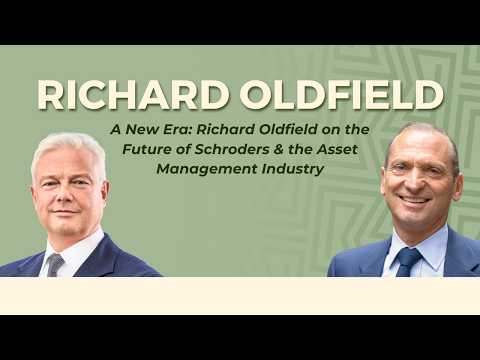
A New Era: Richard Oldfield on the Future of Schroders and the Asset Management industry
 Money Maze Podcast
· · Guests: Richard Oldfield
Summary
Richard Oldfield argues that asset management is being reshaped less by size than by relevance, client needs, and the ability to generate alpha. He says Schroders has been deliberately refocused around active management, a smaller but stronger wealth franchise, and a broader public-to-private offering, because passive products have become increasingly concentrated in US mega-cap technology names rather than truly diversified portfolios. He also says benchmarks have become so skewed that they can distort how managers are judged and how investors think about risk.
Oldfield says the Schroders-Nuveen combination solves three strategic gaps: a larger US wealth presence, a stronger US fixed income capability, and more permanent capital for private markets. He says the merged group will have about $2.5tn in assets and keep the Schroders brand in many markets, while using Nuveen where it is stronger. Cultural fit, long-term orientation, and client service, he says, were central to getting both the family owners and the board comfortable with the deal.
He is upbeat about Asia, public markets, AI, and tokenization. Oldfield says Asian and emerging markets investing remains largely active and is seeing renewed demand, while AI should make people “superhuman,” not replace portfolio managers. He also insists public markets remain essential for capital formation and transparency, and says London still matters as a financial centre.
Key takeaways
- Oldfield says size is not the defining feature of an asset manager; relevance to clients and alpha generation matter more.
- He argues passive investing has become overly concentrated in US technology stocks, making diversification and risk control more important.
- Oldfield says the Schroders-Nuveen deal addresses gaps in US wealth, US fixed income, and private markets scale.
- He expects Asia and emerging markets to regain attention as investors diversify away from the US.
- He says AI will augment portfolio managers and tokenization could cut fees and speed up fund plumbing.
Notable quotes
“size is less important than relevance to your clients”
“what they're really invested in is the United States and the dollar, and in particular a very small number of technology companies”
“I think benchmarks the scourge of the industry”
“AI is about making our people superhuman, not replacing them”
“It will take over someone's lifetime billions of pounds of fees out of the system”
How the episode opens
No one should take my comments here as thinking I'm anti-passive, cuz I think it's a really important building block in everyone's portfolios. But it shouldn't be the only thing you have alongside private markets. Uh and so most people today would think uh the average man on the street would think that if you invested in a passive MSCI uh product that he's got a good diversified, currency diversified, asset mix.
And of course, what they're really invested in is the United States and the dollar, and in particular a very small number of technology companies. When you look at the world, there's less public companies than there were historically. And there seen the rise of the private markets is actually making sure that even when you're thinking about private markets, you get the right mix of assets.
So, is that really private equity? Is it real estate? Is it private credit?
Um uh for us in particular, is that um infrastructure investing, given we have a renewable infrastructure business.
Most CEOs take years to make their mark. But after three decades dissecting and helping other people's businesses at PwC, our guest today spent two years inside Schroders before deciding it was time to sell the 220-year-old business. Today, he joins us to explain why he was convinced it was the right decision to take.
What are the irresistible forces changing the investment business? Priorities, profitability, private and public assets, passive and active, and if size matters more than ever. Richard Oldfield, CEO of Schroders PE, see a warm welcome to the Money Maze podcast.
Thank you very much, Simon. — We've been trying to get a date in the diary to have this conversation, I think, since early February. And now we've got you, it's very hot.
From the episode’s captions: roughly the first two minutes, lightly cleaned. Keep watching on YouTube →
Topics
- asset management industry
- public vs private assets
- passive vs active investing
- ai in asset management
- benchmarks and risk
Companies and tickers mentioned
- PwC
- Schroders
- Nuveen
Watch the episode
Summary, takeaways and quote selection by Octagon. Quotes are short excerpts; the full conversation is in the episode.
More from Money Maze Podcast
-
 Why, Where and How? CPP Investments' Heather Tobin on Building Large Hedge Fund Portfolios
-
 How Can We Educate Our Children Better As the World of AI Envelops Us? With Sir Anthony Seldon
-
 The Black Box Dilemma: Who Controls What AI Can Say? With CTGT’s Founder, Cyril Gorlla
-
 The Region That Defies Prediction - Simon Sebag Montefiore on The Middle East
-
 Fraud, Fees & Fake Degrees! Where's the Alternatives Allocation Headed? John Claisse, CEO, Albourne
-
 Come Fly with Me! Delta Air Lines, The World’s Biggest Airline - With CEO, Ed Bastian.
Money Maze Podcast, this episode and its artwork belong to Money Maze Podcast. Octagon is not affiliated with the show; this page is an independent summary.
