
Episode summary
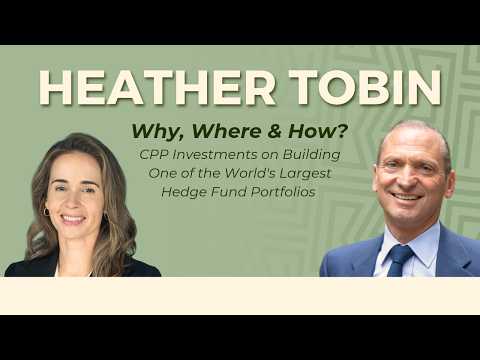
Why, Where and How? CPP Investments' Heather Tobin on Building Large Hedge Fund Portfolios
 Money Maze Podcast
· · Guests: Heather Tobin
Summary
Heather Tobin argues that hedge funds still matter because the asset class has become larger, more institutional and more competitive, yet the opportunity set remains compelling. At CPP Investments, the program is built to generate uncorrelated, liquid and scalable returns, with market neutral strategies used to strip out beta and isolate manager skill. She says the backdrop of higher rates, elevated volatility and wider dispersion has ended the post-GFC “alpha winter” and helped skilled managers.
A major theme is how CPP constructs the portfolio. Heather Tobin says the firm runs roughly 80 external manager relationships across about a dozen strategy types, alongside an internal systematic strategies team covering quantitative equity, systematic macro and volatility. The external book is judged against cash, with a strong emphasis on net returns, liquidity terms, alignment and operational discipline. Manager selection is systematic and unforgiving: CPP evaluates people, process, performance, risk, terms and transparency, and will redeem if returns are not persistent, strategy drifts, or governance weakens.
She also stresses that scale has changed the industry through platforms, fee pressure and capacity constraints, making talent mapping and long-term partnerships more important. The conversation ends with a strong Canadian lens: Heather Tobin says CPP is “high conviction Canada,” with more than $120 billion invested domestically and a portfolio overweight the country versus its share of global GDP.
Key takeaways
- Heather Tobin says hedge funds remain attractive because higher rates, volatility and dispersion have improved the setup for skilled managers.
- CPP Investments runs about 80 external manager relationships across roughly a dozen strategy types, plus internal systematic strategies for quantitative equity, macro and volatility.
- Heather Tobin says manager selection is built to say no, using six dimensions: people, process, performance, risk, terms and transparency.
- She says the industry’s best platforms are more capital-efficient, but fees, liquidity and alignment have become much tougher to underwrite.
- Heather Tobin says CPP is “high conviction Canada” and has more than $120 billion invested domestically.
Notable quotes
“the industry is larger more institutional and more competitive than it's ever been. But we really feel that the opportunity set does remain compelling”
“Those are the conditions that really effectively ended the post GFC alpha winter uh for these programs”
“we seek to deliver uncorrelated liquid scalable returns across market cycles in a market neutral context”
“manager selection is not simply looking at a set of data as it relates to back tests or historical correlations”
“diversification is an act of humility and nowhere has that been more true than than in our program”
How the episode opens
How do you view the topography of the hedge fund world?
Yeah, so I would say the industry is larger, more institutional and more competitive than it's ever been, but we really feel that the opportunity set does remain compelling. As you say, it's grown into a 4 to5 trillion global ecosystem. Uh, and hedge fund strategies have become a structural pillar of portfolio construction for institutional investors at scale.
The environment's been very conducive to alpha generation, especially over the last several years as we've been living in a an environment with higher rates, elevated volatility, and wider dispersion. Those are the conditions that really effectively ended the post GFC alpha winter uh for these programs. And with that ongoing backdrop, we think the setup for skilled managers in this segment of the market remains very favorable.
Among the world's super allocators sits a Canadian institution whose scale and allocations are an antidote to the passive rules all narrative. In addition to managing nearly $900 billion, it occupies an unusual position of one of the world's largest allocators to hedge funds, an investing destination which many other such investors are reluctant to tread. Inside this organization sits a critical engine, capital markets and factor investing.
This runs one global portfolio of market neutral absolute return strategies combining external hedge fund partnerships where CPP investments is among one of the largest allocators and internal systematic strategies. Today we hope to understand how CPP thinks about diversification, conviction, adaptability, fees, manager evaluation, and how they calibrate risk. Leading that effort is Heather Tobin, senior managing director of CPP.
And Heather from Toronto, welcome to the Moneym Podcast.
Thank you, Simon. Great to be with you. — Well, and for the French Canadians, yes, they absolutely exist. For those who doubted Heather Merc, — Very good.
From the episode’s captions: roughly the first two minutes, lightly cleaned. Keep watching on YouTube →
Topics
- hedge fund portfolios
- manager selection
- liquidity and gates
- risk management
- hedge fund fees
Companies and tickers mentioned
- CPP Investments
Watch the episode
Summary, takeaways and quote selection by Octagon. Quotes are short excerpts; the full conversation is in the episode.
More from Money Maze Podcast
-
 The Black Box Dilemma: Who Controls What AI Can Say? With CTGT’s Founder, Cyril Gorlla
-
 The Region That Defies Prediction - Simon Sebag Montefiore on The Middle East
-
 Fraud, Fees & Fake Degrees! Where's the Alternatives Allocation Headed? John Claisse, CEO, Albourne
-
 Come Fly with Me! Delta Air Lines, The World’s Biggest Airline - With CEO, Ed Bastian.
-
 AI and the Investment Edge: Enhancement, Replacement, or Reinvention?
-
 A New Era: Richard Oldfield on the Future of Schroders and the Asset Management industry
Money Maze Podcast, this episode and its artwork belong to Money Maze Podcast. Octagon is not affiliated with the show; this page is an independent summary.
