
Episode summary
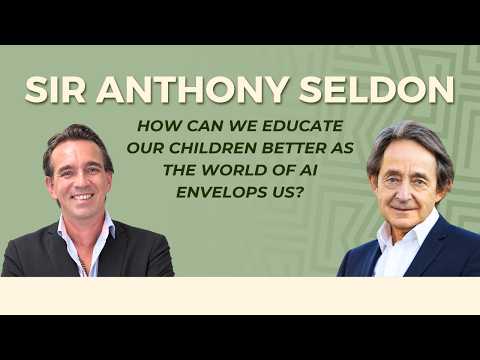
How Can We Educate Our Children Better As the World of AI Envelops Us? With Sir Anthony Seldon
 Money Maze Podcast
· · Guests: Peter Frankopan, Anthony Seldon
Summary
The conversation argues that AI is forcing a once-in-a-generation rethink of schooling, because the current system mainly rewards exam performance rather than real education. The guest says education should be about “leading out” the whole person: curiosity, character, creativity, judgment, social skills, and the ability to learn independently. He says schools have become too narrow, too standardized, and too detached from the human needs that matter in work and life.
He is strongly pro-AI as a tool for personalized learning. In his view, AI can adapt to each child’s pace, identify strengths and weaknesses in real time, and help students in places where specialist teachers are scarce. But he warns that the same technology can deepen psychological harm if children are raised by bots, overexposed to screens, and deprived of secure human attachment, resilience, and belonging.
The guest says governments, including Britain’s, are moving too slowly and should learn from countries such as the UAE, Australia, British Columbia, Germany, Brazil, Uruguay, South Africa, China, and Finland. He backs the OECD’s shift toward a “human flourishing” model that emphasizes understanding, agency, ethics, appreciation, and adaptive problem solving, and he argues that schools should restore adventure, debate, and real-world challenge to education.
Key takeaways
- The guest says AI should be used to personalize learning, not to replace human attachment or the broader purpose of education.
- He argues Britain’s exam-heavy system is failing young people by producing weaker curiosity, resilience, and social skills.
- He says the OECD’s human flourishing model is a major pivot because it values understanding, agency, ethics, appreciation, and adaptive problem solving.
- He warns that AI and social media can intensify mental distress if children are overprotected in the real world and underprotected online.
- He praises high-expectation schools like Katharine Birbalsingh’s, but says their model is hard to scale and not yet proven long term.
Notable quotes
“Education comes from the Latin word. It means leading out, drawing out, uh and educating, honing all the the the the skills, qualities uh that lie within human beings”
“we cannot slow down or stop AI anywhere in the world. So, Scandinavia's tried it, Australia's tried it”
“AI is extraordinarily acute at personalizing itself onto the young person”
“The downside is what you measure, you throw all your resources into”
“we overprotected young people in the real world. We didn't let them climb trees cuz they might have fallen off or or go on walks because they might get lost”
How the episode opens
The episode we're about to share was from a panel at the Money Maze Alligators Summit, which we just held at the London Stock Exchange. Over those two days, we had some fascinating conversations, but this one stood out when we asked participants, guests, which they enjoyed the most. The topic was simple.
How do we educate our children in the world of AI? But of course, that covers up all the complexities and odd behaviors and challenges that we as parents, uncles, aunts, and children themselves are having to deal with. And to address this topic, we chose two people who we thought were really well suited.
Sir Anthony Seldon, one of Britain's great educationists, former guest on the show, and Peter Frankopan, head of global history at Oxford, who was able to ask the questions that I might not have been able to think about and elicited the answers that I think you'll really enjoy. So, here we go.
What Money Maze has done is incredible. So, um it's fantastic for your community, for the podcast, to reach younger people. I mean, I know that I know that was key to when you started this, was to try to get young people involved.
And so, to have a chance to talk about AI, the next generation, um it's fantastic. The community you've built is fantastic. Uh so, thank you for inviting me, and thank you for having me on today twice.
Um how many of you, before we start, are old Wellingtonians? Okay.
The question is The question is how many wish they had been. Uh the answer is all of them, but they're too ashamed to put their hands up. — Uh great. Well, I'm going to go straight in because uh we've got time for some discussion and then for some from Q&A.
From the episode’s captions: roughly the first two minutes, lightly cleaned. Keep watching on YouTube →
Topics
- ai in education
- education reform
- human connection
- mental health resilience
- lessons from social media
Companies and tickers mentioned
- JPM
- J.P. Morgan Asset Management
- IFM Investors
- World Gold Council
- LSEG
- Bloomberg
Watch the episode
Summary, takeaways and quote selection by Octagon. Quotes are short excerpts; the full conversation is in the episode.
More from Money Maze Podcast
-
 The Region That Defies Prediction - Simon Sebag Montefiore on The Middle East
-
 Fraud, Fees & Fake Degrees! Where's the Alternatives Allocation Headed? John Claisse, CEO, Albourne
-
 Come Fly with Me! Delta Air Lines, The World’s Biggest Airline - With CEO, Ed Bastian.
-
 AI and the Investment Edge: Enhancement, Replacement, or Reinvention?
-
 A New Era: Richard Oldfield on the Future of Schroders and the Asset Management industry
-
 The Golden Age of Absolute Returns? With Davidson Kempner’s Managing Partner and CIO, Tony Yosel...
Money Maze Podcast, this episode and its artwork belong to Money Maze Podcast. Octagon is not affiliated with the show; this page is an independent summary.
