
Episode summary
What Do You Call an Institution That Can Play Anywhere in the Capital Stack? With Julian Salisbury
 Money Maze Podcast
· · 52 min · Guests: Julian Salisbury
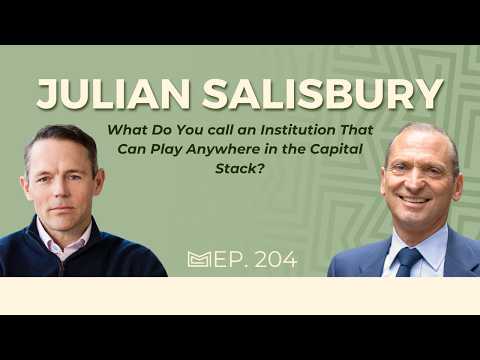
Summary
Julian Salisbury argues that Sixth Street’s edge is a culture and structure built to move across the capital stack, not a narrow product set. The firm was designed around a “one team” model that can pivot quickly between equity, debt, control, and transitional financing, which he says lets it act on dislocations anywhere in the world. He contrasts that with more siloed firms and says the flexibility is especially valuable when capital is scarce or markets are dislocated.
He also explains how Sixth Street thinks about underwriting and growth. Rather than preferring one sector, the firm looks for situations where capital is hard to access or where a business needs a transitional financing solution before moving to more traditional markets. He points to examples like Airbnb, data centers, and European credit opportunities, and says the firm’s model is to start with broad capital and then raise dedicated vehicles only when a theme proves enduring and large enough.
Salisbury is cautious on private markets growth even while defending their role. He says the industry has benefited from an illiquidity and complexity premium, but that premium will compress as private assets become more scalable and more accessible to retail investors. The best current opportunities, in his view, are in stressed balance sheets, asset-based finance, and other complex situations where patient capital can help companies delever, refinance, or grow back into the market.
Key takeaways
- Salisbury says Sixth Street is built to be indifferent to where it sits in the capital stack, so it can move from lending to equity when the opportunity changes.
- He argues the best opportunities are often transitional moments where a company or asset has less capital available than it needs, rather than simple growth stories.
- He says the current complexity premium is strongest in stock private assets, where owners need capital to delever or bridge refinancing gaps.
- Salisbury expects private-market alpha to compress over time as more capital chases simpler strategies and as retail access expands.
- He says Europe still offers more opportunity than the US in some areas because public markets are less liquid and competition is lower.
Notable quotes
“If as an investing organization you are indifferent to where you invest in the capital stack of a company, what type of investor does that make you”
“The original vision stands today. It's really to have the dedicated team, platforms, capabilities, culture and funding partners to be able to pursue any investment theme, any dislocation anywhere around the world”
“Part of the reason you've been able to generate those historic returns is because of the you were getting paid a complexity premium, an illiquidity premium”
How the episode opens
I'd say from day one it was very intentional. The firm was built with this mindset of one team, one group of individuals who were constantly communicating with each other that would move together. And this is what I meant about having the culture to be able to be a true multiasset class, the best of the culture to be able to move from one place to another rather than having siloed teams of individuals who would occasionally connect the dots at the top of the house.
If as an investing organization you are indifferent to where you invest in the capital stack of a company, what type of investor does that make you? Answers might be a generalist. Answer number two might be a specialist situation firm.
And answer three is difficult to define and thus to allocate to as a pension consultant or traditional allocator. But if the creators of this investing entity spent much of their lives at Goldman Sachs and were drawn from the proprietary investing groups there, especially special situations, the answer becomes clearer and might in part explain how they've grown since inception in ' 09 to manage $125 billion today. So to discuss opportunities, priorities, capital deployment, and why Sixth Street would argue they're different, I'm pleased to welcome Julian Ssbury, partner, co-president.
Julian, welcome.
Great to be here. So I need to step back for a minute or two because as we do our research we look at the journey people have taken and I saw Lurra University undergrad and postgrad. Now for those watching and listening from abroad lurb is the preeminent sports university in the UK.
So I was intrigued as to and we just interviewed Carl Clark of Beta Technologies who's running the largest air electric aircraft company in the world and he was a an ice hockey player, a US national before he then became, you know, CEO of this business.
From the episode’s captions: roughly the first two minutes, lightly cleaned. Keep watching on YouTube →
Topics
- one-team culture
- merchant banking evolution
- private markets liquidity
- direct lending complexity premium
- risk calibration in private fund structures
Companies and tickers mentioned
- GS
- Sixth Street
- Goldman Sachs
Watch the episode
Summary, takeaways and quote selection by Octagon. Quotes are short excerpts; the full conversation is in the episode.
More from Money Maze Podcast
-
 Why, Where and How? CPP Investments' Heather Tobin on Building Large Hedge Fund Portfolios
-
 How Can We Educate Our Children Better As the World of AI Envelops Us? With Sir Anthony Seldon
-
 The Black Box Dilemma: Who Controls What AI Can Say? With CTGT’s Founder, Cyril Gorlla
-
 The Region That Defies Prediction - Simon Sebag Montefiore on The Middle East
-
 Fraud, Fees & Fake Degrees! Where's the Alternatives Allocation Headed? John Claisse, CEO, Albourne
-
 Come Fly with Me! Delta Air Lines, The World’s Biggest Airline - With CEO, Ed Bastian.
Money Maze Podcast, this episode and its artwork belong to Money Maze Podcast. Octagon is not affiliated with the show; this page is an independent summary.
