
Episode summary
The Investment Office E15: To DCA or Not to DCA — That Is the Question
 The Investment Office
· · Hosts: Matt, Wendy

Summary
The episode weighs whether a large cash pool should be invested all at once or phased in over time, using the Mother Cabrini Health Foundation as the example. The foundation began in 2019 with $3.2 billion, mostly in treasury bills, and the investment team knew it ultimately wanted more than $1 billion in public equities. The argument for lump sum was straightforward: over long periods, public markets have historically risen, so the highest expected value often comes from investing immediately.
The counterargument was practical rather than theoretical. A prolonged drawdown soon after deployment could severely impair a new portfolio, and that path risk mattered more than chasing the best average outcome. The host and the guest stressed that dollar-cost averaging is not market timing; it is a disciplined way to invest now while reducing exposure to an unlucky entry point. They also noted that individual investors may struggle more with the emotional side of that decision, even if professional investors are not immune to the same biases.
The discussion then shifted to private markets, where pacing matters differently because opportunities are not interchangeable across years. For Cabrini, the private portfolio was built over roughly seven years, using secondary funds to gain early diversification and reduce the J-curve before adding primary commitments to target managers.
Key takeaways
- The guest said lump sum usually has the highest expected value in public equities, and cited a 1980-to-present exercise where it won most of the time.
- At Mother Cabrini, the team chose to phase in more than $1 billion of public equity exposure over roughly six months to a year because a GFC-like drawdown would have been too damaging.
- The guest framed dollar-cost averaging as risk management, not market timing, and argued that investors should not wait for a supposedly better future entry point.
- The guest said institutional investors are still emotional, but formal process and experience can help them override fear and treat drawdowns as opportunity.
- Private markets were handled differently: Cabrini modeled about seven years of deployment to achieve vintage-year and manager diversification, starting with secondary funds to reduce the J-curve.
Notable quotes
“the highest expected value decision, meaning what is the thing that is going to give you the highest probability of the greatest return, that is almost certainly going to be put all your dollars at once into the investment”
“what we couldn't accept, what was not for us an acceptable outcome was if we invested all at once and then we then experienced a return path, a return series that looked like the GFC”
“what I'm not saying is that an investor should time the market, right? That actually is very explicitly what I'm not saying here”
“We're not robots, right? We individually are just at times as concerned and unsettled and our feelings about the market may be similar to how individual investors might feel”
“the pacing that we looked at that made the most sense for us as an institution and would get us to a place of reasonable diversification across the portfolio would take us about seven years”
How the episode opens
We're not robots, right? We individually are just at times as concerned and unsettled and our feelings about the market may be similar to how individual investors might feel. But I do agree that we have maybe a better ability to override those feelings in the sense that we also can overlay our professional experience.
Hi, this is Matt Pauker with Wendy Li, our co-founders at Ivy Invest, and welcome to this week's episode of the Investment Office. As always, we're here to discuss the latest in private markets, alternative assets, and institutional investing. This week I wanted to kind of key off your most recent substack newsletter article, Wendy, which I think was really interesting in that you talked about a topic that a lot of individual investors face, but you faced in a kind of unique way in your last institution at the Mother Cabrini Health Foundation, which is this question of, you've just got a big lump sum of money in cash.
Do you invest it all at once, or do you dollar cost average over time? And for an individual, this might be the kind of question they face when, for example, they got a bonus at the end of the year, or maybe they inherited some money. You faced it in a similar, but obviously a much larger scale way at Mother Cabrini, $3.5 billion, I think you mentioned in the post that you started with at the outset of that foundation.
So would love just maybe you can give a quick recap of the situation at Mother Cabrini and how you approached it, and then we can dive into some of the more nuances of both the math, but also to your point, I think the psychology of this question. Yes, that's right. So the Mother Cabrini Health Foundation started as a brand new foundation back in 2019.
From the episode’s captions: roughly the first two minutes, lightly cleaned. Keep watching on YouTube →
Topics
- lump sum vs dca
- institutional investing
- market timing
- private markets diversification
- year-end bonus windfall
Watch the episode
Watch “The Investment Office E15: To DCA or Not to DCA — That Is the Question” on YouTube
Summary, takeaways and quote selection by Octagon. Quotes are short excerpts; the full conversation is in the episode.
More from The Investment Office
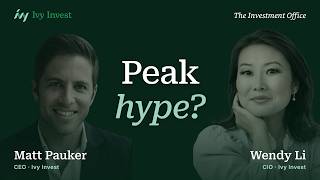


The Investment Office, this episode and its artwork belong to Ivy Invest. Octagon is not affiliated with the show; this page is an independent summary.
