
Episode summary
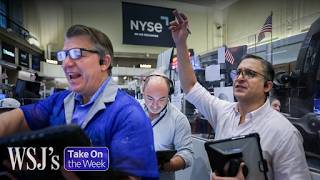
How Emerging-Market Bonds Can Hedge Against U.S. Market Volatility | WSJ’s Take On the Week
 The Journal
· · Hosts: Telis Demos, Miriam Gottfried · Guests: Eric Fine

Summary
The episode argues that recent oil spikes and the Iran conflict are best read through market pricing: oil around $90 suggests investors do not expect a full loss of production, but do expect a partial disruption and a messy, longer-running conflict. The hosts also preview earnings from ConAgra Brands, Cal-Maine Foods and McCormick, saying food producers are under pressure because inflation has outlasted their ability to pass higher costs through to consumers.
The main discussion is with Eric Fine of VanEck, who says traditional U.S. bond assumptions have broken down. He argues that fiscal dominance, not just inflation, is now the key lens, and that developed markets like the U.S., Europe, the UK and Japan increasingly resemble the crisis-prone emerging markets of the past. By contrast, he says many emerging-market sovereigns now offer higher carry, lower inflation risk and better diversification, especially commodity exporters such as Brazil and Colombia.
Fine’s core claim is that investors are often owning the wrong bonds. He says U.S. Treasurys and classic 60/40 portfolios have not provided the safe-haven protection investors expect, while some emerging-market debt has offered better yields and, in his view, a more stable risk/reward profile.
Key takeaways
- The hosts say oil near $90 implies the market is pricing in partial disruption, not a full cutoff of 16 million barrels a day.
- ConAgra Brands, Cal-Maine Foods and McCormick may face more margin pressure if consumers resist further price increases.
- Eric Fine says the key bond framework is fiscal dominance, with developed markets now showing the kind of bond-stock correlation that used to define emerging markets.
- Fine argues EM government bonds have higher carry, around 7% in his framework, while many developed-market bonds offer only 3% to 4%.
- Fine says commodity exporters such as Brazil, Colombia and Malaysia can benefit when oil and other commodity prices stay elevated.
Notable quotes
“the market is saying, well, we're not going to lose all 16 barrels of production. We're going to lose some of that”
“Bonds, the way most of your viewers think of them have been bad. Last 5 years are down like”
“when we present we've been using the lens of fiscal dominance to describe the world namely avoid places with excessive government debt that is the developed markets”
“what happens when we have our crisis, right? Often the the opposite”
How the episode opens
Hi, Telis. — Hi, Miriam. — So, we've had episodes about international stocks on this show and we've had episodes about US bonds. — Yeah. Where are you going with this? — In light of current events, um we feel that it's time this week to talk about something very exciting, which is international bonds.
Oh, connecting the dots. — Yes. This has been the missing link in everyone's portfolio, which we're about to find out. But first, we want to check in on the price of oil and what else the market might be thinking about this upcoming week.
I just want to remind everybody of what we talked about on a previous episode with Natasha Kova from JP Morgan about how to think about the price of oil because I think that really like
It's just a good framework I think. So, what she said was was that every million barrels of production that are missing kind of translates into like $4 in the price of oil, right? So her math was that if there are going to be 16 million barrels of oil that are a day that are not being produced, then that means that, you know, 16* 4 is $64, which brought you from the original oil price before all of this, which was in the $60 range, to the $120 range, you know, where things have topped out.
Um, how so the fact that we're at 90ish basically means that the market is saying, well, we're not going to lose all 16 barrels of production. We're going to lose some of that. That is, I think, the framework for thinking about what the price of oil is telling us about kind of the state of the conflict
And people's expectations for the duration of the conflict, but also how certain nations might be able to independently negotiate with Iran to have oil pass through the strait as Natasha talked about — Or in the sort of strange moment of the US kind of letting Iran sell some oil uh partly in order to help kind of calm the oil market.
From the episode’s captions: roughly the first two minutes, lightly cleaned. Keep watching on YouTube →
Topics
- emerging-market bonds
- u.s. treasuries
- oil vs gold hedges
- duration and market volatility
- emerging market fiscal dominance
Companies and tickers mentioned
- CAG
- CALM
- MKC
- ConAgra Brands
- Cal-Maine Foods
- McCormick
- VanEck
Watch the episode
Summary, takeaways and quote selection by Octagon. Quotes are short excerpts; the full conversation is in the episode.
More from The Journal
-
 Nvidia Built Its AI Empire on Jensen Huang. What Happens Without Him? | WSJ Tech News Briefing
-
 What Happens When Everyday Investors Buy the Dip? | WSJ’s Take On the Week
-
 How North Korean Hackers Pulled Off a $6.3 Billion Crypto Heist
-
 Why Apollo’s CEO is Betting Billions on a 'Global Industrial Renaissance' | WSJ Leadership Institute
-
 Tech Stocks and AI Bonds Are Tumbling. Is the AI Trade in Trouble? | WSJ’s Take On the Week
-
 Why Anthropic Needs $100B More to Keep Growing | WSJ Tech News Briefing
The Journal, this episode and its artwork belong to The Wall Street Journal & Spotify Studios. Octagon is not affiliated with the show; this page is an independent summary.
