
Episode summary
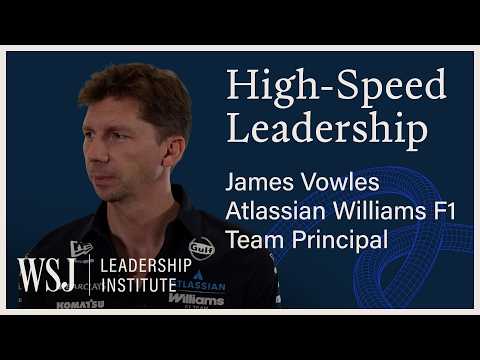
James Vowles on Rebuilding Atlassian Williams F1 Team | WSJ Leadership Institute
 The Journal
· · Hosts: Alan Murray · Guests: James Vowles
Summary
James Vowles says Atlassian Williams F1 is in a long rebuild, with championship contention targeted for 2030 and 2028 meant to be the year the team is viewed as a serious threat. He argues that the sport’s two-week cycle provides a blunt performance metronome, but that the real drivers of results are the decisions, people, and systems put in place roughly three years earlier.
Vowles describes Williams as a once-glorious team that had become too dependent on passion and a small number of top leaders. His response has been to replace a culture of improvisation with process, structure, and accountability, even if that means making painful organizational changes. He says the team needs “brutal honesty,” no politics, and leaders who surface problems early rather than hide them.
He also explains how he won Carlos Sainz over by laying out a clear three-year plan and proving Williams would execute it. On performance, Vowles says the car matters more than the driver, but the driver is still the team’s most powerful sensor, especially with 55,000 live data channels. AI, he says, is useful only after the data foundation is clean, and Williams is still early in that process.
Key takeaways
- Vowles says Williams is building toward a 2030 championship target, with 2028 meant to signal that the team is a serious threat.
- He argues that Formula 1 results mostly reflect decisions made about three years earlier, not just this season’s choices.
- Vowles says the biggest fix at Williams was replacing a passion-only operation with process, systems, tools, and clearer leadership.
- He says Carlos Sainz joined because Williams showed honesty, transparency, and a credible multi-year plan.
- Vowles says AI is useful for simulation and strategy only after the team has clean, structured data.
Notable quotes
“The work you've done typically three years ago is actually what's driving your results today”
“2030 is our um target for winning championships”
“No processor, no system, no structure, no tools. Driven by human beings that wanted that car to be built and wanted to get out the door”
“In addition to that, the driver is the most powerful sensor you have in the car”
How the episode opens
The work you've done typically three years ago is actually what's driving your results today. And if you lose sight of that and get too drawn into the short term, you're going to end up just going backwards. In the last few years, I've become a fan of F1 in part because I think it's an incredible cauldron for testing leadership and leadership skills.
It involves great teamwork. It involves high-end engineering. It involves intense use of massive amounts of data and and particularly speed.
constantly adapting to changing circumstances. That's why I'm very excited about the conversation we're having uh today on leaders. A little different than the usual one.
We've got James Vol, who is team principal at at the Atlassian Williams team.
That's correct. Well done. — You took you took over three years ago at kind of a low point. We'll talk about that. — Um but thank you very much for taking the time to be with us. — Oh, you're welcome. And and that's a fantastic intro cuz actually you've summarized incredibly well why I fell in love with the sport. It is a high octane continuously moving um technology product that's just on a world stage
And split-second decisions that have to be made by you and your colleagues. — Indeed these days less so by myself that used to be my former job but very much entrusted into individuals but you are spot on. most um when you're live in an event, a number of decisions are taking place within a second or two.
Yeah. So, I want to talk first about where you are right now. I I watched a video you put out just a few days ago about your performance in the first half of this year.
From the episode’s captions: roughly the first two minutes, lightly cleaned. Keep watching on YouTube →
Topics
- formula one team turnaround
- leadership and culture
- continuous improvement
- driver recruitment
- data and performance sensors
Companies and tickers mentioned
- TEAM
- Atlassian
- Williams Racing
Watch the episode
Watch “James Vowles on Rebuilding Atlassian Williams F1 Team | WSJ Leadership Institute” on YouTube
Summary, takeaways and quote selection by Octagon. Quotes are short excerpts; the full conversation is in the episode.
More from The Journal
-
 Nvidia Built Its AI Empire on Jensen Huang. What Happens Without Him? | WSJ Tech News Briefing
-
 What Happens When Everyday Investors Buy the Dip? | WSJ’s Take On the Week
-
 How North Korean Hackers Pulled Off a $6.3 Billion Crypto Heist
-
 Why Apollo’s CEO is Betting Billions on a 'Global Industrial Renaissance' | WSJ Leadership Institute
-
 Tech Stocks and AI Bonds Are Tumbling. Is the AI Trade in Trouble? | WSJ’s Take On the Week
-
 Why Anthropic Needs $100B More to Keep Growing | WSJ Tech News Briefing
The Journal, this episode and its artwork belong to The Wall Street Journal & Spotify Studios. Octagon is not affiliated with the show; this page is an independent summary.
