
Episode summary
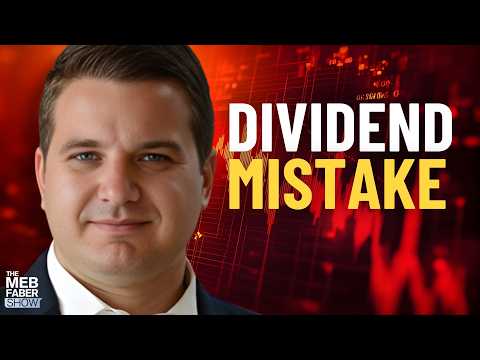
Sam Hartzmark: The Dividend Mistake Most Investors Still Make
 The Meb Faber Show
· · 1 hr 3 min · Hosts: Meb Faber · Guests: Samuel Hartzmark
Summary
Samuel Hartzmark argues that many investors still misunderstand dividends at the most basic level: they often treat a payout as free cash instead of recognizing that the stock price typically drops by the dividend amount. He calls that error the “free dividends fallacy,” and says it leads investors to confuse income with total return, overconsume distributions, and chase products marketed around yield.
The discussion expands into how dividend demand can distort prices. Hartzmark says investors pile into dividend stocks when interest rates are low or when income is fashionable, which can inflate valuations and hurt subsequent returns. He also argues that funds can “juice” yields by trading around ex-dividend dates, which may raise inflows but often raises taxes and lowers performance. By contrast, buybacks are more flexible and in theory closer to how firms should return cash, though they are often less understood by the public.
The episode closes with broader implications for investing behavior: total return should be the starting point, taxable investors generally should prefer to avoid unnecessary distributions, and even market indexes can mislead when they show price returns instead of total returns. Hartzmark also briefly touches on sustainable investing and prediction markets, where he says popular moral intuitions and attention flows can diverge from actual economic effects and forecasting accuracy.
Key takeaways
- Hartzmark says the core error is treating dividends as free money, when the stock price usually falls by roughly the payout amount.
- He argues that dividend demand rises when investors want income, especially in low-rate environments, and that can inflate prices and depress later returns.
- He says some mutual funds “juice” dividend yields by trading around payouts, which can attract flows but often creates tax drag and weaker performance.
- He says investors should focus on total return, not headline yield, because dividends, price changes, and taxes all matter together.
- On sustainable investing, Hartzmark says divesting from controversial stocks may satisfy moral preferences but does not necessarily change corporate behavior.
- He says prediction markets can be good at forecasting but may get less accurate when attention and unsophisticated money surge in.
Notable quotes
“we call this mistake the free dividends fallacy because the first thing is like clearly this isn't true”
“all of a sudden it can become quite costly in terms of you're really increasing your taxable issues”
“It turns out this leads to big return predictability. So just in terms of you can think about what's going to happen”
How the episode opens
Welcome to the Met Favor Show, where the focus is on helping you grow and preserve your wealth. Join us as we discuss the craft of investing and uncover new and profitable ideas, all to help you grow wealthier and wiser. Better investing starts here.
Met Faber is the co-founder and chief investment officer at Camry Investment Management. Due to industry regulations, he will not discuss any of Camry's funds on this podcast. All opinions expressed by podcast participants are solely their own opinions and do not reflect the opinion of Cambria Investment Management or its affiliates. For more information, visit cambrianvestments.com.
Today's show is sponsored by Cambria. Do you hold legacy investment positions with significant gains? What if you could transition into an ETF without facing a large tax bill?
You can with a 351 ETF exchange. Here's how it works. Investors contribute stocks or other securities to a newly formed ETF in exchange for ETF shares as long as the special rules and diversification requirements are met.
The investor is essentially able to seed the launch of the ETF without an immediate taxable event. Because ETFs typically don't distribute any capital gains, investors don't face taxes until they sell their ETF shares, allowing for better control over the timing of the tax event. Are you ready to explore a 351 ETF exchange?
Visit cambriafunds.com/351 to take the next step in innovative taxsavvy investing with Cambria today. Camrian investment management LP Camri is a registered investment adviser. The information set forth herein is for informationational purposes only and does not constitute financial investment, tax, or legal advice.
Past performance does not guarantee future results. All investments are subject to risk including the risk of loss of principal. Welcome back everybody.
Today we got another awesome episode. My guest is Sam Hartzmark, professor of the Seidner Department of Finance at Boston College Carol School of Management.
From the episode’s captions: roughly the first two minutes, lightly cleaned. Keep watching on YouTube →
Topics
- dividend misconceptions
- free dividends fallacy
- dividend vs buybacks
- total return
- prediction markets
Watch the episode
Watch “Sam Hartzmark: The Dividend Mistake Most Investors Still Make” on YouTube
Summary, takeaways and quote selection by Octagon. Quotes are short excerpts; the full conversation is in the episode.
More from The Meb Faber Show
-
 How to Get Out of a Bubble Without Selling Too Early: Jeff deGraaf Explains
-
 The AI Narrative Is Hiding a Much Bigger Problem
-
 Vincent Deluard: Why the Stock Market Is More Fragile Than You Think
-
 It's a Bubble. So Why Is Citi's Dirk Willer Buying?
-
 36% of Your Portfolio Just Disappeared In the Last 30 Years (Andrew Ang Explains How)
-
 The Asset That Could Be the Market’s Biggest Mispricing
The Meb Faber Show, this episode and its artwork belong to The Idea Farm. Octagon is not affiliated with the show; this page is an independent summary.
