
Episode summary
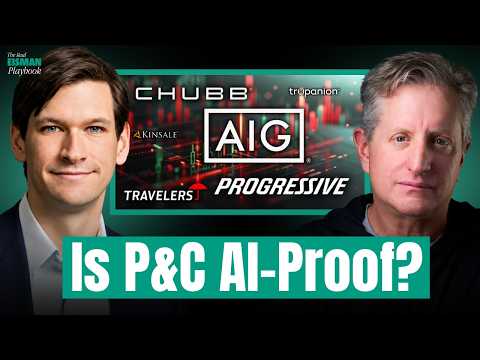
P&C Stocks Worth Owning: The AI Hedge with Ryan Tunis | The Real Eisman Playbook Episode 74
 The Real Eisman Playbook
· · 48 min · Hosts: Steve Eisman · Guests: Ryan Tunis
Summary
Property and casualty insurance is presented as a sector that cycles on its own rhythm rather than with the broader economy. Ryan Tunis breaks the industry into personal lines, commercial lines, reinsurance, and brokers, and argues that distribution and reserving discipline matter as much as headline growth. He is most negative on personal lines, where auto pricing has softened after outsized rate increases and where driver-assistance technology is reducing collision frequency and shrinking the long-term premium pool.
On commercial lines, Ryan says the market is moving from a long hard market into a soft cycle, which favors companies with stronger middle-market franchises and conservative reserves. That is why he prefers Travelers over Chubb, while still acknowledging both are expensive. He also likes AIG as a self-help story: the stock trades near book value, the company has simplified materially, and he expects execution around expense saves and reinsurance synergies to matter more than the cycle.
He is less concerned about AI disrupting insurance brokers than the market is. In his view, brokers remain embedded in complex commercial placements and claims handling. He is more cautious on Trupanion, where valuation and weak unit economics remain problems, and sees Kinsale as a good underwriter but one that could face headwinds as business shifts back to admitted carriers in a soft market.
Key takeaways
- Ryan Tunis is cautious on personal lines because auto rate increases have already outrun loss trends and ADAS is reducing accident frequency.
- Ryan says commercial lines are entering a soft market, which should pressure growth and margins across the group.
- Ryan prefers Travelers over Chubb because Travelers has more middle-market exposure and a stronger reserve position.
- Ryan calls AIG the most interesting self-help story, saying it trades near book value and has meaningful expense-save and reinsurance-synergy upside.
- Ryan thinks AI is a limited threat to insurance brokers because complex commercial placements and claims disputes still require human intermediaries.
- Ryan views Kinsale as a good underwriter but warns that a soft market could pull business back into the admitted market and pressure growth.
Notable quotes
“I think the biggest reason it's happened is again you have two really really good carriers”
“I think we'll probably be having a conversation just like this through the end of 2027 if I had to guess”
“we've seen the worst of what the pricing environment is going to do to them”
“I think that the early soft market playbook, the the companies that are the least the the first kind of blush thing that matters”
“I think there's more franchise value now than there's been because there's been so much consolidation”
How the episode opens
Hi, this is Steve Eisman and welcome to another episode of the real Eisman playbook. So, every group has within it subsectors and every group within the subsectors has growth, some are cyclical, some are stable. So, if you were to divide up the entire financial services sectors, you would have divide it this way.
the big banks, the regional banks, some of the trading companies like NASDAQ and ICE, asset managers, alternative asset managers, specialty finance, and then you would get life insurance and property and casualty insurance. Of all the sectors within financials, property and casualty insurance is unique and a world unto itself. Yes, it is cyclical, but it's not cyclical with the economy.
Its pricing cycles go according to its own rhythm. And so, as a result, during periods where people want a lot of growth in their portfolios, they're not going to own property and casualty stocks. But in periods where you're looking for something more stable, people are going to own property and casualty stocks.
So, we're going to explore all this with Ryan Tunis, who is the PNC analyst at Caner, and we're going to do this very comprehensively. Uh, and afterwards, I'll be back with some lessons learned. Hi, this is Steve Eisman and welcome to another episode of the real Eisman playbook.
So today we have as a guest Ryan Tunis, property and casualty insurance analyst of Kenter. Welcome Ryan.
Thanks Steve. Uh pleasure to be here. — Thank you. So we've never done anything in the property and casualty sector. So I'm going to take this as an opportunity really to do a deep dive with you. So before we even get to any specific companies and what you like and what you don't like and we'll get to that.
From the episode’s captions: roughly the first two minutes, lightly cleaned. Keep watching on YouTube →
Topics
- p&c personal lines
- ai risk and driver assistance
- commercial lines soft cycle
- reinsurance
- insurance brokers and ai risk
Companies and tickers mentioned
- AIG
- CB
- TRUP
- KNSL
- Cantor
- AIG
- Chubb
- Trupanion
- Kinsale
Watch the episode
Summary, takeaways and quote selection by Octagon. Quotes are short excerpts; the full conversation is in the episode.
More from The Real Eisman Playbook
-
 The AI Debate is No Longer Boom vs Bust: Why It’s Time to Go Back to Stock Picking | The Weekly Wrap
-
 The Midterms Have Changed the AI Narrative: S&P Down 4.4%, Nasdaq Down 5.5% | The Weekly Wrap
-
 Why Young Americans Feel Locked Out with the Lemonade Stand Podcast | The Real Eisman Playbook Ep 82
-
 Anthropic’s Growth is Slowing: Is AI Capex Next? | The Weekly Wrap
-
 Inflation, The Deficit & Why the Dollar Stays King with Benn Steil | The Real Eisman Playbook Ep 81
-
 AI Narrative Switched, Debt Yields Spike | The Weekly Wrap
The Real Eisman Playbook, this episode and its artwork belong to Steve Eisman. Octagon is not affiliated with the show; this page is an independent summary.
