
Episode summary
The High Stakes of SNAP: Inside America’s Food Safety Net
 Wall Street Week
· · 12 min
Summary
SNAP, formerly food stamps, is shown as both a household lifeline and a major economic engine. The program helps families buy groceries, but the episode argues that the money also ripples through supermarkets, suppliers, farmers and rural communities, with an estimated $1.50 of economic activity for every dollar spent. For many recipients, SNAP covers only part of the month, and food banks like Feeding Westchester fill the gap when benefits run out.
The central warning is that Congress is preparing the largest SNAP reductions in the program’s history, with the One Big Beautiful Bill set to cut more than $186 billion over the next decade. Grocers, food banks and farmers are bracing for weaker demand and more food insecurity, especially after last November’s government shutdown showed how quickly delays can stress families and strain pantries.
The episode also ties SNAP to the Farm Bill. Roughly 80% of that bill is nutrition spending, and farmers say the political coalition around it depends on linking urban anti-hunger priorities with rural support programs. Several speakers argue that splitting those interests would endanger both food assistance and farm safety nets.
Key takeaways
- The episode says every dollar of SNAP spending generates about $1.50 in economic activity, making the program a broad economic support system, not just an anti-hunger benefit.
- The One Big Beautiful Bill is expected to cut SNAP by more than $186 billion over the next decade, prompting food banks and grocers to prepare for more demand and less support.
- A food-industry perspective in the episode is that SNAP customers often shop more frequently and depend heavily on grocery stores because eating out costs 4.3 times more than eating at home.
- North Dakota farmers argue that SNAP is politically tied to the Farm Bill, and that removing nutrition programs from the coalition could weaken support for both farmers and consumers.
- The episode says rural counties are heavily exposed: many of the top SNAP-dependent counties are not metro areas, and some rural communities are 30 miles from the nearest grocery store.
Notable quotes
“every dollar of SNAP spending generates about $1.50 in economic activity”
“the largest reductions in the SNAP program's history”
“-So food banking is about a pounds game. So we often will talk in pounds”
“Roughly 80% of the Farm Bill is nutrition programs, mainly SNAP”
“-The farm economy is in really tough shape. Most farmers are losing money every acre of crop that they plant and harvest”
How the episode opens
The Supplemental Nutrition Assistance Program, formerly known as food stamps, was created to help those who could not afford to feed their families. But over time, it's become harder to do that good, even as it's turned into an important part of the larger industry that provides food to Americans of all income levels. -You need help, and we're going to help you.
We don't ask for specific details. If you show a need, we're going to be there. Westin: This may look like a lot of moving parts.
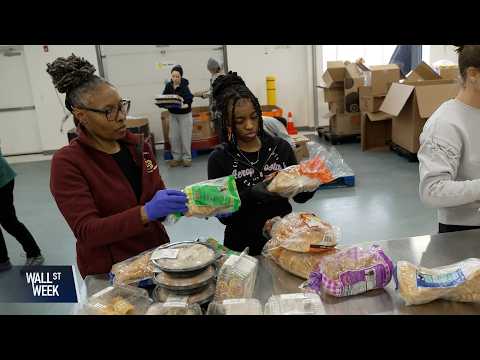
-Watch your backs, everybody, please. Westin: It's actually a well-oiled operation of volunteers at Feeding Westchester, sorting and packing food for their hungry neighbors. -In this space, we have a variety of things.
Westin: Tami Wilson is at the helm. You are feeding Westchester. -Correct.
Westin: And most of us, I think, think of Westchester County as being relatively affluent. -Absolutely. So Westchester having need was a shocker to me.
You know, even affluent counties have food insecurity, and food insecurity can look like anyone. Westin: Wilson says SNAP can only get you so far. For most families, the program provides only enough food for the first two or three weeks in the month.
After that, they turn to food banks for help. But people may be getting even less of the food they need with revisions to SNAP, hotly debated in the so-called One Big Beautiful Bill, about to come into effect. -Cuts, waste, fraud, and abuse in government programs like SNAP and Medicaid.
Westin: Although the target of the program has always been helping Americans who can't afford food, the tens of billions of dollars it injects into the economy each year have wide-ranging impacts, spreading all the way from grocers... -It's our job to make sure that, regardless of that person's budget, they can still get healthy, nutritious food.
From the episode’s captions: roughly the first two minutes, lightly cleaned. Keep watching on YouTube →
Topics
- snap cuts
- food safety net
- food economy
- farmers and grocers
- working families
Watch the episode
Watch “The High Stakes of SNAP: Inside America’s Food Safety Net” on YouTube
Summary, takeaways and quote selection by Octagon. Quotes are short excerpts; the full conversation is in the episode.
More from Wall Street Week
-
 Wall Street Week | Nvidia Shakeup, Midwest Stadium Bids, Care Work Gap, India’s Wedding Economy
-
 What American Manufacturers Are Telling the Fed about the Economy
-
 Europe’s Welfare State Faces a Reckoning
-
 How the Blue Wave Could Reshape America’s Economy
-
 Inside Alaska’s Oil Paradox
-
 Wall Street Week | Blue Wave Economic Impacts, European Welfare Woes
Wall Street Week, this episode and its artwork belong to Bloomberg. Octagon is not affiliated with the show; this page is an independent summary.
