
Episode summary
Wall Street Week | Examining Trump’s Economy, Takeaways from Corporate & Government Mistakes
 Wall Street Week
· · 57 min · Guests: Jason Furman, Michael Lynton
Summary
Harvard economist Jason Furman argues that President Trump’s economy looks less like a breakout boom than a steady continuation of the prior year: solid growth, a stable unemployment rate, and only modest signs of better productivity. He says tariffs have subtracted from growth and added meaningfully to inflation, especially in goods such as furniture and consumer electronics, while creating uncertainty that can delay investment and push activity overseas. He also says tariff deals and claims that tariffs could replace the income tax are economically overstated, and that any tariff refunds from a legal defeat would be administratively complex but likely owed if the tariffs are ruled illegal.
The episode then turns to Michael Lynton and Josh Steiner, who use their book on mistakes to argue that embarrassment becomes more damaging when people refuse to examine it. Lynton revisits Sony’s decision to make The Interview and the cyberattack that followed, while Steiner reflects on the Whitewater subpoena fight and the cost of turning over his diary. Their point is that mistakes are often context failures, and that pausing to understand the emotional and practical causes can reduce shame and improve judgment.
The final segment looks at Sweden’s modular-housing industry as a possible answer to U.S. housing scarcity. The case for factory-built homes is speed, lower financing costs, and potentially lower prices, but the guests emphasize that regulation, stigma, and cyclical demand still limit how far the model can spread.
Key takeaways
- Jason Furman says Trump’s economy was “perfectly good,” but not a turning point versus 2024, with steady growth and only slight productivity improvement.
- Furman says tariffs have “subtracted a bit from growth and added a meaningful amount to inflation,” especially in consumer goods.
- Jennifer Hillman says if the tariffs are illegal, refunds could total about $88 billion to $100 billion through the end of August, but the process would be cumbersome.
- Michael Lynton says agreeing to make The Interview was the core mistake behind Sony’s crisis, and that the bigger error was refusing to reflect on it afterward.
- Josh Steiner says his Washington mistake was writing sensitive Whitewater-related material in a personal diary and then turning it over under subpoena.
- Swedish factory builders and housing investors say modular construction can cut build time and lower costs, but it is not a silver bullet for affordability.
Notable quotes
“to a first approximation, the year since Donald Trump became president economically was very similar to the year before he was president”
“I think it has subtracted a bit from growth and added a meaningful amount to inflation”
“That's ludicrous. income tax collects over ten trillion dollars over the next decade”
“At the core core, it was agreeing to make the movie The Interview”
“I had written things about Whitewater. And keeping a personal diary in Washington is not necessarily a mistake”
How the episode opens
This is Wall Street Week. I'm David Weston, bringing you stories of capitalism. With all the talk about housing affordability, is there anything we can do to make houses cheaper instead of just helping people pay more?
Our new contributor, Christian Freeland, travels to Sweden to see how it works when we manufacture houses instead of building them. And we all make mistakes, whether we like to admit them or not. Two people well known to Wall Street, Josh Steiner and Michael Linton, have come clean about their big, embarrassing mistakes.
One at Sony Pictures, the other at the Treasury Department. In their new book, From Mistakes to Meaning, they show us why learning from our mistakes is both harder and more important than we thought. But we start with that big story of a duel between the Supreme Court and President Trump.
In a few moments, I will sign a historic executive order instituting reciprocal tariffs on countries throughout the world. Reciprocal. That means they do it to us and we do it to them. — They're all coming in over the next week. We're making deals with all of them. And I I said, "If we don't make a deal, then we're going to tariff them an extra five, six, seven, 8%, whatever the difference is, and we'll take it that way." The Supreme Court's ruling on tariffs is deeply disappointing, and I'm ashamed of certain members of the court, absolutely ashamed for not having the courage to do what's right for our country.
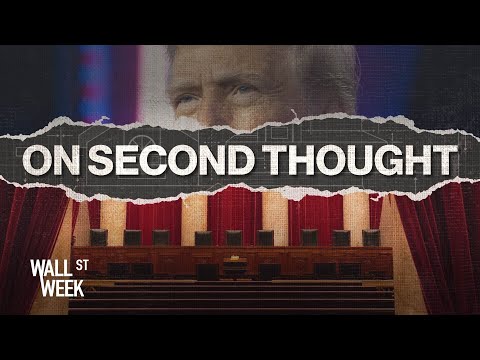
That played out this week when the president gave his State of the Union address with the members of the court. right up front. Jason Ferman of Harvard takes us through the ramifications of the conflict for the economy and what likely comes next.
From the episode’s captions: roughly the first two minutes, lightly cleaned. Keep watching on YouTube →
Topics
- trump economy
- economic growth outlook
- corporate mistakes
- cyberattack leadership
- modular construction affordability
Companies and tickers mentioned
- SONY
- Sony
Watch the episode
Summary, takeaways and quote selection by Octagon. Quotes are short excerpts; the full conversation is in the episode.
More from Wall Street Week
-
 Wall Street Week | Nvidia Shakeup, Midwest Stadium Bids, Care Work Gap, India’s Wedding Economy
-
 What American Manufacturers Are Telling the Fed about the Economy
-
 Europe’s Welfare State Faces a Reckoning
-
 How the Blue Wave Could Reshape America’s Economy
-
 Inside Alaska’s Oil Paradox
-
 Wall Street Week | Blue Wave Economic Impacts, European Welfare Woes
Wall Street Week, this episode and its artwork belong to Bloomberg. Octagon is not affiliated with the show; this page is an independent summary.
