
Episode summary
Why Geothermal Could Be the Energy Breakthrough Everyone Agrees On
 Wall Street Week
· · Hosts: Chrystia Freeland, David Westin
Summary
The episode argues that geothermal could become a rare energy source with broad political and commercial appeal just as AI data centers drive U.S. electricity demand higher. The host frames geothermal as part of an all-of-the-above power mix, and the guest from Ormat says its main advantage is steady 24-7 baseload electricity that does not depend on sun or wind.
A big theme is that enhanced geothermal systems, or EGS, may unlock geothermal in far more places than traditional hot springs. The guest explains that the industry is adapting oil-and-gas drilling and fracking techniques to create fractures in deep rock, potentially allowing hot water to be harvested almost anywhere if operators drill deep enough to reach temperatures around 400 degrees F and higher. Sage Geosystems says its partnership with Ormat could speed a first commercial project by at least a year and a half and aim to flip the switch in 2027.
Investors are already moving in, with next-generation geothermal attracting more than $1.5 billion since 2021. The guest says scaling should improve economics over the next two or three years, but analysts warn that water access, permitting, and grid interconnection remain key risks, especially as projects expand into places like Texas.
Key takeaways
- The host says U.S. power demand is projected to rise by as much as 20% over the next decade, increasing interest in baseload sources like geothermal.
- The guest from Ormat says geothermal's main selling point is 24-7 output, regardless of sun or wind.
- Sage Geosystems says drilling next to Ormat's existing field could speed commercialization by at least 1.5 years and target 2027 startup.
- An analyst says water availability and permitting are the biggest investor risks, especially in new geographies like West Texas.
- The guest says next-generation geothermal has attracted more than $1.5 billion since 2021 and could scale to 400 to 500 megawatts within two or three years.
Notable quotes
“-We operate 24-7, every day, regardless of the sun, regardless of the wind”
“-We need baseload power, and that's the sweet spot that geothermal brings us”
“These are areas where fractures don't extend to the surface and are not abundant enough to allow water to circulate in the subsurface”
“-We're going to be drilling adjacent to their conventional geothermal field and then putting our production, which will be hot water, into an existing power plant”
“-It helps Utah and Nevada that much of the land where EGS geothermal can be developed belongs to the U.S. government, and the Bureau of Land Management is making more of that land available”
How the episode opens
In the quest to feed AI data centers, the U.S. is looking to get more power from just about everywhere it can, from fossil fuels to wind and solar to nuclear. But it turns out that an important part of the puzzle lies beneath our feet.
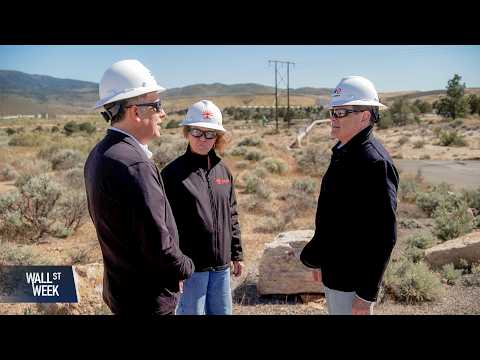
Our colleague Michael McKee takes us into the promising and developing world of geothermal energy. -This is not a gold mine, but in an age of power hungry data centers desperate for energy, it might be even better. So what are we looking at here?
-The Ormat geothermal power plant in Steamboat, where we have to generate electricity. -How much electricity do you produce here? -In the entire Steamboat area, we produce between 80 to 90 megawatts.
-That's enough to power more than 50,000 homes, a small city. Ormat Technologies is one of America's largest geothermal companies, with plants throughout the southwest, the hotbed of the country's geothermal activity. -These are the heat exchangers.
-Doron Blachar is the company's chief executive. -We operate 24-7, every day, regardless of the sun, regardless of the wind. And that's the main benefit that you get from geothermal, a steady 24-7 electricity.
-Led by the hyperscaling of AI installations, electricity demand in the U.S. is projected to grow by as much as 20% over the next decade. Analysts say that means the country needs an all-of-the-above approach to power generation.
And on the list of potential sources, geothermal stands out for being a clean source of constant, or baseload, power. -We need baseload power, and that's the sweet spot that geothermal brings us. You don't have to worry about it if the sun's not shining, if the wind's not blowing.
It allows that baseload that every grid needs to operate. -So far, geothermal is just a small piece of the U.S.
From the episode’s captions: roughly the first two minutes, lightly cleaned. Keep watching on YouTube →
Topics
- geothermal adoption
- data center electricity demand
- oil-and-gas techniques for geothermal
- next-gen geothermal investment
- power generation infrastructure
Companies and tickers mentioned
- ORA
- Ormat
- Sage Geosystems
Watch the episode
Watch “Why Geothermal Could Be the Energy Breakthrough Everyone Agrees On” on YouTube
Summary, takeaways and quote selection by Octagon. Quotes are short excerpts; the full conversation is in the episode.
More from Wall Street Week
-
 What American Manufacturers Are Telling the Fed about the Economy
-
 Europe’s Welfare State Faces a Reckoning
-
 How the Blue Wave Could Reshape America’s Economy
-
 Inside Alaska’s Oil Paradox
-
 Wall Street Week | Blue Wave Economic Impacts, European Welfare Woes
-
 The $40 Trillion Problem Washington Won’t Talk About
Wall Street Week, this episode and its artwork belong to Bloomberg. Octagon is not affiliated with the show; this page is an independent summary.
