
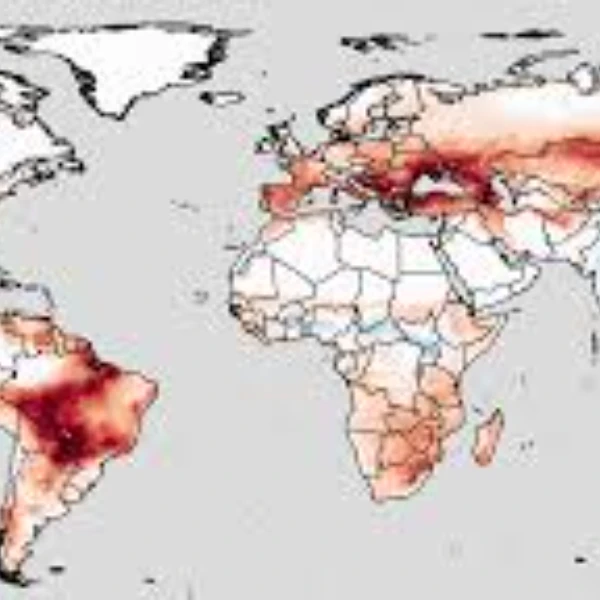
Will the world pass 2 degrees Celsius over pre-industrial levels before 2050?
Yes refers to: Before 2050
Short Answer
1. Market Behavior & Drivers
- Recent atmospheric and oceanic data confirms accelerating global warming.
- James Hansen's team projects 2°C warming significantly earlier than IPCC.
- Deep, rapid, and sustained emissions reductions are needed by 2035.
- National emissions pledges currently show a significant shortfall to limit warming.
- Rapid reduction of Short-Lived Climate Pollutants by 2030 is critical.
Who Wins and Why
| Outcome | Market | Model | Why |
|---|---|---|---|
| Before 2050 | 81.0% | 88.2% | Global greenhouse gas emissions continue to drive warming trends, making the 2-degree threshold likely. |
Current Context
2. Price Chart
Historical Price (Probability)
3. Market Data
Contract Snapshot
The market resolves to "Yes" if the annual global mean surface temperature anomaly reaches or exceeds +2.0°C above 1850-1900 pre-industrial levels in any calendar year before January 1, 2050. This threshold must be reported by at least two of the specified source agencies (NASA Goddard Institute for Space Studies, NCEI, Berkeley Earth, and UK Met Office Hadley Centre). Otherwise, if the event does not occur, the market resolves to "No" and closes by December 31, 2049, 11:59 PM EST.
Available Contracts
Market options and current pricing
| Outcome bucket | Yes (price) | No (price) | Last trade probability |
|---|---|---|---|
| Before 2050 | $0.79 | $0.24 | 81% |
Market Discussion
The IPCC AR6 report indicates that global warming exceeding 2°C above pre-industrial levels during 2041–2060 is very likely under high emissions scenarios, and likely or more likely than not under other significant emissions scenarios [1]. A Carbon Brief analysis estimates the 2°C threshold could be surpassed between 2034 and 2052 (median 2043) in the worst-case scenario (SSP5-8.5), and between 2038 and 2072 (median 2052) in a modest mitigation scenario (SSP2-4.5) [2]. These projections suggest a potential crossing of the 2°C mark before 2050 under several plausible emission trajectories, with similar long-term warming questions frequently tracked in other prediction markets [3].
Sources (3)
- 1https://www.ipcc.ch/report/ar6/wg1/downloads/report/IPCC_AR6_WGI_SPM.pdf?utm_source=newsletter&utm_medium=email&utm_campaign=newsletter_axiosgenerate&stream=topipcc.ch
- 2Analysis: When might the world exceed 1.5C and 2C of global warming? - Carbon Briefcarbonbrief.org
- 3February 2026 Temperature Increase (ºC) Trading Odds & Predictions | Polymarketpolymarket.com
4. Trust Index
Order book is critically thin.
Primary risk· Trade quality
Includes the cost to trade: a $10,000 order can't be filled here because the order book is too thin.
Weighted blend with hard caps — a critically weak safety pillar, or a severe trading anomaly, caps the total regardless of the rest. Full methodology · About the Trust Index
5. What recent atmospheric and oceanic data from agencies like NOAA and the WMO supports the hypothesis of an accelerating rate of global warming?
| Global Temperature Anomaly (2025) | 1.43°C above 1850–1900 average [1][2] |
|---|---|
| Ocean Warming Rate (2005-2024) | More than twice that of 1960–2005 [3] |
| CO2 Concentration (2024) | 423.9 ± 0.2 ppm [4] |
Sources (6)
- 1State of the Global Climate 2025wmo.int
- 2Earth’s climate swings increasingly out of balancebeta.wmo.int
- 3https://wmo.int/sites/default/files/2025-03/WMO-1368-2024_en.pdfwmo.int
- 4https://wmo.int/sites/default/files/2025-10/GHG-21_en.pdfwmo.int
- 5Assessing the Global Temperature and Precipitation Analysis in 2025 | News | National Centers for Environmental Information (NCEI)ncei.noaa.gov
- 6Climate change: global temperature | NOAA Climate.govclimate.gov
6. How do the climate models and assumptions used by James Hansen's team differ from the IPCC's AR6 report regarding the timeline for reaching 2°C warming?
| Hansen team 2°C warming projection | 2030s [1][2][3] |
|---|---|
| IPCC AR6 2°C warming projection (SSP2-4.5) | 2041-2060 [4] |
| IPCC AR6 Equilibrium Climate Sensitivity (ECS) | 3°C [1][5][6] |
Sources (7)
- 1https://www.columbia.edu/~jeh1/mailings/2025/Acceleration.12Feb2025.pdfcolumbia.edu
- 2James Hansen: 2°C global warming is likely to be reached in the 2030s, not at midcentury: r/climatechangereddit.com
- 3https://columbia.edu/~jeh1/Documents/PipelinePaper.2023.07.05.pdfcolumbia.edu
- 4Template:AR6 SSP tableen.wikipedia.org
- 5https://export.arxiv.org/pdf/2212.04474v3.pdfexport.arxiv.org
- 6https://www.columbia.edu/~jeh1/mailings/2025/ForestTrees.06August2025.pdfcolumbia.edu
- 7Seeing the Forest for the Trees - by James Hansenjimehansen.substack.com
7. What major policy shifts or technological breakthroughs in carbon capture or renewables would need to occur by 2035 to significantly alter the IPCC's current warming trajectory?
| Renewables Share by 2050 | 52–67% of primary energy [1] |
|---|---|
| Electricity System Transformation | Underway by ~2035 [1] |
| Carbon Capture/CO2 Removal Deployment | Scalable deployment at system-relevant rates by 2035 [2][3] |
Sources (7)
- 1Global Warming of 1.5 ºC —ipcc.ch
- 2Summary for Policymakersipcc.ch
- 3Figure AR6 WG3ipcc.ch
- 4Figure SPM.5: AR6 Synthesis Reportipcc.ch
- 5Will the world pass 2 degrees Celsius over pre-industrial levels before 2050? | Climate and Weather Prediction Markets | Solflaresolflare.com
- 6Figure AR6 WG2ipcc.ch
- 7Figure AR6 WG3ipcc.ch
8. What are the most current estimates for the world's remaining carbon budget from sources like the Global Carbon Project, and how has this figure been revised between 2020 and today?
| 1.5C Carbon Budget (50% chance) | 130 GtCO2 (as of January 2025) [1][2] |
|---|---|
| 1.5C Carbon Budget (66% chance) | 80 GtCO2 (from 2025) [3] |
| 2C Carbon Budget (Jan 2025) | 1110 GtCO2 [4] |
Sources (13)
9. According to the UNEP's Emissions Gap Report, what is the specific shortfall between current national emissions pledges and the pathway required to limit warming to 2°C?
| Additional emissions cuts for 2C pathway | 14 GtCO2e in 2030 [1][2] |
|---|---|
| Projected temp rise (unconditional NDCs) | 2.9°C by century-end [3][4][2] |
| 2030 emissions cut from 2019 for 2C | 25% [5] |
10. What Could Change the Odds
Key Catalysts
Key Dates & Catalysts
- Expiration: January 08, 2050
- Closes: January 01, 2050
