
Episode summary
276: Bruce Darringer, Founder BSD Strategic Advisors
 Alpha Exchange
· · 1 hr 4 min · Guests: Bruce Darringer

Summary
Bruce Darringer argues that risk management in hedge funds is far broader than market moves alone. A firm’s ability to survive stress depends on its technology, legal documentation, counterparty exposure, financing, human capital, and whether cash and collateral can actually move when markets seize up. He frames 2008 and March 2020 as tests of the whole institution, not just the portfolio.
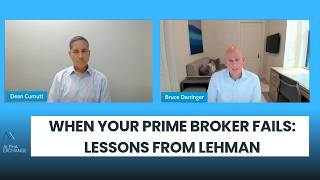
On Lehman, he says the crisis exposed how quickly operational and trading risks converge: firms had to assess prime broker exposure, unwind or transfer trades, manage unsettled positions, and understand bankruptcy and jurisdictional issues while also trying to exploit distressed opportunities. He says firms with strong proprietary systems, legal expertise, and counterparty data were better positioned to both defend themselves and invest.
On COVID, Bruce Darringer emphasizes the abrupt shift to remote work and the importance of preexisting culture, communication, and technology. He says firms with strong relationships and infrastructure adapted more effectively, and many were also able to launch dislocation strategies quickly. He extends that logic to founder-led firms, allocator due diligence, and AI adoption: successful firms must keep evolving their operating model as they scale, while balancing control, cost, and new risks.
Key takeaways
- Bruce Darringer says risk management must cover operations, legal structure, technology, counterparty exposure, and liquidity—not just price risk.
- He says Lehman exposed how a broker-dealer failure can force firms to manage collateral, unsettled trades, bankruptcy regimes, and distress opportunities at the same time.
- He says firms with strong proprietary technology and in-house legal expertise were better able to navigate 2008 and exploit dislocations.
- Bruce Darringer says COVID rewarded firms with strong preexisting culture and connectivity because remote work amplified communication and coordination problems.
- He says allocators increasingly demand evidence of infrastructure, governance, and investor alignment before committing capital.
- He says AI will matter most when firms combine technical capability with real investment-domain expertise, not generic consulting.
Notable quotes
“the risks really are so wide ranging and can be so significant and unpredictable that if there's not a focus on it things are going to happen”
“we were very front-footed in ensuring that we were uh negotiating terms that were going to last us for for the long term”
“having our own legal expertise to be able to quickly evaluate claims that were being shown in the marketplace”
How the episode opens
Risk can change very dramatically and if you're not paying attention to what you need to invest in to mitigate those risks as they evolve. It it is very easy for uh for for something to occur that causes an issue. It may not be existential per se, but it could have pretty significant impacts.
It can take away from management time to deal with something or a crisis that's cropped up. There are obviously impacts that can that can happen to the investor base and that can as we've seen can cause uh that can cause existential issues for a business if uh the capital side of the business is not uh you know short up appropriately. Uh so the business the the risks really are so wide ranging and can be so significant and unpredictable that if there's not a focus on it things are going to happen.
My guest today on the Alpha Exchange is Bruce Daringer. He is the founder of BSD Strategic Advisors, a firm working closely with hedge funds and financial institutions to strengthen various parts of their investment process and risk management infrastructure. Bruce, it is a pleasure to welcome you to the Alpha Exchange.
Dean, it is a pleasure to be here.
Well, we've talked about uh having you on for for quite some time and I'm really excited to have this conversation. and we've known each other for 30 years. I think we're celebrating our 30 30 year anniversary.
I believe we met in 1996. So somehow we've made it. But uh I've always really admired your thought process not just on markets but on really complex issues regarding infrastructure and being in the investment business is a challenge.
It's challenging to manufacture returns. Uh but these are very complicated and comp complex institutions to run effectively and I think that's where I'm really excited to um to solicit your insights.
From the episode’s captions: roughly the first two minutes, lightly cleaned. Keep watching on YouTube →
Topics
- risk management
- market dislocations
- counterparty exposure
- operational due diligence
- remote work technology
Companies and tickers mentioned
- BSD Strategic Advisors
- King Street Capital Management
Watch the episode
Watch “276: Bruce Darringer, Founder BSD Strategic Advisors” on YouTube
Summary, takeaways and quote selection by Octagon. Quotes are short excerpts; the full conversation is in the episode.
More from Alpha Exchange
-
 How to Tell a Pullback From a Bear Market
-
 Consumer Stress Hiding Beneath a Strong Market
-
 Financing the AI Boom: Why Power Assets Appeal to This Credit Investor
-
 What Does a MOVE of 100 Actually Mean?
-
 Why Markets Keep Creating New Opportunities for Alpha
-
 When Your Prime Broker Fails: Lessons from Lehman
Alpha Exchange, this episode and its artwork belong to Dean Curnutt. Octagon is not affiliated with the show; this page is an independent summary.
