
Episode summary
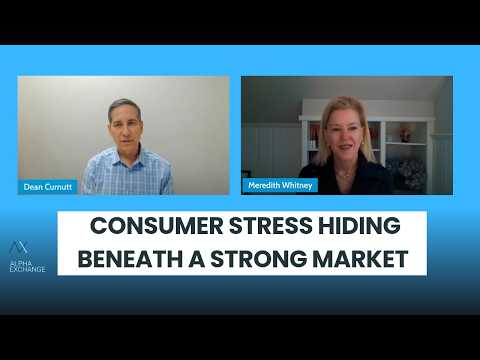
Consumer Stress Hiding Beneath a Strong Market
 Alpha Exchange
· · 7 min
Summary
The guest argues that a strong market is masking a stressed U.S. consumer, especially households that have been pushed out of mainstream bank credit. After the financial crisis, banks pulled back from lending to anything below prime, and the guest says that has left roughly 50% of households reliant on alternative financing for everyday cash flow needs. During and after COVID, stimulus temporarily lifted after-tax income for many families, but that support faded and spending patterns have since weakened.
Key takeaways
- The guest says banks have sharply reduced credit access for less-than-prime borrowers, leaving about 50% of households to seek loans elsewhere.
- Daily wage access products such as Daily Pay and Pay Active are growing fast, with the guest saying their implied APR can be close to 200%.
- The guest says pawn lenders are doing well because customers are not paying down loans even when tax refunds arrive.
- Home equity extractions are described as the fastest growing lending product at banks, suggesting households are tapping housing wealth to bridge gaps.
- Flat-to-negative grocery spending is presented as evidence that consumers are choosing gas over food to keep working.
Notable quotes
“So they've gotten out of lending to anybody who is um less than prime”
“I would say 50% of households um have to go to other means have had to go to other means um to get loans”
“the uh the I, you know, the APR, if you were to treat it like a credit card, is close to 200%”
“Grocery spending has been flat to negative. And what that tells you is that people are choosing to put money gas in their tank to get to work versus spending on groceries”
How the episode opens
Let's fast forward to today because you've got a lot to say about what I think is an under in some ways under uh covered aspect of today's economy which is the consumer. You know people throw out the K shape and and it's real and it's it matters but um you're really your process uh really dives into you know the implications of the case shape. You've talked about access to credit from boy some of these um micro lenders which uh you know folks are having to access.
You've talked about the trade-off between gas and groceries. Why don't you maybe start from 30,000 ft in terms of what you see uh from a US consumer standpoint and of course we'll ultimately you know bring in the AI part of the you know the analysis but start with the consumer
To carry a a thread through this whole conversation. Um going back to the credit uh the great financial crisis, the banks ha paid $70 billion in fees um yeah plus um in terms of mortgage penalties and fines um sorry fees fines right after the crisis they're like never again. So they pulled back from lending to a wider group of people, right?
Remember, they needed to lend to everybody to keep the uh the the the party going in the in in mortgage land. Um to shrinking that pool dramatically and it took them a long time to do it because different states had different foreclosure rules and um uh and and you had to work the port work the work down the portfolio. I'll give you an example.
the uh home equity uh lines of credit book at bank on bank at banks was close to 700 billion. It's 290 billion today. And you think about the level of equity at the crisis there was 9 trillion of equity.
From the episode’s captions: roughly the first two minutes, lightly cleaned. Keep watching on YouTube →
Topics
- consumer stress
- credit access
- micro lenders
- household affordability
- k-shaped recovery
Companies and tickers mentioned
- AXP
- American Express
Watch the episode
Watch “Consumer Stress Hiding Beneath a Strong Market” on YouTube
Summary, takeaways and quote selection by Octagon. Quotes are short excerpts; the full conversation is in the episode.
More from Alpha Exchange
-
 What Does a MOVE of 100 Actually Mean?
-
 Why Markets Keep Creating New Opportunities for Alpha
-
 When Your Prime Broker Fails: Lessons from Lehman
-
 How the AI Boom Is Distorting Corporate Debt & Bond Markets
-
 277: Meredith Whitney, Founder and CEO, Meredith Whitney Advisors
-
 276: Bruce Darringer, Founder BSD Strategic Advisors
Alpha Exchange, this episode and its artwork belong to Dean Curnutt. Octagon is not affiliated with the show; this page is an independent summary.
