
Episode summary
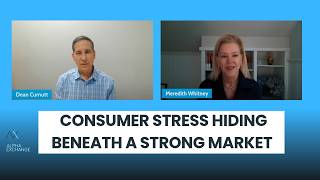
277: Meredith Whitney, Founder and CEO, Meredith Whitney Advisors
 Alpha Exchange
· · 43 min · Guests: Meredith Whitney

Summary
Meredith Whitney argues that the U.S. consumer is far more divided than bank earnings suggest. She says roughly 50% of households now have to rely on nonbank sources for credit because banks have pulled back from lending to anyone below prime, while prime and super-prime borrowers still make the system look healthy. In her view, the strain is showing up in daily-wage access products, pawn lending, and rising home-equity extraction, even as reported bank losses stay low.
She traces that split back to the post-GFC retrenchment in lending and to the way stimulus, then inflation, reshaped household cash flow after COVID. Meredith Whitney says gas and grocery costs are forcing consumers to make hard choices, and that the pressure is moving up the income distribution. She points to flat-to-negative grocery spending, the growth in credit-card balances, and a roughly $1100 per household increase in energy-related costs since the end of February as signs of stress.
On markets, she says the big risk is not just consumer weakness but concentration. She is skeptical of the AI capex trade because it is increasingly circular and depends on ever more financing, while the equity market’s gains are concentrated in a small group of names. She also favors energy, saying the oil forward curve looks too optimistic given low inventories, reserve rebuilding needs, and geopolitical risk.
Key takeaways
- Meredith Whitney says about 50% of households now need nonbank credit because banks have largely exited lending below prime.
- She says daily-wage access products and pawn lenders are thriving because many consumers cannot absorb higher gas and grocery costs.
- Whitney thinks the market is underestimating consumer strain because bank credit metrics still look clean even as household behavior deteriorates.
- She says the AI capex trade is vulnerable because the spending is circular and increasingly dependent on financing.
- Whitney is constructive on energy, arguing oil expectations are too low given low inventories and geopolitical risk.
Notable quotes
“So what's happened is, I would say 50% of households um have to go to other means, have had to go to other means um to get loans”
“it's extremely expensive to be poor because the rates you pay for whatever liquidity you can get are just obscene”
“the concentration, you know, just even looking at the market, you look at the indices and it looks like, oh, great, this market, you know, this has been a fairly decent year”
How the episode opens
So what's happened is, I would say 50% of households um have to go to other means, have had to go to other means um to get loans. Now, I'm not saying they're not banked. Banks will take deposits.
They'll give you a a a debit card um but they're not going to give you less and less there are they going to give you a credit card. Uh they're definitely not going to give you a home equity loan um and very rarely will they give you other type of lending products.
My guest today on the Alpha Exchange is Meredith Whitney. She is the founder and CEO of Meredith Meredith Whitney Advisors and someone who needs almost no introduction. Meredith, it's great to welcome you to the podcast today. — Well, thanks for having me.
Yeah, I'm really looking forward to this. We were introduced by our mutual friend uh Louis Gave. I'm very glad he made that introduction and I'm glad you took up the uh the invite. — Louis could ask me for just about anything and I do it for him. He's just a a a force. There's no there's no one like Louis and his and his his group and his father is, you know, the Mick Jagger of finance.
And just tremendous sort of thought process on macro, very differentiated. I've always enjoyed the conversations with him as well. Um so let's just start with with you and your background.
So you're famous for a couple of things, but one of which is I want to say it's the last day of October in 2007 asking out loud, will Citi need to cut its dividend? And I just look back, I think the stock was down 6% on the year and it fell another 99% to its to its lows.
From the episode’s captions: roughly the first two minutes, lightly cleaned. Keep watching on YouTube →
Topics
- consumer credit dispersion
- bank credit metrics
- ai equity concentration
- energy and grocery cost pressures
- oil price assumptions
Companies and tickers mentioned
- C
- Citigroup
- Meredith Whitney Advisory Group
Watch the episode
Watch “277: Meredith Whitney, Founder and CEO, Meredith Whitney Advisors” on YouTube
Summary, takeaways and quote selection by Octagon. Quotes are short excerpts; the full conversation is in the episode.
More from Alpha Exchange
-
 How to Tell a Pullback From a Bear Market
-
 Consumer Stress Hiding Beneath a Strong Market
-
 Financing the AI Boom: Why Power Assets Appeal to This Credit Investor
-
 What Does a MOVE of 100 Actually Mean?
-
 Why Markets Keep Creating New Opportunities for Alpha
-
 When Your Prime Broker Fails: Lessons from Lehman
Alpha Exchange, this episode and its artwork belong to Dean Curnutt. Octagon is not affiliated with the show; this page is an independent summary.
