
Episode summary
When Your Prime Broker Fails: Lessons from Lehman
 Alpha Exchange
· · 8 min

Summary
The discussion centers on how the Lehman collapse turned prime brokerage, derivatives, and operations into a single stress test for hedge funds. The point was that what used to be a more separated back-office function had become integral to a firm’s ability to survive, because risk management on the investment side and the operations side now affect each other directly. Lehman was described as an unexpected broker-dealer default that shocked markets, raised contagion fears, and forced firms to quickly sort out terminations, offsets, transfers, unsettled trades, and cross-border jurisdictional issues.
The episode argues that firms with stronger infrastructure were better positioned not only to defend themselves, but also to exploit the opportunity set created by the largest distressed balance sheet in history. The speaker says firms that had proprietary technology, legal expertise, and detailed counterparty documentation were able to understand exposures faster and act more decisively. The contrast was stark: some funds suffered heavy losses or gates, while others, including King Street, were able to post positive returns in 2008.
A key lesson was that risk planning often looks expensive until a disaster scenario arrives. The speaker highlights the importance of negotiating durable ISDA terms, maintaining good access to information, and avoiding hidden optionality in collateral and market disruption provisions. The crisis also reshaped industry practice, especially around collateral safety and tri-party arrangements.
Key takeaways
- The speaker says Lehman showed that operations, legal, and trading risk are inseparable at a modern hedge fund.
- The speaker says firms with proprietary technology and multi-jurisdiction legal expertise were better able to handle the Lehman failure.
- The speaker says King Street had positive returns in 2008 while much of the industry was down 20% to 30% or more.
- The speaker says durable ISDA terms and good counterparty data were a major advantage when Lehman defaulted.
- The speaker says the crisis changed how the industry thought about collateral safety and led to more tri-party collateral arrangements.
Notable quotes
“the operations of these sorts of firms, the smaller hedge funds that existed at that time, could be more of its own, uh, its own entity”
“you have your assets in cash, uh, you're dealing with them as an ISDA counterparty that all of a sudden has this unexpected default”
“it was the first default of a broker dealer, I think since Drexel and I forget if it was 1990 or 1991”
“it really was a time where having uh your own proprietary uh technology stack, having your own legal expertise really across multiple regions”
“you're posting collateral to financial institutions. And again usually the perspective is the small hedge fund is the one that's posing the risk”
How the episode opens
I'm not saying it, uh, kind of a high level. It used to be, you know, 30 years ago, you could have the operations of these sorts of firms, the smaller hedge funds that existed at that time, could be more of its own, uh, its own entity and maybe not as integrated with the investment process. Clearly as the industry has grown, it really is is fully integral to a firm's success.
As you said, these businesses are are complicated and if you don't have the right risk management infrastructure on the investment side, but also the risk management infrastructure on the operations side, which really covers and touches every part of the firm from human capital to, uh, investor capital to technology, etc. And it's very easy for both issues on the operations side to have an impact on the investment side and vice versa. And you have a market event like Lehman and you're really putting what's been built at a firm to that ultimate test.
The amount of market volatility, uh, the amount of price action, as you said, in this case you're dealing with, uh, Lehman as a prime broker, prime brokerage counterparty where you have your assets in cash, uh, you're dealing with them as an ISDA counterparty that all of a sudden has this unexpected default. And it was the first default of a broker dealer, I think since Drexel and I forget if it was 1990 or 1991. You had that brief scare with with Bear Stearns six months earlier, uh, but that was in essence just just a blip.
Obviously the government came in and and, uh, arranged that, uh, quick quick marriage to JP Morgan. Uh, so no one really got to experience what maybe could have happened in that situation and I think in some respect when Lehman did actually go under, I I think it was quite a shock to markets.
From the episode’s captions: roughly the first two minutes, lightly cleaned. Keep watching on YouTube →
Topics
- prime brokerage counterparty risk
- operational risk
- risk management infrastructure
- lehman default and contagion
- isda counterparty exposure
Companies and tickers mentioned
- JPM
- Lehman Brothers
- JPMorgan
- Bear Stearns
- Drexel
Watch the episode
Watch “When Your Prime Broker Fails: Lessons from Lehman” on YouTube
Summary, takeaways and quote selection by Octagon. Quotes are short excerpts; the full conversation is in the episode.
More from Alpha Exchange
-
 How to Tell a Pullback From a Bear Market
-
 Consumer Stress Hiding Beneath a Strong Market
-
 Financing the AI Boom: Why Power Assets Appeal to This Credit Investor
-
 What Does a MOVE of 100 Actually Mean?
-
 277: Meredith Whitney, Founder and CEO, Meredith Whitney Advisors
-
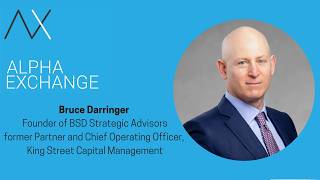 276: Bruce Darringer, Founder BSD Strategic Advisors
Alpha Exchange, this episode and its artwork belong to Dean Curnutt. Octagon is not affiliated with the show; this page is an independent summary.
