
Episode summary
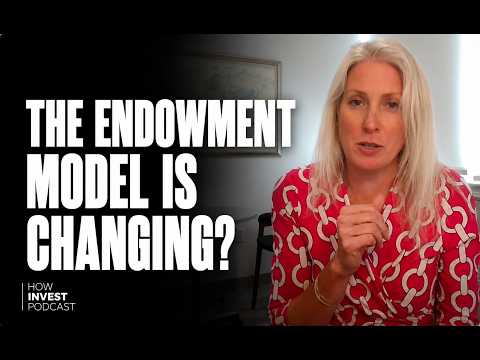
$7 Billion CIO: Why the Endowment Model is Changing
 How I Invest With David Weisburd
· · Hosts: David Weisburd · Guests: Karen Welch
Summary
Karen Welch says the core lesson from Stanford’s endowment is that investing is fundamentally about people: internal team quality, external manager relationships, and the judgment to use AI without surrendering decision-making. She describes the CIO role as a coach who builds the team, sets the game plan, and makes offense-or-defense adjustments as markets change.
She argues that the endowment model still works when it stays focused on long-term horizons, equity bias, diversification, active management, and alignment, but that it needs evolution on three fronts: less dogma around alpha, less blind faith in diversification, and more skepticism about any assumed illiquidity premium. In her view, private markets only earn their keep through access to exceptional managers, not by locking up capital for its own sake.
Welch also explains Spider’s single-portfolio approach for the University of Richmond and nonprofit partners, which she says creates discipline because every investment must stand up for every client. She gives examples of leaning into credit during and after COVID, harvesting gains later, and staying opportunistic in dislocated areas like software and secondaries. The portfolio today is 26% public equities, 34% private equity, 22% absolute return, 12% real assets, and 8% cash and fixed income.
Key takeaways
- Welch says the best investment edge is people and relationships, not mechanics, because AI can increasingly handle analysis and research.
- She argues the CIO should act like a coach: recruit talent, set strategy, and make real-time offensive or defensive adjustments.
- Welch says the endowment model remains valid, but investors should not assume every illiquid asset earns a guaranteed premium.
- She says Spider leaned into credit during and after COVID when spreads blew out, then harvested gains as spreads compressed.
- Welch says private equity now matters more because leading companies in AI, space, and defense are increasingly private-market opportunities.
Notable quotes
“the most important lesson, it's not the skill set or the mechanics of manager selection or portfolio construction, it's really all about people”
“I think what's really going to differentiate the best organizations, the best portfolios, the best investors going forward are the people on their teams”
“I like the analogy of a CIO to a coach, and I consider myself to be a player coach”
“There's no magic illiquidity premium there”
“the team and I really embrace the endowment model and feel it gives the University of Richmond and our client partners the best opportunity to succeed”
How the episode opens
So, Karen, you're the CIO Spider Management, which manages roughly $7 billion, and you came from Stanford's endowment 9 years ago. What lessons do you take from working at Stanford's endowment to how you run Spider Management today? Good question that I've reflected on a little bit as I've been at Spider now for just over 10 years.
When I sit back and think about the most important lesson, it's not the skill set or the mechanics of manager selection or portfolio construction, it's really all about people. And both the people of our internal teams and the relationships that we build with the external managers with whom we invest. It's actually increasingly important now in a world in which the pace of technological change is accelerating, information is ubiquitous, AI can do some of the analysis and research that's I and my colleagues did in the early days of our careers.
I think what's really going to differentiate the best organizations, the best portfolios, the best investors going forward are the people on their teams and the relationships that they build to invest the assets that we steward. I heard this analogy that investment analysts will become investment orchestrators. So, they'll orchestrate and prompt the AI to do what needs to be done for the portfolio.
Does that change how you go about building your team and what you look for in terms of future team members? It's a great question. So, some of the things that I really look for in hiring my team are consistent uh in this pre- and post-AI world.
I look for team members who are really intellectually curious and willing to learn, and that's even more important now again given the pace of technological change. I want individuals who have deep experience and expertise in particular parts of the portfolio, but I also want individuals who are real team players and can think about that portfolio holistically, just like I noted at Stanford, and contribute that bigger picture view to combining the pieces to achieve our collective objectives.
From the episode’s captions: roughly the first two minutes, lightly cleaned. Keep watching on YouTube →
Topics
- endowment model evolution
- ai in portfolio management
- cio role and portfolio monitoring
- private markets illiquidity premium
- venture manager access and portfolio structuring
Companies and tickers mentioned
- Spider Management Company
Watch the episode
Watch “$7 Billion CIO: Why the Endowment Model is Changing” on YouTube
Summary, takeaways and quote selection by Octagon. Quotes are short excerpts; the full conversation is in the episode.
More from How I Invest With David Weisburd
-
 True Anomaly’s Even Rogers on Space Warfare, China’s Military Advantage, and the Defense Tech Boom
-
 Finding the Next Anthropic, Quantifying Venture Capital, and the Science of Picking Winners
-
 Why 95% of AI Projects Fail, Anthropic still at $2T?, and Why AI Is Still in the First Inning
-
 Peter Thiel's 27-Year Partner on the AI Bubble, the Venture Capital Crisis, and the PayPal Mafia
-
 Why Venture Is Eating Public Markets, Picking Great VCs, and the AI Boom w/Brijesh Jeevarathnam
-
 Federated Hermes CEO on $400 Billion in Cash, the Private Markets Boom, and AI
How I Invest With David Weisburd, this episode and its artwork belong to David Weisburd. Octagon is not affiliated with the show; this page is an independent summary.
