
Episode summary
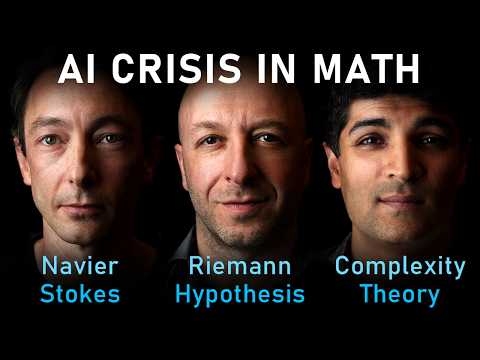
AI Crisis in Math: Navier-Stokes, Riemann Hypothesis & Complexity Theory | Lex Fridman Podcast #503
 Lex Fridman Podcast
· · 3 hr 34 min · Hosts: Lex Fridman · Guests: Ankur Moitra, Steven Brunton, Alex Kontorovich
Summary
The conversation treats recent AI proofs in mathematics as a genuine stress test for the field, especially around Navier-Stokes, the quasi-Riemann hypothesis, the unique games conjecture, and other results. Alex Kontorovich frames the moment less as a crisis than a chance for a “golden age” of mathematical knowledge, while Ankur Moitra emphasizes the tension between excitement and the fear that the old graduate-student blueprint for success is breaking down. Steven Brunton is broadly hopeful, arguing that AI should expand what humans can do in applied math and engineering, even as it raises hard questions about purpose, uncertainty, and meaning.
A major thread is whether AI is merely recombining existing ideas or actually generating new mathematics. The guests debate “the solved axiom,” the idea that anything a human-plus-AI team can do could eventually be done by AI alone, and mostly reject it as too strong. They argue that human mathematics is not just theorem-proving; it also includes asking good questions, building concepts, and seeing generality and beauty. The doorman fallacy becomes a metaphor for why reducing mathematicians to proof machines misses much of their value.
The episode also digs into institutions and infrastructure. The guests discuss Lean and Mathlib as a way to make proofs machine-checkable, and they compare mathematics to software development, where pull requests, reusable code, and collaborative verification may matter more in the future than one-off papers. They worry journals, conferences, hiring, and graduate training will all need to adapt to a world where AI floods the field with results and forces mathematicians to rethink what counts as contribution.
Key takeaways
- Alex Kontorovich argues the moment may be a “golden age” of mathematical knowledge, not just a crisis.
- Ankur Moitra says AI could make the old graduate-student playbook obsolete and leave young researchers more intellectually adrift.
- Steven Brunton is optimistic that AI will greatly improve applied problem-solving in engineering and science.
- The guests largely reject the strongest version of the “solved axiom,” saying human mathematics still depends on asking questions, making concepts, and seeing beauty.
- Lean and Mathlib are presented as a model for a more collaborative, machine-checkable future for mathematics.
- The guests think AI results will force changes in journals, conferences, hiring, and the way mathematical contributions are recognized.
Notable quotes
“It's a chance to rethink what it is we're trying to accomplish, and it's the chaos of opportunity”
“I feel very excited, but maybe more intellectually lonely than I felt before”
“I don't think it destroys mathematics”
“the value of pure mathematics is that it lives in the heads of human beings”
“I think we're entering, if we're not already in, a period of some kind of golden age of mathematical knowledge”
How the episode opens
- All right, so this is a kind of emergency episode I think it's fair to say, about the state of mathematics and artificial intelligence. A kind of crisis moment in the history of mathematics. Over the last few weeks, machines claimed to have solved some of the hardest problems in the history of math.
Navier-Stokes, the quasi- Riemann hypothesis, the unique games conjecture, and hundreds of other results. So here with me, we have Steven Brunton, who's a mathematician, fluid dynamics expert at University of Washington, who can speak to Navier-Stokes, turbulence, all things fluid, and many other topics. Also, here's Ankur Moitra, a mathematician and theoretical computer scientist at MIT, visiting Institute for Advanced Studies in Princeton this year, who can speak to many things, unique games, conjecture, and complexity theory in general, and the mathematics of how the AI learns and all things theoretical computer science.
And Alex, a mathematician, number theorist at Rutgers, who can speak to also very many topics, including Riemann hypothesis and Lean, the automated proof and the automated verifier and checking and so on, and so many other topics in mathematics. All three are brilliant. All are very kind to show up this early morning and talk to me, assemble this kinda multi-agent mini swarm of human brains to try to interpret what happened in this very moment.
A lot of mathematicians, brilliant mathematicians, including Terence Tao and others, are freaking out. It's a mix of awe, terror, dread, and few inklings of light, of hope also. So I apologize to start with a question about feeling, but what have you been feeling about this historic moment?
Maybe Alex, do you wanna go first? - Yeah, I don't know if I would call it a crisis. There's a lot of opportunity in that crisis.
From the episode’s captions: roughly the first two minutes, lightly cleaned. Keep watching on YouTube →
Topics
- ai and mathematics
- riemann hypothesis
- navier-stokes
- complexity theory
- lean proof assistants
Watch the episode
Summary, takeaways and quote selection by Octagon. Quotes are short excerpts; the full conversation is in the episode.
More from Lex Fridman Podcast
-
 DHH: Future of Programming, AI, Agentic Engineering, Vibe Coding & Linux | Lex Fridman Podcast #501
-
 Khabib Nurmagomedov: Dagestan, MMA, UFC, Islam, Conor, Fedor & Football | Lex Fridman Podcast #500
-
 Gary Gallagher: American Civil War, Slavery, Lincoln, Grant & Lee | Lex Fridman Podcast #499
-
 The Rise and Fall of the Roman Empire and the Byzantine Empire | Lex Fridman Podcast #498
-
 Biggest Mysteries in Physics: Antimatter, Dark Energy & ToE - Don Lincoln | Lex Fridman Podcast #497
-
 FFmpeg: The Incredible Technology Behind Video on the Internet | Lex Fridman Podcast #496
Lex Fridman Podcast, this episode and its artwork belong to Lex Fridman. Octagon is not affiliated with the show; this page is an independent summary.
