
Episode summary
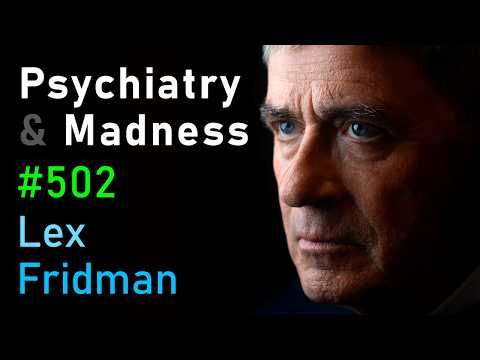
Psychiatry, Insane Asylums, Mental Illness, ECT, Lobotomies, Freud & Jung | Lex Fridman Podcast #502
 Lex Fridman Podcast
· · 3 hr 37 min · Hosts: Lex Fridman · Guests: Andrew Scull
Summary
Andrew Scull argues that modern psychiatry is in a crisis because its core tools remain limited: drugs and talk therapy can help some patients, but they are mostly symptomatic treatments, not cures. He says the field has made real but modest progress since the 1950s, while also creating iatrogenic harms and still not knowing in advance who will respond well to treatment.
A central part of the discussion is diagnosis. Scull traces how DSM-III and later editions moved psychiatry toward symptom checklists and reliability, but not necessarily validity. He says the result is a system that is more standardized yet still built on categories that may not map onto underlying reality, while leading institutions like NIMH increasingly bet on brain disease, genetics, and neuroscience without producing transformative clinical gains.
The episode also follows psychiatry’s darker history: asylums, eugenics, sterilization, Nazi killing programs, insulin coma therapy, malaria treatment for syphilis, surgical “cures” like lobotomy, and public-policy failures that left many seriously ill people in jails and on the streets. Scull’s larger claim is that psychiatry has repeatedly swung between overconfidence and despair, often using scientific language to justify damaging interventions.
Key takeaways
- Scull says psychiatry still lacks a “psychiatric penicillin,” and most current treatments are only partially effective symptomatic interventions.
- He argues DSM-style diagnosis improved reliability but may have sacrificed validity by grouping unlike conditions under broad labels.
- Scull says NIMH spent more than $20 billion on genetics and neuroscience without materially improving the lot of the mentally ill.
- He links the asylum era’s optimism to later eugenics and sterilization, warning that biological explanations can be turned into social justifications for abuse.
- He argues public policy, not just psychiatry, helped produce today’s crisis by shifting seriously ill patients into jails, streets, and short-term crisis care.
Notable quotes
“What we have available to us are symptomatic treatments not cures. We don't have a psychiatric penicillin for any of the conditions we're gonna be talking about”
“When I entered psychiatry, it was brainless psychiatry, leaving it mindless psychiatry”
“Community care is a shell game without a pee. It's like one o' those. confidence tricks”
“This is the beginning of the darkness”
“after spending 20 billion dollars, the lot of the mentally ill has improved not one bit right”
How the episode opens
- The following is a conversation with Andrew Scull, a historian of psychiatry and mental health. He has authored many books that I highly recommend including Madness in Civilization: A Cultural History of Insanity from the Bible to Freud, from the Madhouse to Modern Medicine and Desperate Remedies: Psychiatry's Turbulent Quest to Cure Mental Illness. Andrew Scull has spent decades studying how societies have understood madness, how psychiatry rose to authority, and how often that authority was used with false confidence and catastrophic consequences.
In this conversation we'll trace the long arc from the asylum era to eugenics, from lobotomy and insulin coma therapy to electroconvulsive therapy, psychoanalysis, antipsychotics, antidepressants and the modern crisis of mental health. It is in part a story about the terrifying history of bad ideas in medicine but it is also about the fascinating mystery of the human mind and about the difficult journey to understand it. This is a Lex Fridman podcast.
To support it please check out our sponsors in the description where you can also find links to contact me, ask questions, give feedback and so on. And now dear friends here's Andrew Scull. Is it fair to characterize your view on psychiatry and mental illness as that there's a crisis in modern psychiatry?
We have made some progress- - Yes - ... over the past century but mostly we still are not good at treating mental illness either via the drugs or talk therapy meaning psychopharmacology or psychotherapy or as you put it the brain or the mind route. So let's start at the end of our story.
Let's start at where we stand before we go into the rich history that you so eloquently write about. - So psychiatry is a profession that tries to deal with an enormously complicated thing.
From the episode’s captions: roughly the first two minutes, lightly cleaned. Keep watching on YouTube →
Topics
- crisis in psychiatry
- categories of mental illness
- asylums eugenics nazis
- lobotomies and ect
- future of psychiatry
Watch the episode
Summary, takeaways and quote selection by Octagon. Quotes are short excerpts; the full conversation is in the episode.
More from Lex Fridman Podcast
-
 Russia-Ukraine War: Putin, Zelenskyy, Drones and the Future of Warfare | Lex Fridman Podcast #504
-
 Khabib Nurmagomedov: Dagestan, MMA, UFC, Islam, Conor, Fedor & Football | Lex Fridman Podcast #500
-
 Gary Gallagher: American Civil War, Slavery, Lincoln, Grant & Lee | Lex Fridman Podcast #499
-
 The Rise and Fall of the Roman Empire and the Byzantine Empire | Lex Fridman Podcast #498
-
 Biggest Mysteries in Physics: Antimatter, Dark Energy & ToE - Don Lincoln | Lex Fridman Podcast #497
-
 FFmpeg: The Incredible Technology Behind Video on the Internet | Lex Fridman Podcast #496
Lex Fridman Podcast, this episode and its artwork belong to Lex Fridman. Octagon is not affiliated with the show; this page is an independent summary.
