
Episode summary
Biggest Mysteries in Physics: Antimatter, Dark Energy & ToE - Don Lincoln | Lex Fridman Podcast #497
 Lex Fridman Podcast
· · Hosts: Lex Fridman · Guests: Don Lincoln

Summary
Don Lincoln frames particle physics as a long history of unification: Newton merged celestial and terrestrial gravity, Maxwell unified electricity and magnetism, and Einstein extended the pattern by linking space and time and then gravity with spacetime geometry. The recurring theme is that apparently unrelated phenomena often turn out to be different views of a deeper structure, and that scientific progress depends on both intuitive leaps and ruthless critique.
He then moves to the Standard Model era, where the weak nuclear force and electromagnetism were unified into the electroweak theory, with the Higgs field supplying mass to particles that interact with it while leaving the photon massless. The Higgs boson is described as the detectable vibration of that field, and the search for it became a major experimental goal at Fermilab’s Tevatron and later CERN’s LHC.
Lincoln also explains how accelerators create new particles by converting collision energy into mass, why higher energy and higher collision rates matter, and how enormous detectors and trigger systems sift through billions of events to find rare signals. The 2012 Higgs discovery is presented as the culmination of a decades-long search, with Fermilab close but ultimately overtaken by the LHC’s greater energy and event rate.
Key takeaways
- Don Lincoln argues that physics advances by unifying apparently separate phenomena, from Newton’s gravity to Maxwell’s electromagnetism to Einstein’s spacetime.
- He says the Higgs field explains why many particles have mass while the photon does not, and the Higgs boson is the field’s detectable excitation.
- Lincoln emphasizes that particle accelerators turn collision energy into new matter, including antimatter pairs and rare heavy particles.
- He says the LHC’s higher energy and far greater collision rate gave it the edge over Fermilab in the Higgs search.
- The Higgs discovery required trigger systems and detectors that reduced about a billion collisions per second to a manageable stream for analysis.
Notable quotes
“the history of physics can be told effectively as a kind of history of unifications”
“Electricity equals magnetism. And that is a staggering concept”
“the idea of atoms goes back to Democrus and you know he his idea was that like um there was a smallest atom of oil”
How the episode opens
The following is a conversation with Don Lincoln, a particle physicist at Firmeny Lab, who has spent decades working at the frontier of high energy physics. This was a mind-blowing and inspiring conversation. Don turned out to be one of my favorite people to talk to about physics.
truly a unique mind with that Richard Fineman ability of taking very complicated ideas and explaining them simply without losing any of the essential brilliant insights at the core of those ideas. This is the Lex Freedman podcast. To support it, please check out our sponsors in the description where you can also find ways to contact me, ask questions, give feedback, and so on.
And now dear friends, here's Don Lincoln. In describing the search for theory of everything in physics, you describe the history of physics can be told effectively as a kind of history of unifications. There's this centuries long quest to show that these distinct phenomena are actually linked by some unified underlying principles.
uh even starting with Newton that you can think of the effort of physics as one as trying to unify the laws of nature. So I was wondering if we could talk through the history of unification that lens of physics. There are of course lots of different ways to do physics, but the the way that I would say that particle physicists, cosmologists do is they are trying to to really find basically the underlying principles that govern the laws of of nature.
If we go back say to the I don't know 1650s or so, uh you're the most brilliant person around and you've noticed two things. One you've noticed is that when you trip, you fall. That is the nature of gravity that that we all experience daytoday.
But then there's sort of astronomy where you look out at the heavens and you see the stars march across the sky.
From the episode’s captions: roughly the first two minutes, lightly cleaned. Keep watching on YouTube →
Topics
- unifying laws of nature
- theory of everything
- physics of empty space
- antimatter
- dark energy
Companies and tickers mentioned
- Fermilab
Watch the episode
Summary, takeaways and quote selection by Octagon. Quotes are short excerpts; the full conversation is in the episode.
More from Lex Fridman Podcast
-
 Russia-Ukraine War: Putin, Zelenskyy, Drones and the Future of Warfare | Lex Fridman Podcast #504
-
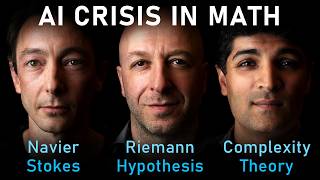 AI Crisis in Math: Navier-Stokes, Riemann Hypothesis & Complexity Theory | Lex Fridman Podcast #503
-
 Psychiatry, Insane Asylums, Mental Illness, ECT, Lobotomies, Freud & Jung | Lex Fridman Podcast #502
-
 DHH: Future of Programming, AI, Agentic Engineering, Vibe Coding & Linux | Lex Fridman Podcast #501
-
 Khabib Nurmagomedov: Dagestan, MMA, UFC, Islam, Conor, Fedor & Football | Lex Fridman Podcast #500
-
 Gary Gallagher: American Civil War, Slavery, Lincoln, Grant & Lee | Lex Fridman Podcast #499
Lex Fridman Podcast, this episode and its artwork belong to Lex Fridman. Octagon is not affiliated with the show; this page is an independent summary.
