
Episode summary
Trading Desk - October 15th 2026
 MacroVoices
· · Hosts: Erik Townsend, Patrick Ceresna

Summary
The discussion centered on whether a sharp move in markets marked the start of a broader regime shift. The host argued that a hot CPI print initially pushed yields and the dollar higher, but the bigger story was the sudden stress in AI-linked credit, especially CoreWeave, where equity weakness and rising bond yields suggested that the AI trade may be running into financing limits. That, in turn, was presented as a possible catalyst for sector rotation away from the Nasdaq leaders and toward defensives, bonds, and other beaten-up areas.
Treasuries were framed as the key confirmation signal. The host pointed to a 25 basis point intraday reversal in 10-year and 30-year yields, a potential double bottom in the December 2027 SOFR contract, and widening junk credit spreads as evidence that risk appetite may be fading. The dollar was still described as being in a clean bull trend, though vulnerable to a pullback if the broader intermarket shift continues.
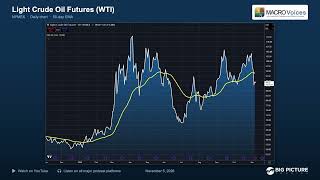
On commodities, crude oil was described as structurally firm in deferred contracts even as WTI front-month prices stayed contained, with backwardation flattening and positioning still extremely short. Gold was said to be trying to find a bottom near $4,000, but without technical confirmation yet. In positioning, the host highlighted heavy selling in 5-year Treasury futures and buying in the long bond, suggesting either a steepener unwind or a new flattening trade.
Key takeaways
- The host sees CoreWeave and other AI names as a possible first warning that the credit-fueled AI trade is starting to strain.
- The host thinks yesterday’s rally in defensives and bonds could be the start of a broader sector rotation, though one day is not enough to confirm it.
- Treasury action mattered most: the host highlighted a roughly 25 basis point reversal in the 10-year and 30-year yields as a key intermarket signal.
- The dollar remains in a clean bull trend for now, but the host said a move toward 101 would not be surprising if the new risk-off tone persists.
- Crude oil looks stronger in deferred contracts than in front-month WTI, while the host said gross short positioning remains at multi-year extremes.
- Gold is not confirmed as a bottom yet, even though the host said the setup could improve if yields keep falling and growth expectations cool.
Notable quotes
“the attention shifted to AI credit very very quickly and the story turned to coreweave where shares were down close to 16%”
“the real question is is coreweave that important? Well, really the whole market is just trying to figure out when is the financing cycle going to get stressed”
“We had basically utilities, consumer staples, healthc care, all advancing while we basically saw very strong pullbacks in almost all of the AIdriven names”
“from peak to trough, we saw close to a 25 basis point move in both the 10-year and the 30-year yields”
How the episode opens
Thanks, Eric. Now, Yaser highlighted a critical requirement for nuclear buildout. Reactor production can only scale if the fuel supply chain expands alongside it.
This brings us to Centress Energy, which is the symbol LEU. The company supplies enriched uranium and is expanding domestic enrichment capacity for both existing reactors and advanced designs. That creates a long-term investment thesis around nuclear growth and the strategic importance of secure fuel supply.
But the sector is under substantial selling pressure. And we don't know how deep or prolonged this correction will be. What interests me is the combination of lower share prices and elevated implied volatility that allows us to collect a meaningful premium for committing to own centrists substantially below today's prices.
So here's the structure. With the stock around $122, I'm looking at selling the January 21st, 2028 $70 strike put. That's with 464 days remaining.
So, it's a LEAP option. The midpoint in this option spread is $10.25 or $1,025 in premium per standard contract. That strike is approximately 43% below the current share price.
So, if assigned, we would be obligated to buy a 100 shares of the LEU at $70. But considering the $10 premium we just discussed, that would give you an adjusted cost base much closer to $60 a share or roughly 50% below today's reference price. If the option expires unexed, we retain that entire premium.
That represents a 14.6% return on the obligation of potentially owning the shares. The trade-off is straightforward. Our maximum profit is the premium.
So, a strong recovery would leave us without the shares. Now, if the sell-off continues, we may acquire the potential long-term holding at a substantially lower entry price, but that lower price is not a guarantee of value. Losses remain possible.
The position can always move against us before assignment and margin requirements can increase.
From the episode’s captions: roughly the first two minutes, lightly cleaned. Keep watching on YouTube →
Topics
- cot report
- trading desk
Watch the episode
Watch “Trading Desk - October 15th 2026” on YouTube
Summary, takeaways and quote selection by Octagon. Quotes are short excerpts; the full conversation is in the episode.
More from MacroVoices
-
 Trading Desk - November 12th 2026
-
 MacroVoices #558 Mike Alkin: Uranium at a Crossroads
-
 MacroVoices #558 Mike Alkin: Uranium at a Crossroads
-
 Trading Desk - November 5th 2026
-
 MacroVoices #557 Michael Every: The Blue Tsunami Lands on Markets... and Geopolitics
-
 MacroVoices #557 Michael Every: The Blue Tsunami Lands on Markets... and Geopolitics
MacroVoices, this episode and its artwork belong to Erik Townsend. Octagon is not affiliated with the show; this page is an independent summary.
