
Episode summary
Trading Desk - November 12th 2026
 MacroVoices
· · 11 min · Hosts: Erik Townsend, Patrick Ceresna

Summary
The guest argues that the uranium trade is being mispriced because it is getting lumped in with the broader AI narrative. He says the supply deficit is real regardless of AI demand, with existing reactors needing fuel and new mine supply still constrained by higher costs and delays. His trade is a January 15th, 2027 $25 by $28 bull call spread on the Canadian listing of the SPAT physical uranium trust, aiming to profit if the trust’s discount to net asset value narrows even modestly from today’s level.
On equities, the host and guest describe the recent market move as a bounce rather than a confirmed bottom. The S&P 500 has rebounded toward 7,700 and is testing its 50-day moving average, but the NASDAQ remains much weaker and the selloff has been concentrated in AI and semiconductors. Breadth has held up better than the major indexes, which leaves open the question of whether the weakness stays isolated or broadens out.
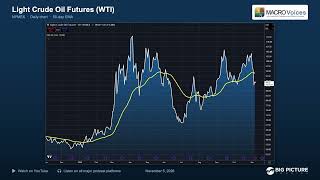
They also argue that hotter-than-expected October inflation has raised the risk of tighter policy, stronger yields, and a firmer dollar, all of which are headwinds for risk assets. Oil remains a key swing factor because any renewed Middle East escalation could bring back risk premium and pressure inflation higher. Gold, meanwhile, is described as still in a downtrend, with a possible downside inflection toward $3,600 if current support gives way.
Key takeaways
- The guest sees uranium as a supply-deficit story independent of AI, and wants exposure through a discount-narrowing trade in SPAT physical uranium trust units.
- He says a return to full net asset value would imply about $31.50, but a move toward a 5% to 10% discount could still justify the spread trade.
- The guest says the S&P 500’s rebound toward 7,700 is only a bounce so far, while the NASDAQ remains structurally weaker and far below its highs.
- The host and guest say hotter October CPI has pushed yields and the dollar higher, which could tighten financial conditions and weigh on risk assets.
- The guest says gold’s primary trend is still down and warns that a break lower could send prices toward $3,600.
Notable quotes
“Mike's argument is that the uranium supply deficit exists independently of the AI investment cycle”
“so as of this moment, this has just been a bounce in the markets”
“What we had was inflation came in hotter than expected 40 basis points on CPI month overmonth, 30 basis points on core”
“The vulnerability is that a breakdown here could send us down towards $3,600 on the downside”
How the episode opens
Okay, Patrick, where's the trade?
Thanks, Eric. Mike's argument is that the uranium supply deficit exists independently of the AI investment cycle. Existing reactors need fuel, utilities need to replenish inventories, and new mine supply continues to face rising costs and delays.
Yet, uranium investments are being sold alongside the broader AI trade, creating an opportunity to acquire physical exposure at a substantial discount to its underlying asset value. This week, I'm looking at the SPAT physical uranium trust, which US investors may know by its OTC symbol SR UF. That quotation doesn't offer US-listed options.
So, this strategy requires access to the Canadian dollar listing U.N. with options trading on the Montreal Exchange. Using the $2660 as a reference price, a return to full net asset value would imply a price around $31.50 based on our our working estimate.
But the trust frequently trades at a discount. So, a full convergence is an ambitious assumption. The more practical question is whether today's deep discount could narrow to something closer to 5 to 10%.
At an unchanged 31.5 net assive value, even a 10% discount would imply a unit price near $28.35. That gives us a recovery objective without requiring uranium itself to appreciate. To express that, I'm looking at the January 15th, 2027 $25 by $28 bull call spread.
Buying the $25 call around $2.5 and selling the $28 call at 90 produces a net debit of $160 per unit. All figures are in Canadian dollars. The long call contains a $160 of intrinsic value and 90 cents of time value.
So selling that upper strike offsets the time value entirely, leaving the expiration break even at $26.60, our reference price. So at $28 or higher at expiration, the spread produces a maximum profit of $1.40 per unit.
From the episode’s captions: roughly the first two minutes, lightly cleaned. Keep watching on YouTube →
Watch the episode
Watch “Trading Desk - November 12th 2026” on YouTube
Summary, takeaways and quote selection by Octagon. Quotes are short excerpts; the full conversation is in the episode.
More from MacroVoices
-
 MacroVoices #558 Mike Alkin: Uranium at a Crossroads
-
 Trading Desk - November 5th 2026
-
 MacroVoices #557 Michael Every: The Blue Tsunami Lands on Markets... and Geopolitics
-
 MacroVoices #557 Michael Every: The Blue Tsunami Lands on Markets... and Geopolitics
-
 MacroVoices #556 Luke Gromen: US Midterms & Beyond
-
 Trading Desk - October 29th 2026
MacroVoices, this episode and its artwork belong to Erik Townsend. Octagon is not affiliated with the show; this page is an independent summary.
