
Episode summary
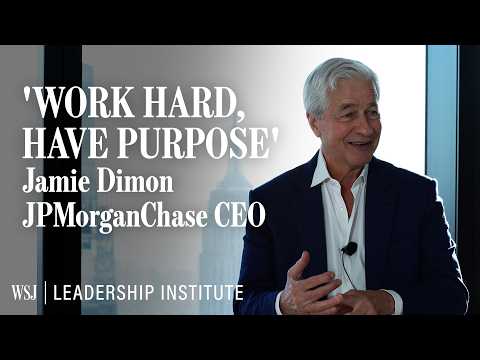
Jamie Dimon on the Biggest Risks Facing the Global Economy | WSJ Leadership Institute
 The Journal
· · Hosts: Alan Murray · Guests: Jamie Dimon
Summary
Jamie Dimon argues that JPMorgan Chase’s Security and Resiliency Initiative is more than a patriotic gesture: it is a practical response to fragile supply chains, weak industrial capacity, and rising geopolitical risk. He says the effort now spans advanced manufacturing, defense, energy, healthcare, grids, and allied countries, and that the bank is helping companies bridge the gap between promising technology and bankable contracts.
He is blunt that the biggest danger is cyber warfare, which he says is now "the biggest risk by far." Dimon also says wars can disrupt the global economy in unexpected ways, while AI is simultaneously boosting investment and creating new vulnerabilities. On inflation, he calls it sticky and says the economy is strong but exposed to deficits, remilitarization, trade restructuring, and policy mistakes.
Dimon uses the second half of the conversation to defend his view of leadership. He says executives should not try to make the boss happy, but should do the right thing for the company, clients, community, and country. He stresses trust, grit, heart, and teamwork, and says his job is to be direct, avoid bureaucracy, and fix bad management fast.
Key takeaways
- Jamie Dimon says the Security and Resiliency Initiative now extends across 29 industries and allied countries, with a focus on supply-chain weakness, skills, and financing gaps.
- He says cyber warfare is "our biggest risk" and later calls it "the biggest risk by far," citing vulnerabilities in fiber cables, vendors, and critical infrastructure.
- Dimon says the U.S. economy is strong now, but sticky inflation, deficits, and AI-fueled investment could create a later cycle or downturn.
- He argues business should engage on public policy, but only on issues that improve national growth, security, and civic functioning.
- Dimon says leadership depends on trust, grit, heart, and teamwork, and that his role is to be blunt and eliminate bureaucracy.
Notable quotes
“The job of no one in this company is to make me happy. The job of this company is to do the right thing”
“I said and I meant it, it's our biggest risk. Okay? And that was a couple weeks before mythos. And now it is our biggest risk by far”
“the American economy is kind of booming right now. It's good times, you know, corporate profits way up”
“I think the big picture is AI we've been using it since 2012, okay? And we have a thousand use cases”
How the episode opens
I've seen people when they get a big job, their insecurity comes out. They start to cover up. You know, they don't embarrass the boss. The people who work for them is, you know, make the boss happy. The job of no one in this company is to make me happy. The job of this company is to do the right thing for the company, the clients, the community, the country.
Thank you all for being here. Thanks to all the members of the Wall Street Journal CEO Council who are here. It's warming to uh to see you all and and thank you, Jamie, for hosting us. — Thrilled to be here. Thank you.
Uh nice digs you have here. — We earned it. — You Well, I was — The bankers earned it. We take good care of our people. — I mean, here you're you're at the top of the world here, you know, you're most important financial institution, tallest building in the city, most important city in the world. D- Does it ever go to your head?
Not really. First, I am thrilled to be here. I hope you all notice the American flag when you come in. Um blowing in the wind. I salute that every morning. Uh and — You're not joking.
I'm not joking. No. And uh and it reminds me of the values that created this great country of ours that should be celebrated and taught everywhere.
Freedom of speech, freedom of religion, freedom of enterprise. A lot of these entrepreneurs Michael was talking about are from other countries. And how deeply love this country and they came here to be to actually have the American dream, the American principles and and that is kind of foundational to even to SRI, by the way.
From the episode’s captions: roughly the first two minutes, lightly cleaned. Keep watching on YouTube →
Topics
- sticky inflation
- ai infrastructure investments
- cyber warfare risk
- supply chain security
- corporate leadership
Companies and tickers mentioned
- JPM
- JPMorgan Chase
Watch the episode
Summary, takeaways and quote selection by Octagon. Quotes are short excerpts; the full conversation is in the episode.
More from The Journal
-
 Nvidia Built Its AI Empire on Jensen Huang. What Happens Without Him? | WSJ Tech News Briefing
-
 What Happens When Everyday Investors Buy the Dip? | WSJ’s Take On the Week
-
 How North Korean Hackers Pulled Off a $6.3 Billion Crypto Heist
-
 Why Apollo’s CEO is Betting Billions on a 'Global Industrial Renaissance' | WSJ Leadership Institute
-
 Tech Stocks and AI Bonds Are Tumbling. Is the AI Trade in Trouble? | WSJ’s Take On the Week
-
 Why Anthropic Needs $100B More to Keep Growing | WSJ Tech News Briefing
The Journal, this episode and its artwork belong to The Wall Street Journal & Spotify Studios. Octagon is not affiliated with the show; this page is an independent summary.
