
Episode summary
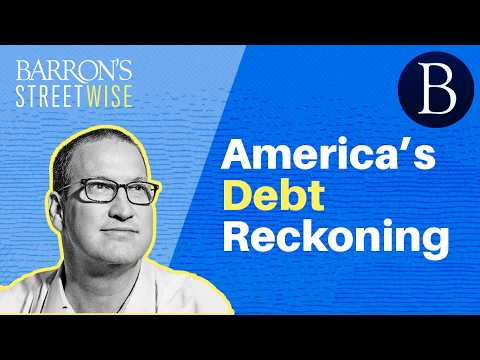
America’s Debt Reckoning: 5 Paths Forward | Barron's Streetwise
 Barron's Streetwise
· · 36 min · Hosts: Jack Bary
Summary
The host argues that America’s debt problem is moving toward a hard deadline: the country has “maybe 20 years” at most before markets lose confidence that Congress will fix the fiscal path. He lays out the scale of the problem in blunt terms, contrasting the $40 trillion gross debt with debt held by the public of about $32 trillion, and emphasizing that the deficit is already about $2 trillion, or 6% of GDP. Interest costs are the real accelerant, with this year’s bill likely at $1.1 trillion and projected to rise to $2.1 trillion within a decade.
He dismisses the popular escape routes. Inflating the debt away would require sustained higher inflation that bond markets would notice, while a growth miracle from AI is described as “far-fetched” because Social Security and Medicare liabilities would rise along with wages and costs. Japan-style stagnation is also ruled out as a model for the U.S. because American debt is more exposed to foreign investors and market discipline.
The most plausible solution, in his view, is a real bipartisan budget deal, though he says that is politically difficult. Maya McGinnes argues that a commission could work if it has enough credibility and power, and Kent Smeters of the Penn Wharton budget model says changes to Social Security, health care, and legal immigration are the clearest levers. The host concludes that shared sacrifice is unavoidable before markets force it on Washington.
Key takeaways
- The host says the U.S. has “maybe 20 years” before bond markets stop believing Congress will fix the debt problem.
- He says debt held by the public is closer to $32 trillion, and that interest costs are the main reason deficits keep growing.
- Kent Smeters says a growth miracle from AI is “far-fatched” and would not solve Social Security or Medicare on its own.
- Maya McGinnes says a bipartisan commission could help if it is empowered to force an up-or-down vote and includes unlikely allies.
- The host argues that inflating away the debt would require higher inflation that markets would quickly price into borrowing costs.
Notable quotes
“We basically have really as an outer limit maybe 20 years to get our act together”
“The debt is the amount that we owe. The deficit is the amount by which we go further into the hole each year”
“And the bottom line is that when the panic happens, really it comes down to when the markets stop believing that Congress will ever get its act together”
“Far-fatched is the bottom line. I mean, you certainly hear about this. It's nice to be optimistic”
“I think it is so easy to demagogue. So even though doing nothing on social security is the worst of all possibilities, if someone dares to say what I think would be very sensible, we should look at means testing”
How the episode opens
We basically have really as an outer limit maybe 20 years to get our act together. And the bottom line is that uh when the panic happens really it comes down to when bans markets stop believing that congress will ever get its act together. Hello and welcome to the Baron Streetwise podcast.
I'm Jack How and the voice you just heard that's Kent Smeters. He's the director of the Penn Wharton budget model. Now, I don't know if you have a favorite budget model, but if you're interested in the national debt, and you should be, Pen Wharton is a widely respected source for projections, and Kent is the guy to speak with.
We'll hear from him and other experts. Maya McGinness, she's the president of the Committee for a Responsible Federal Budget. We have anything but a responsible federal budget.
We have more of a a clown car collision with dollar signs, but Maya has thoughts on getting back on track. And we'll hear from Henry Allen. He's a macro strategist at Deutsch Bank, and he says that because of the debt, we're losing our stock market safety net.
Investors need to be ready for more wild swings. We'll explain why. Let's get into it.
Listening in is our under the weather self-inflicted audio producer Emily someone. Explain yourself, Emily. What happened?
Hi, Jack. In an attempt to prevent myself from becoming ill, yeah, — I gave myself the flu and COVID vacc same day. And now I feel like I have both the flu and CO. So, that really worked out for me. I'm so glad I did it.
It happens about like every third or fourth year. You like feel like you've just made yourself sick to keep from getting sick. How's the old arm feel?
From the episode’s captions: roughly the first two minutes, lightly cleaned. Keep watching on YouTube →
Topics
- us debt
- inflation
- economic growth
- budget policy
- debt repayment strategies
Watch the episode
Watch “America’s Debt Reckoning: 5 Paths Forward | Barron's Streetwise” on YouTube
Summary, takeaways and quote selection by Octagon. Quotes are short excerpts; the full conversation is in the episode.
More from Barron's Streetwise
-
 Does Show Business Still Work? | Barron's Streetwise
-
 The Disruption Scorecard | Barron's Streetwise
-
 Spooky Agents, Cable’s Second Death, and Stock Picks | Barron's Streetwise
-
 Buybacks, Bond Doubts, DRAM, and T-Rex | Barron's Streetwise
-
 Weird Ways to Predict Stock Returns | Barron's Streetwise
-
 Terminator, AI Jobs, and Financial Nudism | Barron's Streetwise
Barron's Streetwise, this episode and its artwork belong to Barron's. Octagon is not affiliated with the show; this page is an independent summary.
