
Episode summary
$3.3 Billion Investor on Private Markets, Liquidity, and the Next IPO Boom
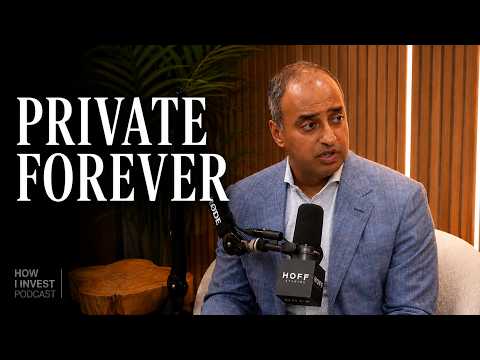
 How I Invest With David Weisburd
· · Hosts: David Weisburd · Guests: Ravi Viswanathan
Summary
Ravi Viswanathan argues that venture capital has changed structurally because companies stay private much longer while fund lives have not changed. That mismatch, he says, is why NewView Capital was built around liquidity solutions: company-led secondaries, employee tenders, and primary capital that make the firm a long-term partner rather than a purely transactional secondary buyer.
He makes the case that the current liquidity wave is being driven by pressure on employees, early founders, institutions, and LPs, especially as the market has accumulated a large DPI deficit. Ravi says thoughtful secondaries can relieve that pressure without creating misalignment, but the right size matters; too little frustrates holders, while too much can distort incentives. He repeatedly frames the goal as preserving founder control and cap-table quality.
The conversation also explores whether a major IPO window for companies like SpaceX, OpenAI, and Anthropic could reset liquidity in venture. Ravi thinks generational IPOs will help recycle capital back to LPs and revive the flywheel, though he also argues that venture will remain an access class where great companies can stay private longer. He closes by emphasizing that relationships, patience, and dislocation are the real sources of edge in venture.
Key takeaways
- Ravi Viswanathan says NewView Capital was launched in 2018 to address the structural liquidity gap created by companies staying private longer.
- He argues that company-led secondaries are becoming the preferred model because they let founders control the cap table while giving employees and early investors liquidity.
- Ravi says the right secondary size is a "Goldilocks problem," with roughly 10% to 30% of vested equity as a possible sweet spot depending on the company.
- He believes major IPOs from companies like SpaceX, OpenAI, and Anthropic would meaningfully replenish LP liquidity and restart venture’s capital flywheel.
- Ravi says venture still rewards relationships and patience, especially during periods of market dislocation and FOMO-driven investing.
Notable quotes
“Companies are staying private longer. Another dynamic that was happening is that was really the start of the huge AUM boom”
“Our view is company-led secondaries. One of the most interesting facets of the of the secondaries market in venture that we're seeing”
“I think there is going to be this flight to quality and there's going to be again this return to having trusted capital partners”
“If it's too small, you you'll get frustration from the employees and the institutions that they weren't able to sell enough”
How the episode opens
Robbie, tell me the story of how you spun out of NEA and launched a $ 1.3 billion fund in 2018. So in 2018, I had been a growth investor for NEA for about 15 years and was noticing some structural changes in the industry. Companies are staying private longer.
Another dynamic that was happening is that was really the start of the huge AUM boom. And this wasn't just NEA. This was across venture because I was talking to a lot of my friends at other firms, but the venture ecosystem really hadn't evolved.
And I found that there was a need for real liquidity and flexible solutions. And so that was really the launch of of Nuvia. We launched Nuv in 2018, raised 1.35 billion to really buy out a set of 30 odd companies from NEA and use that as a vehicle to spin off really as a firm not just a point in time um transaction but really to build something that I felt was going to be something prevalent for for a decade beyond which is really the need for liquidity uh across venture capital.
Is it consensus who the top companies are? In other words, there's some people that believe that by series B and beyond, pretty much it's known who which basket of companies is going to succeed. Or is there still these diamonds in the rough that you could find?
You are seeing right now, at least in the AI boom, a flock to consensus investing. Sometimes that's early, a lot of times it is much later. Our view, we don't have a minimum when we invest in terms of scale. For us, it's really not focusing on consensus around. is really focusing on product market fit, the market, and the team.
From the episode’s captions: roughly the first two minutes, lightly cleaned. Keep watching on YouTube →
Topics
- private market liquidity
- venture capital secondaries
- dpi drought
- continuation vehicles
- employee liquidity
Companies and tickers mentioned
- NewView Capital
- NEA
- MuleSoft
- Braintree
- Acquia
- Cyence
- GlobalLogic
- OpenAI
- Anthropic
- SpaceX
Watch the episode
Watch “$3.3 Billion Investor on Private Markets, Liquidity, and the Next IPO Boom” on YouTube
Summary, takeaways and quote selection by Octagon. Quotes are short excerpts; the full conversation is in the episode.
More from How I Invest With David Weisburd
-
 Hunter Walk: Why Venture is Getting Harder, Picking Great Founders, and Investing Against Consensus
-
 True Anomaly’s Even Rogers on Space Warfare, China’s Military Advantage, and the Defense Tech Boom
-
 Finding the Next Anthropic, Quantifying Venture Capital, and the Science of Picking Winners
-
 Why 95% of AI Projects Fail, Anthropic still at $2T?, and Why AI Is Still in the First Inning
-
 Peter Thiel's 27-Year Partner on the AI Bubble, the Venture Capital Crisis, and the PayPal Mafia
-
 Why Venture Is Eating Public Markets, Picking Great VCs, and the AI Boom w/Brijesh Jeevarathnam
How I Invest With David Weisburd, this episode and its artwork belong to David Weisburd. Octagon is not affiliated with the show; this page is an independent summary.
