
Episode summary
How LPs Decide Who Gets Funded | Narayan Chowdhury
 How I Invest With David Weisburd
· · Hosts: David Weisburd · Guests: Narayan Chowdhury
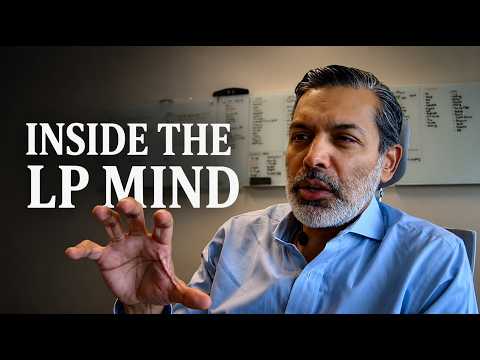
Summary
Narayan Chowdhury argues that venture today feels unusually untethered because the market is full of one-off extremes, from giant compensation packages to trillion-dollar infrastructure bets, and the familiar rules no longer seem to hold. He says the harder question is still basic: why founders give up equity at all, and what kind of investor relationship makes that trade worth it. In his view, the current market is noisier, more fragmented, and less underwritable than prior cycles.
He is skeptical of backward-looking data because venture datasets are often incomplete, self-biased, and lagged, which makes them especially vulnerable to regime shifts. He argues that access, founder trust, and long-term relationships now matter more than legacy brand alone, but only if a firm stays disciplined about stage, pricing, and the type of founder it serves. He sees value in established networks, specialist knowledge, and continuous reference work, since the best opportunities are often found before they become obvious.
Narayan also says two things are clearly knowable right now: small teams can build faster than ever, and buyers are more willing than ever to swap incumbents for new software. That combination, he thinks, creates a strong backdrop for venture even if the market remains hard to model.
Key takeaways
- Narayan Chowdhury says venture is harder to underwrite now because the market is full of unprecedented, spiky events and few stable precedents.
- He argues that venture data is often too incomplete and biased to support clean conclusions, especially after a regime shift.
- He believes durable LP and founder outcomes come from long-term trust, continuous references, and staying disciplined about stage and fit.
- Narayan says specialist approaches can outperform in areas like cyber because the market is relationship-driven and idiosyncratic.
- He is convinced that AI is making both building and customer replacement faster, which should keep creating venture opportunities.
Notable quotes
“Every week there seems to be some event some pricing, some scaling thing that you, you know, I can't I there's no basis for no precedent for”
“the data is very often plagued with holes, non-reporting, self-biased reporting. It's lagged”
“we think that groups that have um engendered a lot of founder love by virtue of being in the market, having important seats, being in the trenches for decade, two decades has a lot of merit”
“the ability to build and the ability or the the willingness for buyers to think about uh or think about swapping incumbents I think are both at all times high”
How the episode opens
Nine, you're the a co-founder and a partner at Franklin Park. Tell me where Franklin Park sits at an AUA basis today. — We are about a 21 billion AUA aUM firm uh based out of Philadelphia. — And you said last time we chatted you said it's the most confusing untethered sentiment today investing in nature that you've seen. That's quite the statement given that you've been in the industry for a while. Why? Why did you say that?
Every week there seems to be some event some pricing, some scaling thing that you, you know, I can't I there's no basis for no precedent for. Um, so you know, things like a single person getting a $ 1.5 billion comp package to leave a company that he just co-founded months before. That's these things have never happened.
you know, trying to figure out trillion dollar spends on data center buildouts. Um the the sort of uh growth and death and retention metrics of some of these um companies that are just you know a few engineers are are are creating incredible products for enterprise and consumers. Uh it it's it's just unprecedented.
I'm I'm I'm in awe the amount of options founders have. Uh seemingly many, but when when it when it gets down to the nitty-gritty of of those financings and those fundraises, the this the halves and halves have not stories are seem so uh insane to me. the it's just a very bipolar market, all these all these little niches.
I can't imagine how confusing it is for um all the market participants when you have all these really really spiky events. Our our ground truth has always got to be why do why do founders want to give up part of their their precious life's work to somebody else?
From the episode’s captions: roughly the first two minutes, lightly cleaned. Keep watching on YouTube →
Topics
- venture capital data gaps
- lp manager selection
- founder trust and relationships
- regime shifts in investing
- generalist vs specialist investing
Companies and tickers mentioned
- Franklin Park
- Bright Mind
Watch the episode
Watch “How LPs Decide Who Gets Funded | Narayan Chowdhury” on YouTube
Summary, takeaways and quote selection by Octagon. Quotes are short excerpts; the full conversation is in the episode.
More from How I Invest With David Weisburd
-
 Hunter Walk: Why Venture is Getting Harder, Picking Great Founders, and Investing Against Consensus
-
 True Anomaly’s Even Rogers on Space Warfare, China’s Military Advantage, and the Defense Tech Boom
-
 Finding the Next Anthropic, Quantifying Venture Capital, and the Science of Picking Winners
-
 Why 95% of AI Projects Fail, Anthropic still at $2T?, and Why AI Is Still in the First Inning
-
 Peter Thiel's 27-Year Partner on the AI Bubble, the Venture Capital Crisis, and the PayPal Mafia
-
 Why Venture Is Eating Public Markets, Picking Great VCs, and the AI Boom w/Brijesh Jeevarathnam
How I Invest With David Weisburd, this episode and its artwork belong to David Weisburd. Octagon is not affiliated with the show; this page is an independent summary.
