
Episode summary
Why Investors Are Buying Stakes in Investment Firms Themselves
 How I Invest With David Weisburd
· · Hosts: David Weisburd · Guests: Todd Owens
Summary
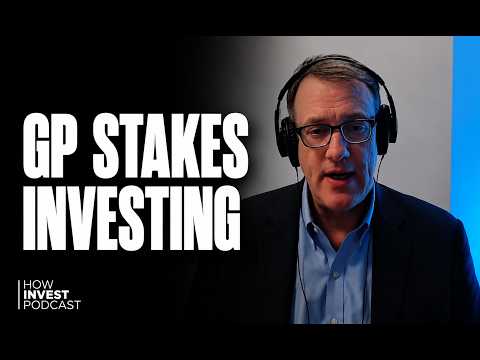
GP stakes are minority equity investments in the operating businesses of alternative asset managers, not in the funds themselves. Todd Owens said the investor is effectively buying into fee streams such as management fees, carried interest, incentive fees, and other economics tied to the manager’s capital-raising and portfolio management business. He argued that the appeal is exposure to equity-like returns in a growing asset class, but the central risk is unpredictable liquidity because the investor does not control the exit.
A major theme was structural innovation around liquidity. Owens said many managers are trying strip sales, levered recaps, or public listings to solve the exit problem, and he framed Cantilever Group’s own model as one designed to become a publicly listed 40 Act vehicle in the United States. He said that would benefit LPs through liquidity, while also reassuring affiliates that the firm is a permanent capital partner rather than a buyer that needs a near-term exit.
Owens also described where Cantilever focuses: lower middle market GP stakes, typically $20 million to $25 million checks, because there is less competition for capital there. He said GP sellers usually have three motives—growth capital, capital restructurings, or taking money off the table—and that the best deals are the ones where the new capital clearly accelerates growth or helps institutionalize a durable business.
Key takeaways
- Todd Owens said GP stakes underwrite the manager’s fee streams and equity value, not the fund’s portfolio returns.
- Owens said liquidity risk is the biggest drawback because minority GP investors do not control the exit.
- Cantilever targets lower middle market deals, usually $20 million to $25 million, where Owens sees less capital competition.
- Owens said the three main GP stake use cases are growth capital, capital restructurings, and taking money off the table.
- Owens said venture capital is often too volatile for GP stakes unless the firm has hard-to-replicate business assets.
- Cantilever’s public-listing strategy is meant to solve liquidity for LPs and strengthen alignment with affiliate managers.
Notable quotes
“fundamentally GP stakes investing is a minority equity investment in the operating business of an alternative asset manager”
“you are in effect betting with the principles of that firm and relying on them ultimately for your exit”
“Going public creates a lot of benefits for for most importantly for our LPs. It provides liquidity”
“we want to be able to make investments that are between 15 million5 on the low side and 75 million on the high side”
“our capital can be used to fund GP commitments and that's I think reasonably straightforward”
How the episode opens
So Todd, you're managing partner at Canaliever Group where you focus on GP stakes. Why do you like GP stakes? — It's a it's a very interesting and new asset class, new in the last decade and it provides an opportunity for investors to partner with the principles of private asset money managers. And so we think it's a very interesting space with a lot of tailwinds and a very deep number of potential targets.
When you invest into a manager, what exactly are you buying and how do you look at it as an investment? — Yeah, fundamentally GP stakes investing is a minority equity investment in the operating business of an alternative asset manager. And what that means when you drill down is you are uh purchasing a participation in the fee streams that are derived in these private asset managers. So specifically management fees, carried interest, incentive fees and other fees that come about for managing the capital.
And when LPs look at investing, they could invest within the fund, they could invest in GP stake. How should an LP think about whether they want exposure to a fund or exposure to a manager?
Yeah, it's a good question. So, as an LP, you're investing in a fund that's managed by the GP. And the economics can are related, of course, but they can be different.
And so, if you are investing in, for example, a private credit business, those returns will be somewhere between 8 and 12% at the fund level. Whereas if you're making an equity investment at the GP level, those returns are more commensurate with equity investing and more like private equity. It's a derivative of the same business.
And there are lots of examples of investors doing both, being an investor, an LP in the fund, but also owning a portion of the economics at the management company.
From the episode’s captions: roughly the first two minutes, lightly cleaned. Keep watching on YouTube →
Topics
- gp stakes
- lp vs gp underwriting
- liquidity risk
- minority stake investing
- permanent capital models
Companies and tickers mentioned
- GS
- Cantilever Group
- Goldman Sachs
Watch the episode
Watch “Why Investors Are Buying Stakes in Investment Firms Themselves” on YouTube
Summary, takeaways and quote selection by Octagon. Quotes are short excerpts; the full conversation is in the episode.
More from How I Invest With David Weisburd
-
 Hunter Walk: Why Venture is Getting Harder, Picking Great Founders, and Investing Against Consensus
-
 True Anomaly’s Even Rogers on Space Warfare, China’s Military Advantage, and the Defense Tech Boom
-
 Finding the Next Anthropic, Quantifying Venture Capital, and the Science of Picking Winners
-
 Why 95% of AI Projects Fail, Anthropic still at $2T?, and Why AI Is Still in the First Inning
-
 Peter Thiel's 27-Year Partner on the AI Bubble, the Venture Capital Crisis, and the PayPal Mafia
-
 Why Venture Is Eating Public Markets, Picking Great VCs, and the AI Boom w/Brijesh Jeevarathnam
How I Invest With David Weisburd, this episode and its artwork belong to David Weisburd. Octagon is not affiliated with the show; this page is an independent summary.
