
Episode summary
Why Most VCs Firms will Die by 2030
 How I Invest With David Weisburd
· · Hosts: David Weisburd · Guests: Camilo Acosta

Summary
Camilo Acosta argues that AI is moving beyond copilots into agentic systems that combine prediction, judgment, and action, eventually replacing large parts of human workflows. He says the biggest near-term opportunities are in markets where incumbents are less likely to move, especially areas that are not heavily regulated, while law and healthcare will change more slowly. He also believes AI will disrupt labor broadly, but that restaurants, hotels, trades, and robot maintenance will still create durable jobs.
A major theme is how incumbents shape venture strategy. Acosta says big tech and the major AI labs have distribution advantages and can make some startup markets unattractive, but they also leave open spaces where a $10 billion outcome matters to venture investors even if it barely moves a trillion-dollar company. He thinks the next decade will touch every asset class, including private equity and endowment allocation, and that the Yale model itself can be automated.
On venture fundraising, he says many emerging managers are failing because they run a fund, not a firm. For him, the firm is a brand that must be marketed constantly to founders and LPs. He also emphasizes founder psychographics over polished business plans, saying the best founders are often ruthless, hard to work with, and able to pivot quickly when the right opportunity appears.
Key takeaways
- Acosta says agentic AI will replace prediction, judgment, and action, not just isolated tasks, and will ultimately eat human workflows.
- He expects less regulated sectors to change first, while law and healthcare will lag because licensing and safety barriers slow adoption.
- He says big tech’s scale creates openings for startups because a $10 billion company is too small to matter to Meta, OpenAI, or Anthropic.
- Acosta believes the Yale endowment model and manager selection can be automated as AI reaches allocator workflows.
- He argues that venture success depends on marketing a firm as a brand to founders and LPs, not just making investments.
- He says the best founders often combine charisma and ruthlessness, and he is willing to back founders pre-idea if the team is exceptional.
Notable quotes
“the reality is that artificial intelligence is really centrally concerned with replacing human decision-m”
“Software is becoming agentic, which means it's not only eating software um uh but it's actually able to eat entire human workflows”
“A firm is a brand. And most people don't realize that you're as a vent to be a successful venture manager, you have to be consistently marketing that brand to founders and to LPs”
“we've invested pre idea. Like I met a founder who had amazing two or three ideas under his belt, and he was like, "I don't know what I'm going to do next”
“the best founders in the world are not necessarily always the best people to work for or to work with”
How the episode opens
So Camila, you started at Meta where you were top AI engineer and now you run Perceptive Ventures, one of the top agentic AI seed funds in the world. Tell me about how your experience from Meta informs your day-to-day as a venture capitalist.
It's pretty critical and and before joining Meta, my company was acquired. So I was a startup founder and CEO and both of those experiences are really critical to how I invest today. Um, having been a founder, I know how fast one can move and how nimble one can be.
But having also been a big tech operator, I understand which large spaces big tech finds attractive and wants to move into. And the key here as an investor is making sure that we're not investing in spaces that big tech is going to dominate or be really interested in. Uh and by the way, when I say big tech, I also mean open AI and anthropic because at this point they have sort of like a neo-incumbent power in in AI.
How do you know whether big tech whether meta, Facebook or anthropic open AI is going to go after space or not?
Understanding scale. You know, I ran a $10 billion product suite at Meta, which is, you know, sounds large, but in the grand scheme of Meta was actually not that big. Uh, and so or $10 billion businesses that these large companies don't really have an interest in entering or pursuing, uh, because it doesn't really move the needle when you're a multi-trillion dollar company.
Uh, that's too small for them. But a $10 billion startup is a very interesting outcome for for a venture investor like myself. If there's not top engineers on meta that are going to go after a problem, you think that's a safer place to build a startup and to build something that could be dominant there versus having to compete every day against these large LMS.
From the episode’s captions: roughly the first two minutes, lightly cleaned. Keep watching on YouTube →
Topics
- agentic ai
- venture capital strategy
- ai regulation
- labor disruption
- asset allocation and private markets
Companies and tickers mentioned
- META
- Meta
- Perceptive Ventures
Watch the episode
Watch “Why Most VCs Firms will Die by 2030” on YouTube
Summary, takeaways and quote selection by Octagon. Quotes are short excerpts; the full conversation is in the episode.
More from How I Invest With David Weisburd
-
 Hunter Walk: Why Venture is Getting Harder, Picking Great Founders, and Investing Against Consensus
-
 True Anomaly’s Even Rogers on Space Warfare, China’s Military Advantage, and the Defense Tech Boom
-
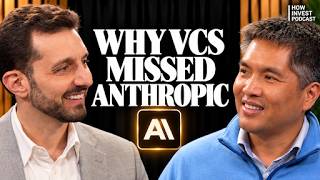 Finding the Next Anthropic, Quantifying Venture Capital, and the Science of Picking Winners
-
 Why 95% of AI Projects Fail, Anthropic still at $2T?, and Why AI Is Still in the First Inning
-
 Peter Thiel's 27-Year Partner on the AI Bubble, the Venture Capital Crisis, and the PayPal Mafia
-
 Why Venture Is Eating Public Markets, Picking Great VCs, and the AI Boom w/Brijesh Jeevarathnam
How I Invest With David Weisburd, this episode and its artwork belong to David Weisburd. Octagon is not affiliated with the show; this page is an independent summary.
