
Episode summary
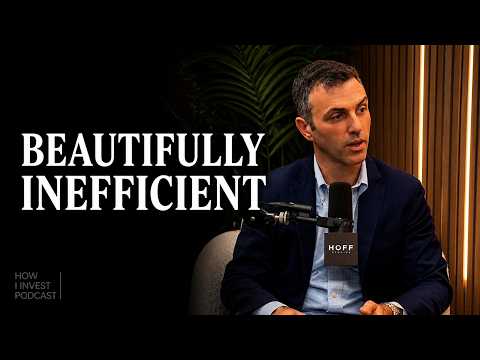
Beautifully Inefficient Markets: Where Real Alpha Still Lives | Raphael Schorr
 How I Invest With David Weisburd
· · 45 min · Hosts: David Weisburd · Guests: Raphael Schorr
Summary
Raphael Schorr argues that the best opportunities are in markets that are inefficient but still durable enough to support repeatable alpha. He defines “beautifully inefficient” markets as ones where returns can persist for years, where expertise compounds, and where barriers to entry protect early specialists. He points to lower middle market private equity as a long-running example, and says the same logic can apply to venture, biotech, and other overlooked niches.
A major theme is that governance determines whether institutions can actually capture that alpha. Schorr says allocators need clarity on risk appetite, decision rights, and how much discretion managers have to lean in or cut losses. He argues that most institutions cannot know everything, so they need a few focused areas of expertise and strong partnerships. He also says diversification matters, but only up to the point where it reduces fragility without washing out conviction.
On private markets, Schorr says the industry has matured, so investors should expect longer hold periods, lower DPI, and more emphasis on underwriting valuation and management quality. He is bullish on continuation vehicles as a tool that can keep high-quality assets in place longer. He is also constructive on biotech and venture because long-duration capital can exploit both public-market dislocations and the power-law upside of early innovation.
Key takeaways
- Schorr says “beautifully inefficient” markets are inefficient enough for alpha but durable enough to be repeatable over years, not just one-off trades.
- He argues lower middle market private equity remains attractive because there are many securities, less coverage, and more room for disciplined security selection.
- Schorr says private markets have matured, so investors should expect longer holds, lower DPI, and more focus on valuation and operator quality.
- He views continuation vehicles as an increasingly important way to keep the best assets compounding instead of forcing premature exits.
- He says biotech can be compelling when it is out of favor, because healthcare demand grows and public-market pricing can create mispricings.
- Schorr argues governance is the hidden driver of performance because it determines who can act, when they can act, and how they respond to drawdowns.
Notable quotes
“Everyone talks about inefficient markets, but what Andre figured out was that there are many markets that are inefficient, but they don't have the repeatability that investors are after”
“You want it to be inefficient so you can get outsized returns, but you also want it to be somewhat systematic, somewhat repeatable so that there's some duration to the investment opportunity”
“There's no one governance model. I think you know in our own case because we're investing across lower middle market private equity early stage venture asset back private credit as well as biotechnology”
“Private markets are much more mature than they were. And so the idea of sponsor to sponsor exits at the pace that we saw them over the course of our careers”
“we think the continuation vehicle market that technology will now increasingly be used by sponsors to hold on to their best businesses”
How the episode opens
Rafie, you're the deputy CIO and you co-lead H High Vista Strategies, a firm with $14 billion in AUM. Last time we chatted, you said that you love markets that are beautifully inefficient. What does that mean?
So, my CIO, partner, and co-leader of High Vista, Andre Perold, coined the term beautifully inefficient. And so, I'll give him credit where credit's due. Everyone talks about inefficient markets, but what Andre figured out was that there are many markets that are inefficient, but they don't have the repeatability that investors are after really to be a great investment opportunity.
You want it to be inefficient so you can get outsized returns, but you also want it to be somewhat systematic, somewhat repeatable so that there's some duration to the investment opportunity. And beautifully inefficient markets have the characteristic of having a great opportunity that hopefully persists for a reasonable period of time. Nothing lasts forever, but a reasonable period of time.
And if you're really lucky, it's a market where you can build a sustainable advantage by participating in that market. So that over the course of time, there's also somewhat of a barrier to entry to those who were early to those markets.
Those are kind of the frictions. So if you think on one side you have this one trade, it's an it's an amazing trade. Nobody's looking at it because no one's really set up to do that. They don't have the team to do that. But it might have a high mo high IR, but it's one time.
And then on the other end, you have a trade that's going to be around for 30, 40 years, but at some point it's a consensus trade and the alpha gets traded away. You look for something in the middle.
From the episode’s captions: roughly the first two minutes, lightly cleaned. Keep watching on YouTube →
Topics
- beautifully inefficient markets
- private equity holding periods
- continuation vehicles
- long-duration venture capital
- diversification vs diworsification
Companies and tickers mentioned
- HighVista Strategies
- AlphaSense
Watch the episode
Watch “Beautifully Inefficient Markets: Where Real Alpha Still Lives | Raphael Schorr” on YouTube
Summary, takeaways and quote selection by Octagon. Quotes are short excerpts; the full conversation is in the episode.
More from How I Invest With David Weisburd
-
 Hunter Walk: Why Venture is Getting Harder, Picking Great Founders, and Investing Against Consensus
-
 True Anomaly’s Even Rogers on Space Warfare, China’s Military Advantage, and the Defense Tech Boom
-
 Finding the Next Anthropic, Quantifying Venture Capital, and the Science of Picking Winners
-
 Why 95% of AI Projects Fail, Anthropic still at $2T?, and Why AI Is Still in the First Inning
-
 Peter Thiel's 27-Year Partner on the AI Bubble, the Venture Capital Crisis, and the PayPal Mafia
-
 Why Venture Is Eating Public Markets, Picking Great VCs, and the AI Boom w/Brijesh Jeevarathnam
How I Invest With David Weisburd, this episode and its artwork belong to David Weisburd. Octagon is not affiliated with the show; this page is an independent summary.
