
Episode summary
The Tsunami of Pain Facing Venture Capital
 How I Invest With David Weisburd
· · 19 min · Hosts: David Weisburd · Guests: Trey Ward
Summary
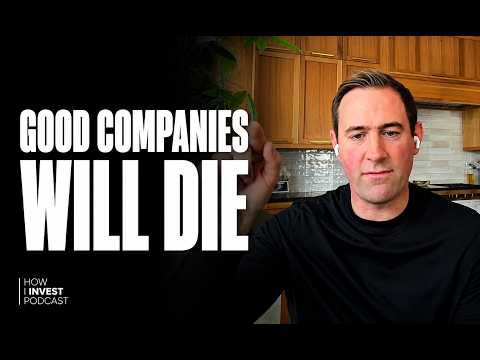
Trey Ward argues that the biggest venture problem is not that every startup is bad, but that many capital-intensive companies are being cut off before they have a real chance to prove themselves. He contrasts software, which can reach revenue quickly and scale smoothly, with hard-tech businesses that often spend years with no revenue and then grow in stepwise jumps. That creates a predictable “Death Valley” period where startups can look promising internally but still fail if the next financing round never arrives.
Ward says the market is now exposing a large cohort of weakly funded companies. He points to Carta data showing that 80% of the 1,700 companies that raised a Series A between 2019 and 2021 and later raised an extension still had not raised a Series B by 2025. He also cites falling two-year Series A-to-Series B graduation rates, dropping from 42.6% for the 2020 cohort to sub-15% for companies that raised in 2022 or 2023. In his view, the post-2022 venture funding downturn is creating a hangover that will force many companies to zero.
Against that backdrop, Ward describes a strategy of buying venture-backed assets with strong technology, customers, and IP at a fraction of historical R&D spend, then narrowing the business to one use case and pushing it to profitability within 24 months. He says this can give founders more time and preserve upside for existing investors. His long-term goal is to build something like Constellation Software, but in the physical world.
Key takeaways
- Trey Ward says hardware businesses are less about higher capital intensity and more about slower, stepwise revenue ramps than software.
- Trey Ward says 80% of 1,700 Series A companies from 2019 to 2021 still had not raised a Series B by 2025.
- Trey Ward says two-year Series A-to-Series B graduation rates have fallen to sub-15% for 2022 and 2023 cohorts, implying a large wave of failures.
- Trey Ward’s fund buys venture-backed companies with real products and customers at a fraction of historical R&D spend, then aims for profitability in 24 months or less.
- Trey Ward says existing investors may prefer a restructuring that preserves some upside over an almost certain zero and a messy shutdown.
Notable quotes
“The first element that comes to people's mind when you bring up hardware and software is they say hardware so capital intensive”
“It really isn't true. And and it might be surprising, but if you start to look at the data”
“it's very typical that a hardware business could have no revenue for five or six years”
“80% of those businesses haven't raised a series B. 80%”
“the 2-year graduation rate to series B is sub 15%. Sub 15%”
How the episode opens
Before we go into the tsunami of pain, as you told me last time, that's facing the venture market. I want to go back to when you were in Ethere, you invested it all in Tesla. This was back in 2014.
What gave you the conviction to invest so much of your capital in one stock? I truly felt like I was watching a generational entrepreneur and a lot of people were saying, you know, this is a car company, but if you were reading what he was doing, if you read the master plans, if you if you listen to how he was approaching the problem, he was going after something much much larger. On one hand, him being a great entrepreneur is one thing, but that doesn't make it a compelling investment, right?
Because if everyone agrees with you, the value is already baked in. What made it special was I had strong conviction, but the market didn't. Right?
If you read the news articles, it was short positions. It was this is a car company that doesn't make money. And so to me, the best bets are something that you you truly believe, but the market doesn't.
14 is when he announced the Gigafactory. And that to me was the line in the sand moment of you think I'm building a car company, let's go, right? and built a multi-billion dollar battery factory.
Last time we chatted, you showed me a graph about how revenues diverge in software and hardware companies. Tell me about that. In what ways are these two different types of businesses fundamentally different? — The first element that comes to people's mind when you bring up hardware and software is they say hardware so capital intensive. Like that's the initial gut reaction.
From the episode’s captions: roughly the first two minutes, lightly cleaned. Keep watching on YouTube →
Topics
- venture capital downturn
- hard tech startups
- capital intensity
- death valley
- series a to series b graduation rates
Companies and tickers mentioned
- Rook
Watch the episode
Watch “The Tsunami of Pain Facing Venture Capital” on YouTube
Summary, takeaways and quote selection by Octagon. Quotes are short excerpts; the full conversation is in the episode.
More from How I Invest With David Weisburd
-
 Hunter Walk: Why Venture is Getting Harder, Picking Great Founders, and Investing Against Consensus
-
 True Anomaly’s Even Rogers on Space Warfare, China’s Military Advantage, and the Defense Tech Boom
-
 Finding the Next Anthropic, Quantifying Venture Capital, and the Science of Picking Winners
-
 Why 95% of AI Projects Fail, Anthropic still at $2T?, and Why AI Is Still in the First Inning
-
 Peter Thiel's 27-Year Partner on the AI Bubble, the Venture Capital Crisis, and the PayPal Mafia
-
 Why Venture Is Eating Public Markets, Picking Great VCs, and the AI Boom w/Brijesh Jeevarathnam
How I Invest With David Weisburd, this episode and its artwork belong to David Weisburd. Octagon is not affiliated with the show; this page is an independent summary.
